THE CLASSIC COLLECTION✦An outlaw’s diary: the CommuneCLASSIC FREE BOOKS
An outlaw’s diary: the Commune
Cécile Tormay
THE CLASSIC COLLECTION · 1853
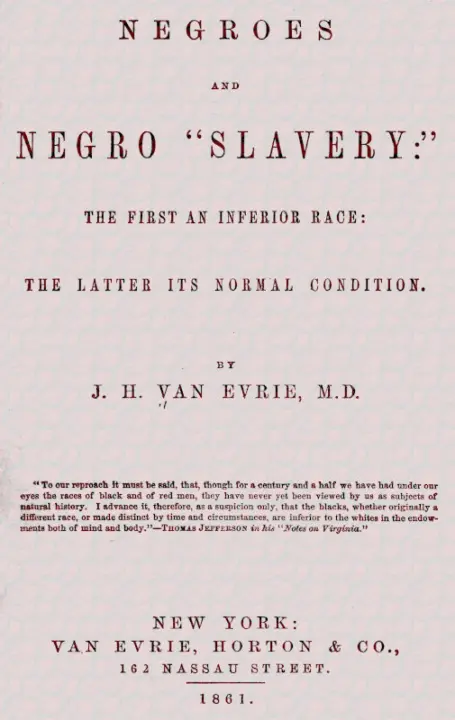
"Negroes and Negro 'Slavery:' the first an inferior race: the latter its normal condition" by J. H. Van Evrie, M.D. is a controversial treatise written in the mid-19th century. The work argues against the abolitionist movement, asserting that it is based on erroneous beliefs about racial equality and the nature of slavery. The author positions the black race as inherently inferior and maintains that slavery is the natural condition for those of African descent. At the start of the book, the author presents a preface discussing the political and social turmoil in America amid the rising anti-slavery sentiment and the onset of the Civil War. He critiques the abolitionist movement as rooted in delusion and foreign influence, particularly from European ideals. Van Evrie aims to provide a justification for the existing social order in the southern United States, asserting that it is rooted in natural law and necessity rather than moral failing. He sets the stage for a detailed exploration of the supposed differences between races, intending to argue for the social subordination of African Americans as not just preferable but essential for societal stability.
Introduction adapted from the source catalogue; source summaries may be automatically generated.
Free to read · English · 105,969 words · No account needed
MAKE TIME FOR A GOOD BOOK
On by default. Untick to stop anonymous reading totals. Each page counts after 10 seconds in view. How this works.
Anonymous counting is on unless you have switched it off.
If the natural relations that men bear to each other are thus misunderstood and disregarded in Europe, it may well be supposed that they are wholly ignorant of the natural relations of races, and without even the remotest conception of the relations that naturally exist between white men and negroes. It is therefore a subject never introduced or treated of—a terra incognita to the European mind,—and dependent as we are on European authority, the natural relation of races, and the normal condition of the negro, have only quite recently become a subject of American investigation.
But while our writers and men of science have been, and quite generally are even now, wholly ignorant of these relations, indeed, worse still, in slavish subserviency to European dictation, have accepted the absurd theories of the former in explanation of the phenomena constantly presented to their view, our people have practically solved their natural relations to the inferior race, and placed or rather retained the negro in his normal condition.
There are eight millions of white people and four millions of negroes in juxtaposition. The latter are, in domestic subordination and social adaptation, corresponding with their wants, their instincts, their faculties, the nature with which God has endowed them. They are different and subordinate creatures, and they are in a different and subordinate social position, harmonizing with their natural relations to the superior race, and therefore they are in their normal condition. This, if not exactly a self-evident, is certainly an unavoidable truth—a truth that no amount or extent of sophistry, self-deception, authoritative dictum, or perverted reasoning can gainsay a moment, for it rests upon facts, fixed forever by the hand of the Creator. The negro is different from, and inferior to the white man. He is in a different and inferior position, and therefore, of necessity, is in a normal condition. That, as a general proposition, is true beyond doubt, for there is no place or material for doubt. God has made him different—widely different, as has been shown; that difference is as unchangeable as are any of the works of the Almighty. He has therefore designed him, of course, for different purposes—for a different and subordinate social position whenever and wherever the races are in juxtaposition. It needs no argument to prove this truth, great and startling as it must be to those who have never before contemplated it. The facts—the simple, palpable, unchangeable facts—only need to be stated, and the inference, the inductive fact, the absolute truth, is unavoidable. God has made the negro different from, and inferior to the white man. They are in juxtaposition—the human law corresponds with the higher law of the Almighty; the negro is in a different and subordinate position, and therefore in a normal condition. But it may be said by some that while this is so, or while the negro, in juxtaposition, must be subordinate, it does not follow that the actual condition of things at the South is essentially right, natural, and just. They would be mistaken, however, for the facts involved do not permit or admit of any such assertion. The white man is superior, the negro is inferior, and therefore the inference is unavoidable that the latter is in his normal condition whenever the social law or legal adaptation is in harmony with these natural relations of white men and negroes. It is true that a wide field for inquiry, for comparison, for arriving at relative truth, is here opened to our view, but the simple, precise, and unavoidable truth remains unaltered and unalterable—the different and inferior negro is in a different and inferior social position at the South, and therefore in harmony with the natural relations of the races, he is in a normal condition. If it were said that the existing condition were defective—that in some respects injustice were done the negro—that there was a wide field for improvement in the social habits of the South—in short, for the progress and improvement of Southern society, then there would be reason, perhaps, in such suggestions. But to say or to assert that the condition of the negro at the South was wrong or unjust in its essential character, would be altogether absurd, and an abuse of language that none but those wholly ignorant of the facts involved would ever, or could ever, indulge in. The simple statement of the facts lying at the base of Southern society, however false our perceptions of them, or whatever our ignorance of them, or whatever may be the perversity of those who will not seek to comprehend them, is sufficient, when clearly presented, to convince every rational mind that the negro is in his normal condition only when in social subordination to the white man.
Your reading position is saved on this browser. Take it to another device with a library code. Reading pages adapt to text, rather than matching a printed edition.
BEHIND THE BOOK
This eBook is for the use of anyone anywhere in the United States and most other parts of the world at no cost and with almost no restrictions whatsoever. You may copy it, give it away or re-use it under the terms of the Project Gutenberg License included with this eBook or online at www.gutenberg.org. If you are not located in the United States, you will have to check the laws of the country where you are located before using this eBook. Read the source licence.
The original source file, including credits and licence, is retained by this library. Request an original-format copy at no charge. Please include the book title and Project Gutenberg identifier #61063.
KEEP YOUR CURIOSITY GOING
Cécile Tormay

Moritz Busch
John L. Ransom
Frances Wright
Cécile Tormay

Mabel Potter Daggett