THE CLASSIC COLLECTION✦An outlaw’s diary: the CommuneCLASSIC FREE BOOKS
An outlaw’s diary: the Commune
Cécile Tormay
THE CLASSIC COLLECTION · 1853
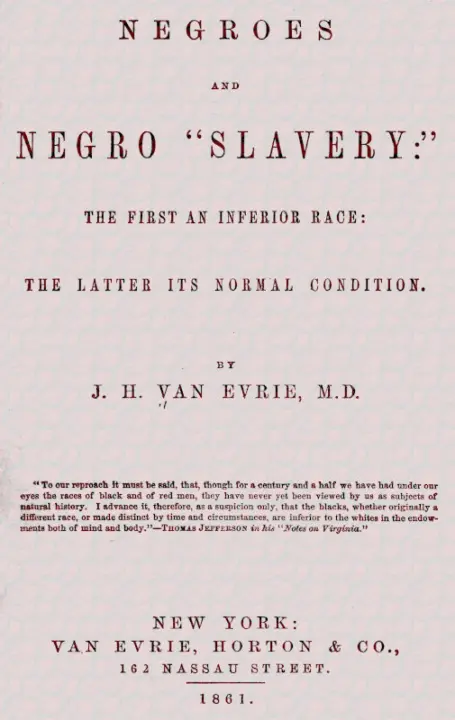
"Negroes and Negro 'Slavery:' the first an inferior race: the latter its normal condition" by J. H. Van Evrie, M.D. is a controversial treatise written in the mid-19th century. The work argues against the abolitionist movement, asserting that it is based on erroneous beliefs about racial equality and the nature of slavery. The author positions the black race as inherently inferior and maintains that slavery is the natural condition for those of African descent. At the start of the book, the author presents a preface discussing the political and social turmoil in America amid the rising anti-slavery sentiment and the onset of the Civil War. He critiques the abolitionist movement as rooted in delusion and foreign influence, particularly from European ideals. Van Evrie aims to provide a justification for the existing social order in the southern United States, asserting that it is rooted in natural law and necessity rather than moral failing. He sets the stage for a detailed exploration of the supposed differences between races, intending to argue for the social subordination of African Americans as not just preferable but essential for societal stability.
Introduction adapted from the source catalogue; source summaries may be automatically generated.
Free to read · English · 105,969 words · No account needed
MAKE TIME FOR A GOOD BOOK
On by default. Untick to stop anonymous reading totals. Each page counts after 10 seconds in view. How this works.
Anonymous counting is on unless you have switched it off.
Another advance, and we arrive at the relations of races—of white men and negroes—and of other races that may chance to be in juxtaposition, and of which the whole world may be said to be profoundly ignorant in theory, while one-half of our people have justly and truly solved them in practice. The social order of the South—the social and legal status of the negro—reposes on the natural relations of the white and black races, and, as has been observed, while the world is ignorant of these relations, the people of the South, indeed it may be said the American people, have practically solved them, and to the mutual benefit of all concerned. But before we can enter on a discussion of the natural relations and social adaptations of races, we must first clearly understand the relations that we bear to each other as individuals, and to the State or aggregate of individuals.
All the individuals of a species, whether animal or human, of course have the same faculties, the same wants, in a word, the same specialties. Occasionally chance—some accident, remote or immediate—deforms or blights individuals; they may be idiotic, insane, or otherwise incapable, but these are exceptional cases that do not disturb the great, fixed, and, unchangeable equality, sameness, or uniformity of the race. The white or Caucasian race, as has been observed, varies much more than any other race. There are tall men and short men, giants and pigmies, blondes and brunettes, red-haired and black-haired, but the nature remains the same; and if they were all placed under the same circumstances of climate, government, religion, etc., all would exhibit the same moral characteristics, and, to a certain extent, the same physical appearances. This is sufficiently illustrated among ourselves every day. Almost universally our people have sprung from the “lower classes” of European society. The coarse skin, big hands and feet, the broad teeth, pug nose, etc., of the Irish and German laborer pass away in a generation or two, and their American offspring have more delicate and classical features than even the most favored and privileged European aristocracy. Having the same faculties, the same wants, etc., it is a self-evident truth that they are entitled to the same rights, the same opportunities, to live out the nature with which God has endowed them. The Divine Author of Christianity promulgated this vital truth with great impressiveness. He selected his disciples from the lowest and most oppressed classes of the people, and thundered his most terrible denunciations in the ears of the sacerdotal aristocracy. The great body of the Jewish people were mere beasts of burden to their brethren—the priestly oligarchy—which governed the State and lived in idle luxury on the toil, ignorance, superstition, and misery of the people. On all occasions these oppressors were denounced, and the great and everlasting truth that God was no respecter of persons, and all men equally precious in His sight—even the beggar Lazarus and the repentent Magdalene—were the daily teachings of Christ. And there can be no doubt that the persecution and final crucifixion of the Author of the Christian religion was intended, by the rulers of the Jews, to crush out the great doctrine of equality, and thus to preserve their ascendency over the minds and fortunes of the people. The Divine ordinance—to “do unto others as we would have them do unto us”—is a complete exposition of our natural relations to each other, and an indestructible rule of nature as well as a religious obligation. All men—that is, all who belong to the race or species—having the same nature and designed by the Creator for the same purposes, the same rights and the same duties, it is an obvious inference that all human governments should rest on this great fundamental truth. No man should be permitted, indeed no man should be base enough to claim privileges denied to his fellow, or to any class of his fellows, and the same great principle which Christ ordained should guide His followers in their personal relations, should be the only legitimate rule in their political relations. To do unto others as we would have them do to us—to recognize in all other men the rights we claim for ourselves—to admit those reciprocal obligations which, in truth, spring from the necessities of our being—in short, to demand equal rights for ourselves, and to admit the same rights on the part of our fellows, seems so obvious, so instinctive, so just, and indeed self-evident, that an intelligent and just mind wonders how it ever could be otherwise, or that systems of government can exist in our own enlightened times in utter contradiction to such simple and self-evident truths. Government, the State, the aggregate citizenship, based on the great fundamental truth of equality, becomes a simple, beneficent, and easily understood institution. It leaves all men where God and nature places them, in natural relation to each other. Its functions, however complicated the details, are simply protective, leaving individuals to ascend or descend in the social scale, just as their industry, cultivation, and moral worth may be appreciated by their fellow-citizens. It protects one man from the violence or injustice of another, and the aggregate citizenship or nation from foreign aggression.
Your reading position is saved on this browser. Take it to another device with a library code. Reading pages adapt to text, rather than matching a printed edition.
BEHIND THE BOOK
This eBook is for the use of anyone anywhere in the United States and most other parts of the world at no cost and with almost no restrictions whatsoever. You may copy it, give it away or re-use it under the terms of the Project Gutenberg License included with this eBook or online at www.gutenberg.org. If you are not located in the United States, you will have to check the laws of the country where you are located before using this eBook. Read the source licence.
The original source file, including credits and licence, is retained by this library. Request an original-format copy at no charge. Please include the book title and Project Gutenberg identifier #61063.
KEEP YOUR CURIOSITY GOING
Cécile Tormay

Moritz Busch
John L. Ransom
Frances Wright
Cécile Tormay

Mabel Potter Daggett