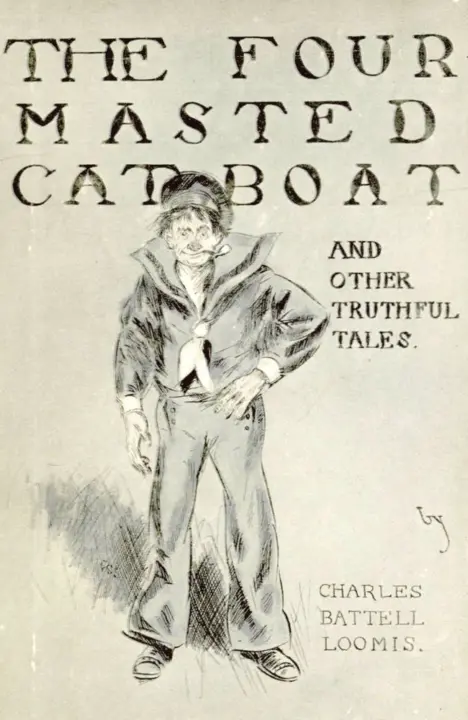
The Four-Masted Cat-Boat, and Other Truthful Tales
Charles Battell Loomis
THE CLASSIC COLLECTION · 1905
"Minerva's Manoeuvres: The Cheerful Facts of a 'Return to Nature'" by Charles Battell Loomis is a light-hearted novel written in the early 20th century. The story revolves around Minerva, a cook from New York City, who is compelled to move to a more rustic environment when her employer, Mrs. Vernon, invites her to Clover Lodge in the countryside after their original cook falls ill. The narrative highlights the amusing culture clash Minerva experiences as she grapples with her new rural lifestyle. The opening of the book introduces readers to the charm and humor of the situation, particularly through the dynamic between Minerva and her employers. As Minerva reluctantly agrees to leave the city for the countryside, she portrays a mix of comedy and exasperation, often lamenting about her aversion to rural life. The scenes that unfold during their journey to Clover Lodge, including Minerva’s comical interactions with a noisy cat, set the stage for a series of misadventures. Loomis's engaging tone and vibrant characterizations promise a delightful exploration of themes around adaptation, identity, and the quirks of transitioning from city to country life.
Introduction adapted from the source catalogue; source summaries may be automatically generated.
Free to read · English · 75,269 words · No account needed
MAKE TIME FOR A GOOD BOOK
On by default. Untick to stop anonymous reading totals. Each page counts after 10 seconds in view. How this works.
Anonymous counting is on unless you have switched it off.
The last turn in the road is a few rods north of our house, and James guided the horses skilfully round that turn and stopped them in front of our house. This was partly because Minerva, having fainted, was no longer screaming, and partly because John’s horse had stumbled and thrown him. And the minister came in second, his horse panting.
“James,” said I indignantly, “what do you mean by driving those horses at such a gait?”
James, when the horses had stopped, had sprung from the seat and was now at their heads talking in a low voice to them and patting them in order to calm them.
Minerva came to herself, said “Oh Lawdy! Are we back again, already?” and climbed ungracefully out of the carriage.
The horses were white with lather, their tongues lolling out of their mouths; and the wagon was sadly scratched. It was a mortifying moment for a liver of the simple life.
“James, what happened?” said I, sternly.
And then John came limping up, with a flesh wound on his forehead and shaking his fist at James, and with his cockaded hat in his hand said to Mrs. Guernsea, “I met him trying to run away with the horses ma’am, and I tried to stop him. The cheek of him, ma’am!”
James gave a contemptuous grunt, and leaving the horses, who had calmed down wonderfully under his ministrations, he pointed to a cut on the flank of the nigh horse.
“That’s what started the trouble, madam,” said he, “and it was your driver that threw the stone.”
I will say for Mrs. Guernsea, that she behaved like a thoroughbred. She was evidently a woman who reasoned things out, and she knew something of the principles of the simple life, for she said:
“Everybody meant well, I’ve no doubt, and the thing is all over
now.”
John was blanketing the sweating horses.
“Don’t let it worry you an instant, Mr. Vernon,” said she. “It was all an accident.”
I tried to get them to come indoors and take some refreshment, for the last few moments had been more strenuous than simple, but they decided that it was better for the horses to exercise them a little more and so they drove slowly home, and Bert went after his horse which had not hurt itself, and the minister went on to pick up his wife whom he had left at the first turn.
“And it was really all your fault,” said Ethel, smilingly, after James and Minerva had departed to the kitchen.
“Well, it gave Minerva something to think about and made life worth living for the Guernseas.”
Your reading position is saved on this browser. Take it to another device with a library code. Reading pages adapt to text, rather than matching a printed edition.
Charles Battell Loomis
Charles Battell Loomis
BEHIND THE BOOK
This eBook is for the use of anyone anywhere in the United States and most other parts of the world at no cost and with almost no restrictions whatsoever. You may copy it, give it away or re-use it under the terms of the Project Gutenberg License included with this eBook or online at www.gutenberg.org. If you are not located in the United States, you will have to check the laws of the country where you are located before using this eBook. Read the source licence.
The original source file, including credits and licence, is retained by this library. Request an original-format copy at no charge. Please include the book title and Project Gutenberg identifier #56872.
KEEP YOUR CURIOSITY GOING
Coulson Kernahan

Maurice Baring
Frances Wright
Cécile Tormay

Frederic Jesup Stimson

W. H. P. (William Henry Pope) Jarvis