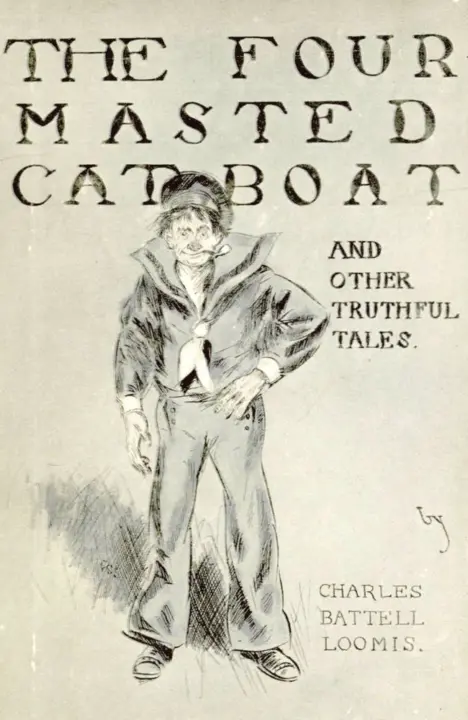
The Four-Masted Cat-Boat, and Other Truthful Tales
Charles Battell Loomis
THE CLASSIC COLLECTION · 1905
"Minerva's Manoeuvres: The Cheerful Facts of a 'Return to Nature'" by Charles Battell Loomis is a light-hearted novel written in the early 20th century. The story revolves around Minerva, a cook from New York City, who is compelled to move to a more rustic environment when her employer, Mrs. Vernon, invites her to Clover Lodge in the countryside after their original cook falls ill. The narrative highlights the amusing culture clash Minerva experiences as she grapples with her new rural lifestyle. The opening of the book introduces readers to the charm and humor of the situation, particularly through the dynamic between Minerva and her employers. As Minerva reluctantly agrees to leave the city for the countryside, she portrays a mix of comedy and exasperation, often lamenting about her aversion to rural life. The scenes that unfold during their journey to Clover Lodge, including Minerva’s comical interactions with a noisy cat, set the stage for a series of misadventures. Loomis's engaging tone and vibrant characterizations promise a delightful exploration of themes around adaptation, identity, and the quirks of transitioning from city to country life.
Introduction adapted from the source catalogue; source summaries may be automatically generated.
Free to read · English · 75,269 words · No account needed
MAKE TIME FOR A GOOD BOOK
On by default. Untick to stop anonymous reading totals. Each page counts after 10 seconds in view. How this works.
Anonymous counting is on unless you have switched it off.
I had never noticed the resemblance before, but there was no gainsaying it, once our attention had been called to it. I imagine that if the head were increased to horse size and the body and legs were in proportion, it would be a more formidable looking beast than the hyena. And if a hyena were reduced to grasshopper size he would be as “cute” as a caterpillar.
“Minerva,” said Ethel, “sit down. You may go, James. I wish you would not scare Minerva.”
“Never thought she’d scare so easy, Mrs. Vernon,” said he respectfully. He was always respectful. He went out into the woodshed to split some kindlings. He had already split enough to last us all of a winter, but it was healthful exercise and I kept him at it when he was not singing or mowing the lawn.
“Minerva, I don’t suppose that there is a more harmless insect in the world than a grasshopper,” said Ethel.
“What are they for?” said Minerva.
“Why—er,” said Ethel, while I held my book up before my face
discreetly.
“Why, they are to hop in the grass.”
“Oh,” said Minerva.
“Yes, they can hop many times the length of their own bodies.”
“Oh,” said Minerva.
Ethel made a mental calculation.
“I should say, Minerva,” said she, “that a grasshopper can hop about one hundred and twenty times his own length. How tall are you?”
“I’m five feet three,” was her unexpected answer.
“Well, call it five feet,” said Ethel, with a very serious face. “If you had the power of a grasshopper you could hop six hundred feet. That is to say, you could hop a long city block.”
The idea of Minerva hopping from Seventh Avenue to Eighth (for instance) was too much for me and I began to cough so hard that I had to go up stairs for a trochee.
When I came down Ethel was saying,
“You’ve heard the noises in the grass, haven’t you?”
“’Deed I have,” said Minerva, dismally.
“Did you know that the grasshoppers make a great deal of that
noise?”
“No’m,” said Minerva, her mouth wide open.
“They do. And how do you suppose they do it?”
“They blow, I suppose.”
“No, they don’t blow. Do they, Philip?”
“No, very few grasshoppers can blow. They can blow away, but they make that noise by—er—why, they make that noise—”
The words of a college song came into my head, “I can play the fiddle with my left hind leg.”
“They make fiddles of themselves and play, Minerva.”
Minerva looked at me seriously.
Your reading position is saved on this browser. Take it to another device with a library code. Reading pages adapt to text, rather than matching a printed edition.
Charles Battell Loomis
Charles Battell Loomis
BEHIND THE BOOK
This eBook is for the use of anyone anywhere in the United States and most other parts of the world at no cost and with almost no restrictions whatsoever. You may copy it, give it away or re-use it under the terms of the Project Gutenberg License included with this eBook or online at www.gutenberg.org. If you are not located in the United States, you will have to check the laws of the country where you are located before using this eBook. Read the source licence.
The original source file, including credits and licence, is retained by this library. Request an original-format copy at no charge. Please include the book title and Project Gutenberg identifier #56872.
KEEP YOUR CURIOSITY GOING
Coulson Kernahan

Maurice Baring
Frances Wright
Cécile Tormay

Frederic Jesup Stimson

W. H. P. (William Henry Pope) Jarvis