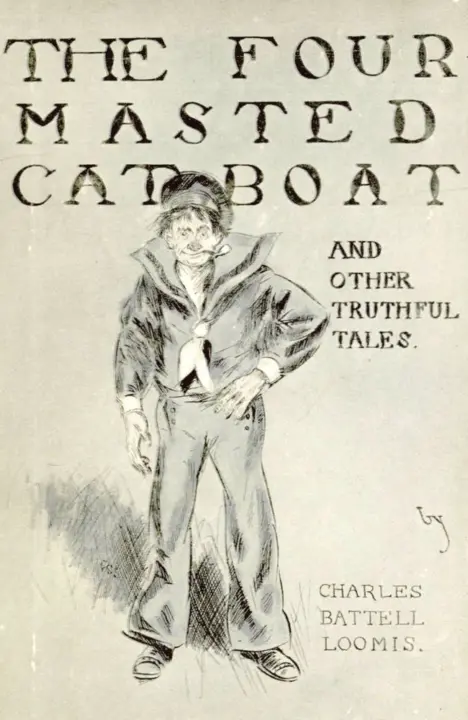
The Four-Masted Cat-Boat, and Other Truthful Tales
Charles Battell Loomis
THE CLASSIC COLLECTION · 1905
"Minerva's Manoeuvres: The Cheerful Facts of a 'Return to Nature'" by Charles Battell Loomis is a light-hearted novel written in the early 20th century. The story revolves around Minerva, a cook from New York City, who is compelled to move to a more rustic environment when her employer, Mrs. Vernon, invites her to Clover Lodge in the countryside after their original cook falls ill. The narrative highlights the amusing culture clash Minerva experiences as she grapples with her new rural lifestyle. The opening of the book introduces readers to the charm and humor of the situation, particularly through the dynamic between Minerva and her employers. As Minerva reluctantly agrees to leave the city for the countryside, she portrays a mix of comedy and exasperation, often lamenting about her aversion to rural life. The scenes that unfold during their journey to Clover Lodge, including Minerva’s comical interactions with a noisy cat, set the stage for a series of misadventures. Loomis's engaging tone and vibrant characterizations promise a delightful exploration of themes around adaptation, identity, and the quirks of transitioning from city to country life.
Introduction adapted from the source catalogue; source summaries may be automatically generated.
Free to read · English · 75,269 words · No account needed
MAKE TIME FOR A GOOD BOOK
On by default. Untick to stop anonymous reading totals. Each page counts after 10 seconds in view. How this works.
Anonymous counting is on unless you have switched it off.
Ethel can hurry upon occasion, and she was no time in coming down. But quick as she was, I was quicker, for I had the eggs on the table before she appeared, and when she came into the room we sat down together with never a suspicion on her part that Minerva had not prepared the breakfast. I felt the way I used to feel when I was a boy and used to do something a little beyond my supposed powers. My bosom swelled with pride as I reflected that every bit of the breakfast had been prepared by me.
Ethel uncovered the oatmeal dish and then she said, rather
irrelevantly, I thought,
“What’s the matter with Minerva?”
“Nothing, dear,” said I, reaching out my hand for my portion.
Her only answer was to ring the bell.
“—Er—I believe Minerva is upstairs,” said I.
“What has she been doing to the oatmeal?” said Ethel, poking at it with her spoon, but not attempting to taste the stiff-looking mass.
“Fact is, Ethel,” said I, “Minerva is a little upset by last night’s disturbance, and I cooked the breakfast.”
“You mean you didn’t cook it,” said Ethel, with just a touch of
sarcasm.
“Well, what I didn’t do, I didn’t do for you. I thought you’d had enough of the kitchen, and if you disguise this with sugar and cream it will be all right.”
But this was an exaggeration. We could not pretend to eat the
gluey mass, so I said,
“Well, anyhow, there are nice fresh eggs. It doesn’t take a great deal of skill to boil them.”
“Did you use the three-minute glass,” said Ethel, as she helped me to two eggs and then took two herself.
I told her that I didn’t know what she meant; that I used no glass at all, but had boiled them in the under part of the oatmeal boiler, as I had noticed Minerva do.
“Yes, but how long?” asked Ethel, as she took up her knife and chipped the shell of one.
“About an hour and a half,” said she, answering her own question. “You meant well, Philip, but you didn’t know. These are as hard as a rock and not yet cold. I hope the coffee is better.”
Ethel is not usually so fault finding, but I laid it to her
broken sleep, and said,
“The bread is cut pretty well. And the butter is just as good as if Minerva had put it on the table herself.”
“Yes, the bread and butter are quite a success, Phil, but this
coffee—”
Your reading position is saved on this browser. Take it to another device with a library code. Reading pages adapt to text, rather than matching a printed edition.
Charles Battell Loomis
Charles Battell Loomis
BEHIND THE BOOK
This eBook is for the use of anyone anywhere in the United States and most other parts of the world at no cost and with almost no restrictions whatsoever. You may copy it, give it away or re-use it under the terms of the Project Gutenberg License included with this eBook or online at www.gutenberg.org. If you are not located in the United States, you will have to check the laws of the country where you are located before using this eBook. Read the source licence.
The original source file, including credits and licence, is retained by this library. Request an original-format copy at no charge. Please include the book title and Project Gutenberg identifier #56872.
KEEP YOUR CURIOSITY GOING
Coulson Kernahan

Maurice Baring
Frances Wright
Cécile Tormay

Frederic Jesup Stimson

W. H. P. (William Henry Pope) Jarvis