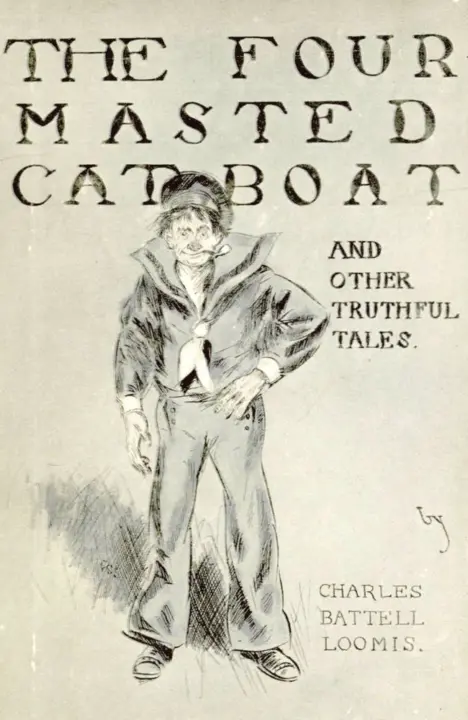
The Four-Masted Cat-Boat, and Other Truthful Tales
Charles Battell Loomis
THE CLASSIC COLLECTION · 1905
"Minerva's Manoeuvres: The Cheerful Facts of a 'Return to Nature'" by Charles Battell Loomis is a light-hearted novel written in the early 20th century. The story revolves around Minerva, a cook from New York City, who is compelled to move to a more rustic environment when her employer, Mrs. Vernon, invites her to Clover Lodge in the countryside after their original cook falls ill. The narrative highlights the amusing culture clash Minerva experiences as she grapples with her new rural lifestyle. The opening of the book introduces readers to the charm and humor of the situation, particularly through the dynamic between Minerva and her employers. As Minerva reluctantly agrees to leave the city for the countryside, she portrays a mix of comedy and exasperation, often lamenting about her aversion to rural life. The scenes that unfold during their journey to Clover Lodge, including Minerva’s comical interactions with a noisy cat, set the stage for a series of misadventures. Loomis's engaging tone and vibrant characterizations promise a delightful exploration of themes around adaptation, identity, and the quirks of transitioning from city to country life.
Introduction adapted from the source catalogue; source summaries may be automatically generated.
Free to read · English · 75,269 words · No account needed
MAKE TIME FOR A GOOD BOOK
On by default. Untick to stop anonymous reading totals. Each page counts after 10 seconds in view. How this works.
Anonymous counting is on unless you have switched it off.
“So I’m to write and tell them all to come? Isn’t this going to be a good deal of a drain on your pocketbook, Philip?”
“We can’t do worse than go home broke and then I’ll begin
again.”
“‘Easy come, easy go,’” quoted Ethel, with a half sigh.
“Don’t you want ’em to come? Will it be too hard on you?”
“No, no, we’ll make them understand it’s a picnic, but you will have to hustle in the fall.”
“Well, hustling never killed anybody, and we’ll have a summer to remember. It’s a lucky thing that James is so handy. He can help in the kitchen.”
And so the sofa was brought into the house and dusted, and the Wardens were implored to come up and told to take the same train that the Benedicts were coming on, and the haying season being practically over, we were able to engage Bert’s double team and his three-seated wagon, and Friday afternoon we all went down to meet them.
No, not all. We left Minerva behind. She and James had to
prepare a dinner for eight.
There was no accident on the way down, and we arrived at the station several minutes before the arrival of the train.
At last we heard the whistle below the bridge and then it steamed in and we took up our station around the parlour car and prepared to greet our guests.
But the only one to get off was a well-setup young fellow in irreproachable apparel, and he did not belong to us.
“Why, of course, they never would have taken a parlour car. The Benedicts might, but the Wardens wouldn’t,” said Ethel, and we looked down the platform to see whether they had alighted. But they had not. Our guests had not come.
“Isn’t it too provoking,” said Cherry, sympathetically to Ethel.
“It really is,” said Ethel. “That dinner will be stone cold if we wait for the next train.”
“When is the next train?” asked Ellery.
“In two hours,” I replied. “They won’t come to-night, though. Something happened to Tom at the last minute and he asked the rest to wait and they waited. We’ll get a telegram saying so. Everybody obeys his will always.”
The irreproachable stranger had been walking around as if he was looking for somebody. He now approached me with uplifted hat.
“Would you be so good as to tell me whether Mr. Vernon lives
near here?”
“I am Mr. Vernon.”
He coloured, stammered and said,
“I am Talcott Hepburn, and I am afraid that I’ve been led into an unpardonably rude act.”
Your reading position is saved on this browser. Take it to another device with a library code. Reading pages adapt to text, rather than matching a printed edition.
Charles Battell Loomis
Charles Battell Loomis
BEHIND THE BOOK
This eBook is for the use of anyone anywhere in the United States and most other parts of the world at no cost and with almost no restrictions whatsoever. You may copy it, give it away or re-use it under the terms of the Project Gutenberg License included with this eBook or online at www.gutenberg.org. If you are not located in the United States, you will have to check the laws of the country where you are located before using this eBook. Read the source licence.
The original source file, including credits and licence, is retained by this library. Request an original-format copy at no charge. Please include the book title and Project Gutenberg identifier #56872.
KEEP YOUR CURIOSITY GOING
Coulson Kernahan

Maurice Baring
Frances Wright
Cécile Tormay

Frederic Jesup Stimson

W. H. P. (William Henry Pope) Jarvis