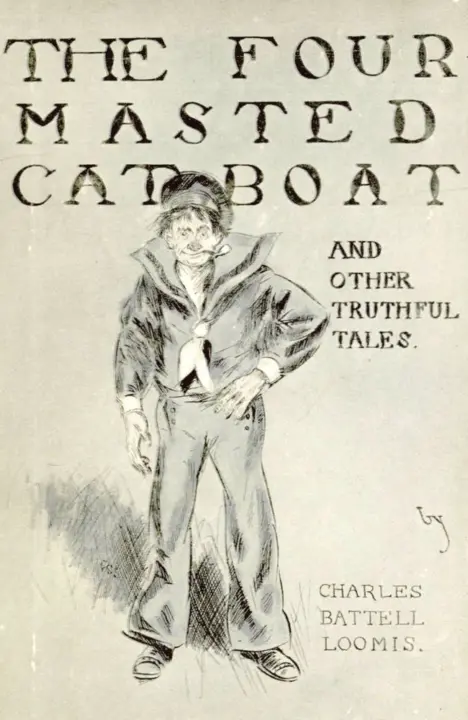
The Four-Masted Cat-Boat, and Other Truthful Tales
Charles Battell Loomis
THE CLASSIC COLLECTION · 1905
"Minerva's Manoeuvres: The Cheerful Facts of a 'Return to Nature'" by Charles Battell Loomis is a light-hearted novel written in the early 20th century. The story revolves around Minerva, a cook from New York City, who is compelled to move to a more rustic environment when her employer, Mrs. Vernon, invites her to Clover Lodge in the countryside after their original cook falls ill. The narrative highlights the amusing culture clash Minerva experiences as she grapples with her new rural lifestyle. The opening of the book introduces readers to the charm and humor of the situation, particularly through the dynamic between Minerva and her employers. As Minerva reluctantly agrees to leave the city for the countryside, she portrays a mix of comedy and exasperation, often lamenting about her aversion to rural life. The scenes that unfold during their journey to Clover Lodge, including Minerva’s comical interactions with a noisy cat, set the stage for a series of misadventures. Loomis's engaging tone and vibrant characterizations promise a delightful exploration of themes around adaptation, identity, and the quirks of transitioning from city to country life.
Introduction adapted from the source catalogue; source summaries may be automatically generated.
Free to read · English · 75,269 words · No account needed
MAKE TIME FOR A GOOD BOOK
On by default. Untick to stop anonymous reading totals. Each page counts after 10 seconds in view. How this works.
Anonymous counting is on unless you have switched it off.
“Sounded something like ‘th’ ould scut,’” said I, for by that name our friend Casey had come to be known.
It proved to be he, bare-footed and hatless, coming to us across
the fields.
“Good marnin’, ’tis a hell of a fine day.”
“Yes, it is,” said I, “although your language is somewhat
strong.”
“No harrum intindid,” said he, looking at Ethel with a pleasant smile. “Ye can’t make an insult out of a hell or two a day like this. I t’harght that perhaps your woman would like some blue berries for breakfast th’ day, an’ I brarght them up. They’re picked this marnin’, an’ the dew is yit on them.” He held out an eight-quart pail filled to the top with tempting berries.
“How much are they, Pat,” said I, putting my hand into my
pocket.
“Who’s insultin’ now?” said he, with a growling laugh. “I’ll sell no prisints this yair. ’Twas a hell of a bad ride ye had th’ other night, an’ I tould me ould woman I’d git square wid ye one way or another, an’ this is the way. They’re dam fine.”
“They certainly are,” said Ethel, unconsciously seconding his
oath.
She went into the house to get a bowl to put them into and just then Ellery and Cherry came up.
“The top of the marnin’ to ye,” said Pat, bowing to Cherry, as he had bowed to Ethel. “It’s easy to tell why it’s a fine day.”
Cherry was unconscious enough to ask him why.
“Sure, wid you out how could’t help ut.”
“Now will you be good, Cherry?” said I.
“You’ve kissed the blarney stone,” said she, with a lovely
blush.
“Sure I have, but I knew beauty before that.”
His tone was not offensive nor did Cherry take offence. It was truth buttered with flattery and that’s as good as cake.
Ethel now came out with the bowl, and the big “bloomy” berries, damp with dew, were poured into it.
“It’s glad I am you’re up here,” said Pat, as he walked down the path. “Neighbours is neighbours, an’ phwin you’re passin’ an’ need restin’ it’s fine buttermilk me ould woman’ll give ye, an’ glad of the chance. Good marnin’ to yez.”
“Good morning, Mr. Casey, and thank you very much for the berries. They’re the best I’ve seen,” said Ethel.
“They’re dam fine, that’s a fact,” said he. “But none too good for the likes of youse.”
Your reading position is saved on this browser. Take it to another device with a library code. Reading pages adapt to text, rather than matching a printed edition.
Charles Battell Loomis
Charles Battell Loomis
BEHIND THE BOOK
This eBook is for the use of anyone anywhere in the United States and most other parts of the world at no cost and with almost no restrictions whatsoever. You may copy it, give it away or re-use it under the terms of the Project Gutenberg License included with this eBook or online at www.gutenberg.org. If you are not located in the United States, you will have to check the laws of the country where you are located before using this eBook. Read the source licence.
The original source file, including credits and licence, is retained by this library. Request an original-format copy at no charge. Please include the book title and Project Gutenberg identifier #56872.
KEEP YOUR CURIOSITY GOING
Coulson Kernahan

Maurice Baring
Frances Wright
Cécile Tormay

Frederic Jesup Stimson

W. H. P. (William Henry Pope) Jarvis