
The Writing of News A Handbook with Chapters on Newspaper Correspondence and Copy Reading
Charles G. (Charles Griffith) Ross
THE CLASSIC COLLECTION · 1907
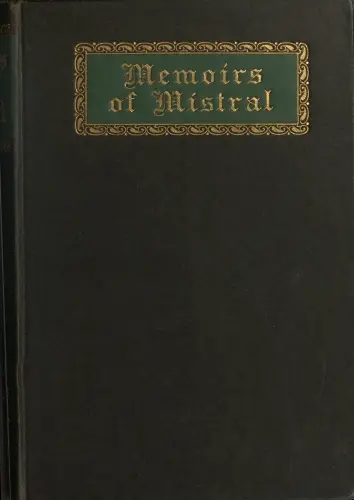
"Memoirs of Mistral" by Frédéric Mistral is a memoir written in the late 19th century. The work provides a vivid account of the author's early life in the province of Provence, capturing the essence of rural life and his formative experiences. The narrative is likely to focus on Mistral's childhood memories, including his family, education, and the natural landscapes that shaped his identity as a poet. The opening portion of the memoir introduces Frédéric Mistral’s childhood in the village of Maillane, nestled at the foot of the Alpilles mountains. He shares details of his family's way of life as yeoman farmers, emphasizing the harmony between their traditions and the landscape. Key figures in his early life, such as his parents, are vividly described; particularly his father, a hardworking patriarch with deep roots in Provençal traditions. Mistral paints a nostalgic picture of his innocent adventures, interactions with local characters, and fond memories tied to nature and familial bonds, establishing a strong sense of place and identity that resonates throughout the memoir.
Introduction adapted from the source catalogue; source summaries may be automatically generated.
Free to read · English · 69,531 words · No account needed
MAKE TIME FOR A GOOD BOOK
On by default. Untick to stop anonymous reading totals. Each page counts after 10 seconds in view. How this works.
Anonymous counting is on unless you have switched it off.
“The police,” we cried; “we snap our fingers at them. “Here,” added Daudet, “go and fetch the visitors’ book.”
The “Counënque” brought the book in which all who passed the night at the inn inscribed their names, and the polite secretary of Monsieur de Morny wrote in his best hand:
A. Daudet, Secretary of the President of the Senate. F. Mistral, Chevalier of the Legion of Honour. A. Mathieu, Félibre of Châteauneuf-du-Pape. P. Grivolas, Master painter of the School of Avignon.
“And if any one,” he continued, “if any one, O Counënque, should ever dare make trouble, be he commissioner, policeman or sub-prefect, thou hast only to place these inky spider’s legs under his moustache. If after that he is not quieted, write to me in Paris and I wager I will make him dance.”
We settled our bill, and accompanied by the admiring glances of all, we left with the air of princes who had just revealed their identity. Arrived at the footpath of the bridge of Trinquetaille:
“What if we danced a bit of a farandole?” proposed the indefatigable and charming novelist of the “Mule du Pape.” “The bridges of Provence are only made for that.”
So forward. In the clear, limpid light of the September moon, which was reflected in the water, behold us stepping gaily and singing on the bridge.
About midway across we saw advancing a procession of Arlesiennes, of delicious Arlesiennes, each one with her cavalier, walking and bowing, laughing and talking. The rustling of petticoats, the frou-frou of silk, the soft murmurs of the happy couples as they spoke together in the peaceful night with the thrill of the Rhône that glided between the boats, was an emotional experience never to be forgotten.
“A wedding!” cried the fat Gafet, who had not yet left us.
“A wedding,” echoed Daudet, who, with his short sight, only just perceived the advancing party. “An Arlesienne wedding! A moonlight wedding! A wedding in the middle of the Rhône!”
And taken with a sudden mad impulse, our buck sprang forward, threw himself on the neck of the bride, and kissed her with a will.
Then followed a pretty row! We were all in for it, and if ever we were hard put to it in our lives, it was certainly on that occasion. Twenty fellows with raised sticks surrounded us:
“To the Rhône with the rascals!”
“What is it all about?” cried Master Gafet, pushing back the crowd. “Can’t you see we have been drinking? Drinking to the health of the bride in the Trinquetaille, and that to commence drinking again would do us harm?”
Your reading position is saved on this browser. Take it to another device with a library code. Reading pages adapt to text, rather than matching a printed edition.
BEHIND THE BOOK
This eBook is for the use of anyone anywhere in the United States and most other parts of the world at no cost and with almost no restrictions whatsoever. You may copy it, give it away or re-use it under the terms of the Project Gutenberg License included with this eBook or online at www.gutenberg.org. If you are not located in the United States, you will have to check the laws of the country where you are located before using this eBook. Read the source licence.
The original source file, including credits and licence, is retained by this library. Request an original-format copy at no charge. Please include the book title and Project Gutenberg identifier #56040.
KEEP YOUR CURIOSITY GOING
Charles G. (Charles Griffith) Ross
Hannah Webster Foster

Emily Lawless
Edwin Hamlin Carr

Charles De Lano Hine
Andrew Ure