
The Writing of News A Handbook with Chapters on Newspaper Correspondence and Copy Reading
Charles G. (Charles Griffith) Ross
THE CLASSIC COLLECTION · 1907
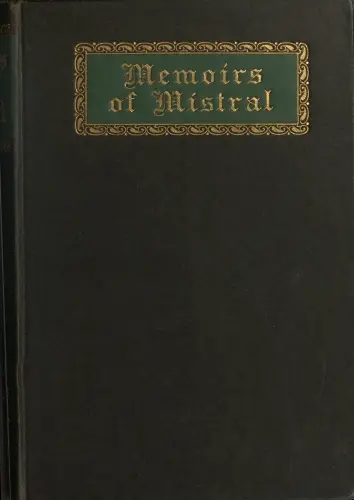
"Memoirs of Mistral" by Frédéric Mistral is a memoir written in the late 19th century. The work provides a vivid account of the author's early life in the province of Provence, capturing the essence of rural life and his formative experiences. The narrative is likely to focus on Mistral's childhood memories, including his family, education, and the natural landscapes that shaped his identity as a poet. The opening portion of the memoir introduces Frédéric Mistral’s childhood in the village of Maillane, nestled at the foot of the Alpilles mountains. He shares details of his family's way of life as yeoman farmers, emphasizing the harmony between their traditions and the landscape. Key figures in his early life, such as his parents, are vividly described; particularly his father, a hardworking patriarch with deep roots in Provençal traditions. Mistral paints a nostalgic picture of his innocent adventures, interactions with local characters, and fond memories tied to nature and familial bonds, establishing a strong sense of place and identity that resonates throughout the memoir.
Introduction adapted from the source catalogue; source summaries may be automatically generated.
Free to read · English · 69,531 words · No account needed
MAKE TIME FOR A GOOD BOOK
On by default. Untick to stop anonymous reading totals. Each page counts after 10 seconds in view. How this works.
Anonymous counting is on unless you have switched it off.
My early years were passed at the farm in the company of labourers,
reapers and shepherds.
When occasionally a townsman visited our farm, one of those who affected to speak only French, it puzzled me sorely and even disconcerted me to see my parents all at once take on a respectful manner to the stranger, as though they felt him to be their superior. I was perplexed, too, at hearing another tongue.
“Why is it,” I asked, “that man does not speak like we do?”
“Because he is a gentleman,” I was told.
“Then I will never be a gentleman,” I replied resentfully.
I remarked also that when we received visitors, such, for instance, as the Marquis de Barbentane, our neighbour, my father, who when speaking of my mother before the servants called her “the mistress,” to the Marquis merely referred to her as “my wife.” The grand Marquis and his lady, the Marquise, a sister of the great Général de Gallifet, whenever they came used to bring me cakes and sweets, but in spite of this, no sooner did I see them driving up in their carriage than, like the young savage that I was, off I ran and hid in the hay-loft. In vain my poor mother would call “Frédéric.” Crouching in the hay and holding my breath, I waited until I heard the departing carriage wheels of our guests, and my mother declaiming for the benefit of all: “It is insufferable; here are Monsieur de Barbentane and Madame de Barbentane, who come on purpose to see that child, and he goes off and hides himself!”
And when I crept out of my hiding-place, instead of the sweets, I
received a good spanking.
What I really loved, however, was to go off with Papoty, our head-man, when he set out with the plough behind the two mules.
“Come on, youngster, and I’ll teach you to plough,” he would call
enticingly.
Then and there off I would go, bareheaded and barefooted, briskly following in the furrow, and as I ran, picking the flowers, primroses and blue musk, turned up by the blade.
How joyous it was, this atmosphere of rustic life. Each season in turn brought its round of labour. Ploughing, sowing, shearing, reaping, the silk-worms, the harvests, the threshing, the vintage and the olive gathering, unrolled before my eyes the majestic acts of the agricultural life, always a stern, hard life, yet always one of calm and freedom.
Your reading position is saved on this browser. Take it to another device with a library code. Reading pages adapt to text, rather than matching a printed edition.
BEHIND THE BOOK
This eBook is for the use of anyone anywhere in the United States and most other parts of the world at no cost and with almost no restrictions whatsoever. You may copy it, give it away or re-use it under the terms of the Project Gutenberg License included with this eBook or online at www.gutenberg.org. If you are not located in the United States, you will have to check the laws of the country where you are located before using this eBook. Read the source licence.
The original source file, including credits and licence, is retained by this library. Request an original-format copy at no charge. Please include the book title and Project Gutenberg identifier #56040.
KEEP YOUR CURIOSITY GOING
Charles G. (Charles Griffith) Ross
Hannah Webster Foster

Emily Lawless
Edwin Hamlin Carr

Charles De Lano Hine
Andrew Ure