
The Writing of News A Handbook with Chapters on Newspaper Correspondence and Copy Reading
Charles G. (Charles Griffith) Ross
THE CLASSIC COLLECTION · 1907
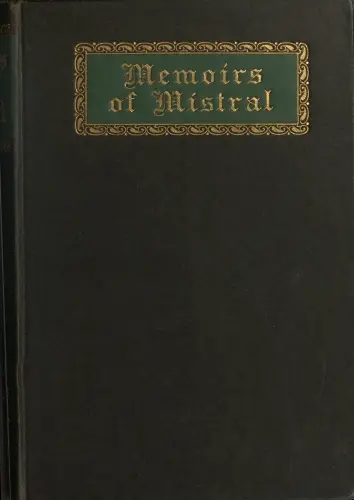
"Memoirs of Mistral" by Frédéric Mistral is a memoir written in the late 19th century. The work provides a vivid account of the author's early life in the province of Provence, capturing the essence of rural life and his formative experiences. The narrative is likely to focus on Mistral's childhood memories, including his family, education, and the natural landscapes that shaped his identity as a poet. The opening portion of the memoir introduces Frédéric Mistral’s childhood in the village of Maillane, nestled at the foot of the Alpilles mountains. He shares details of his family's way of life as yeoman farmers, emphasizing the harmony between their traditions and the landscape. Key figures in his early life, such as his parents, are vividly described; particularly his father, a hardworking patriarch with deep roots in Provençal traditions. Mistral paints a nostalgic picture of his innocent adventures, interactions with local characters, and fond memories tied to nature and familial bonds, establishing a strong sense of place and identity that resonates throughout the memoir.
Introduction adapted from the source catalogue; source summaries may be automatically generated.
Free to read · English · 69,531 words · No account needed
MAKE TIME FOR A GOOD BOOK
On by default. Untick to stop anonymous reading totals. Each page counts after 10 seconds in view. How this works.
Anonymous counting is on unless you have switched it off.
“By our Lady,” answered the one-eyed, “if you had let us know beforehand, we might have prepared you a blanquette à la mode--or an omelette--but when people drop down on you in the twilight like a hair in the soup, you understand, gentlemen, one has to give them what one can.”
Daudet, who in his whole life had never before seen such specimens of the Camargue, seized one of the onions--fine flat onions, golden as a Christmas loaf--and boldly crunched and swallowed it, leaf by leaf, with his fine strong teeth, to the accompaniment of some fermented cheese and haddock. It is only fair to mention we also did our best to help him, while Master Gafet, raising every now and again the brimming jug of Crau wine, his face ablaze as I never saw the like.
“Oh these young bloods!” said he, “the onion makes one drink and keeps
up the thirst.”
In less than half an hour one could have lighted a match on any one of our cheeks. Then the hash (catigot) arrived, a dish in which a shepherd’s crook could have stood upright, salted like the sea, and peppered like the devil.
“Salting and peppering make one find the wine very good,” said the fat Gafet; “let us clink glasses, my boys.”
The bargemen meantime, having finished their kid, ended their repast, as is the custom of the watermen of Condrieu, with a plate of fat soup. Each one poured a big glass of wine into his plate, then, lifting it with both hands, all together they drank off the mixture at one gulp, smacking their lips with pleasure. The master of a raft, who wore his beard like a collar, then sang a song which, if I remember, finished like this:
When our fleet arrives
On the way to Toulon,
We salute the town
With a roll of cannon.
“Thunder! but we must give them one back,” cried Daudet. And he burst out with a chorus which referred to the time of the Civil War with the Vaulois:
To Lourmarin--Light-horseman
There they die!
To Lourmarin--Light-horseman
Quickly fly! &c.
Then the men of the river, not to be outdone, responded with a chorus:
The maidens of Valence
Know naught of love’s sweet way,
But those of fair Provence
Enjoy it night and day.
“Together now, boys,” we cried to the singers. And in unison, making castanets of our fingers, we shouted with such full lungs that the one-eyed interrupted us:
“Shut up,” said she, “if the police pass by they will have you up for brawling at nights.”
Your reading position is saved on this browser. Take it to another device with a library code. Reading pages adapt to text, rather than matching a printed edition.
BEHIND THE BOOK
This eBook is for the use of anyone anywhere in the United States and most other parts of the world at no cost and with almost no restrictions whatsoever. You may copy it, give it away or re-use it under the terms of the Project Gutenberg License included with this eBook or online at www.gutenberg.org. If you are not located in the United States, you will have to check the laws of the country where you are located before using this eBook. Read the source licence.
The original source file, including credits and licence, is retained by this library. Request an original-format copy at no charge. Please include the book title and Project Gutenberg identifier #56040.
KEEP YOUR CURIOSITY GOING
Charles G. (Charles Griffith) Ross
Hannah Webster Foster

Emily Lawless
Edwin Hamlin Carr

Charles De Lano Hine
Andrew Ure