
The Writing of News A Handbook with Chapters on Newspaper Correspondence and Copy Reading
Charles G. (Charles Griffith) Ross
THE CLASSIC COLLECTION · 1907
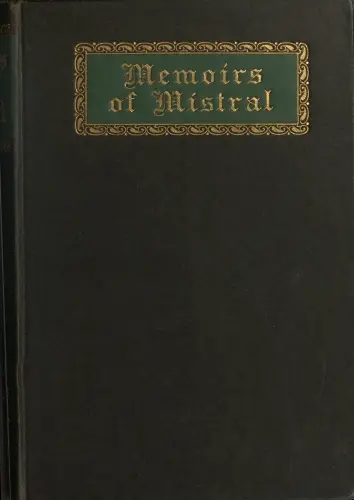
"Memoirs of Mistral" by Frédéric Mistral is a memoir written in the late 19th century. The work provides a vivid account of the author's early life in the province of Provence, capturing the essence of rural life and his formative experiences. The narrative is likely to focus on Mistral's childhood memories, including his family, education, and the natural landscapes that shaped his identity as a poet. The opening portion of the memoir introduces Frédéric Mistral’s childhood in the village of Maillane, nestled at the foot of the Alpilles mountains. He shares details of his family's way of life as yeoman farmers, emphasizing the harmony between their traditions and the landscape. Key figures in his early life, such as his parents, are vividly described; particularly his father, a hardworking patriarch with deep roots in Provençal traditions. Mistral paints a nostalgic picture of his innocent adventures, interactions with local characters, and fond memories tied to nature and familial bonds, establishing a strong sense of place and identity that resonates throughout the memoir.
Introduction adapted from the source catalogue; source summaries may be automatically generated.
Free to read · English · 69,531 words · No account needed
MAKE TIME FOR A GOOD BOOK
On by default. Untick to stop anonymous reading totals. Each page counts after 10 seconds in view. How this works.
Anonymous counting is on unless you have switched it off.
“Long live the bridal couple!” we all exclaimed. And thanks to the valiant Gafet, whom every one knew, and to his presence of mind, the thing ended there.
The next question was where to go next? The Man of Bronze had just struck eleven o’clock. We decided to make the tour of the Aliscamps.[19]
Passing down the Lice d’Arles we went the round of the ramparts, and by the light of the moon descended the avenue of poplars leading to the cemetery of the old Arles of the Romans. And while wandering amongst the tombs and sarcophagi, showing white on either side in long rows, we solemnly chaunted the fine ballad by Camille Reybaud:
The poplars growing in the churchyard here
Salute the dead that in these graves abide--
If thou the sacred mysteries dost fear
Oh never pass the churchyard by so near!
The long, white grave-stones in the churchyard here
Have flung their heavy covers open wide.
If thou the sacred mysteries, &c. &c.
Upon the greensward in the churchyard here
The dead men all stand upright side by side.
If thou the sacred mysteries, &c. &c.
They all embrace within the churchyard here,
These mute and silent brothers who have died.
If thou the sacred mysteries, &c. &c.
’Tis keeping holiday, the churchyard here,
And dancing to and fro the dead men glide.
If thou the sacred mysteries, &c. &c.
Across the churchyard now the moon shines clear;
Each maiden seeks her love, each lad his bride.
If thou the sacred mysteries, &c. &c.
No more they find them, in the churchyard here,
Their loves of yore, that would not be denied.
If thou the sacred mysteries, &c. &c.
Oh open me the churchyard wicket wide!
Let my love in, to comfort them that died!...
(Trans. Alma Strettell.)
Suddenly, from a yawning tomb three paces from us, we heard in dolorous sepulchral tones these words:
“Let sleep in peace those who sleep!”
We remained petrified, and all around us in the moonlight a deep silence
reigned.
At last Mathieu said softly to Grivolas:
“Didst thou hear?”
“Yes,” replied the painter, “it is down there, in that sarcophagus.”
“Eh,” cried Master Gafet, bursting into laughter, “that is a ‘dressed sleeper,’ as we call them in Arles, one of those vagrants who come to lodge at night in the empty tombs.”
“What a pity,” cried Daudet, “that it was not a real ghost! Some beautiful vestal, who at the voice of the poets was roused from her sleep, and, Oh, my Grivolas, wished to rise up and embrace thee!”
Then in a resounding voice he sang, and we all joined in:
Your reading position is saved on this browser. Take it to another device with a library code. Reading pages adapt to text, rather than matching a printed edition.
BEHIND THE BOOK
This eBook is for the use of anyone anywhere in the United States and most other parts of the world at no cost and with almost no restrictions whatsoever. You may copy it, give it away or re-use it under the terms of the Project Gutenberg License included with this eBook or online at www.gutenberg.org. If you are not located in the United States, you will have to check the laws of the country where you are located before using this eBook. Read the source licence.
The original source file, including credits and licence, is retained by this library. Request an original-format copy at no charge. Please include the book title and Project Gutenberg identifier #56040.
KEEP YOUR CURIOSITY GOING
Charles G. (Charles Griffith) Ross
Hannah Webster Foster

Emily Lawless
Edwin Hamlin Carr

Charles De Lano Hine
Andrew Ure