
The Writing of News A Handbook with Chapters on Newspaper Correspondence and Copy Reading
Charles G. (Charles Griffith) Ross
THE CLASSIC COLLECTION · 1907
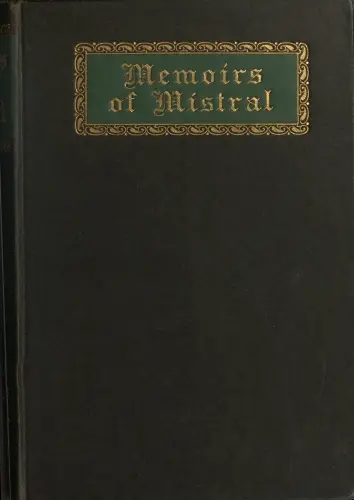
"Memoirs of Mistral" by Frédéric Mistral is a memoir written in the late 19th century. The work provides a vivid account of the author's early life in the province of Provence, capturing the essence of rural life and his formative experiences. The narrative is likely to focus on Mistral's childhood memories, including his family, education, and the natural landscapes that shaped his identity as a poet. The opening portion of the memoir introduces Frédéric Mistral’s childhood in the village of Maillane, nestled at the foot of the Alpilles mountains. He shares details of his family's way of life as yeoman farmers, emphasizing the harmony between their traditions and the landscape. Key figures in his early life, such as his parents, are vividly described; particularly his father, a hardworking patriarch with deep roots in Provençal traditions. Mistral paints a nostalgic picture of his innocent adventures, interactions with local characters, and fond memories tied to nature and familial bonds, establishing a strong sense of place and identity that resonates throughout the memoir.
Introduction adapted from the source catalogue; source summaries may be automatically generated.
Free to read · English · 69,531 words · No account needed
MAKE TIME FOR A GOOD BOOK
On by default. Untick to stop anonymous reading totals. Each page counts after 10 seconds in view. How this works.
Anonymous counting is on unless you have switched it off.
“Good morning, Mr. Frédéric. They tell me that you have need of a man on
the farm.”
“Yes--from whence comest thou?”
“From Villeneuve, the country of the ‘lizards’--near to Avignon.”
“And what canst thou do?”
“A little of everything. I have been helper at the oil mills, muleteer, carrier, labourer, miller, shearer, mower if necessary, wrestler on occasions, pruner of poplars, a high-class trade, and even cleaner of sewers, which is the lowest of all!”
“And they call thee?”
“Jean Roussière, and Rousseyron--and Seyron for short.”
“How much do you ask?--it is for taking care of the beasts.”
“About fifteen louis.”
“I will give thee a hundred crowns.”
“All right for a hundred crowns.”
That is how I engaged Jean Roussière, he who taught me the old folk-melody of “Magali”--a jovial fellow and made on the lines of a Hercules. The last year that I lived at the farm, with my blind father, in the long watches of our solitude Jean Roussière never failed to keep me interested and amused, good fellow that he was. At his work he was excellent and always enlivened his beasts by some cheering song.
Naturally artistic in all he did, even if it was heaping a rick of straw or a pile of manure, or stowing away a cargo, he knew how to give the harmonious line or, as they say, the graceful sweep. But he had the defects of his qualities and was rather too fond of taking life in an easy and leisurely fashion, even passing part of it in an afternoon nap.
A charming talker at all times, it was worth hearing him as he spoke of the days when he led the big teams of horses on the towing-path, tugging the barges up the Rhône to Valence and to Lyons.
“Just fancy!” he said, “at the age of twenty, I led the finest turn-out on the banks of the Rhône! A turn-out of twenty-four stallions, four abreast, dragging six barges! Ah, what fine mornings those were, when we set out on the banks of the big river and silently, slowly, this fleet moved up the stream!”
And Jean Roussière would enumerate all the places on the two banks; the inns, the hostesses, the streams, the sluices, the roads and the fords from Arles to the Revestidou, from the Coucourde to the Ermitage. But his greatest happiness and triumph was at the feast of Saint-Eloi.
“I will show your Maillanais,” he said, “if they have not already seen it, how we ride a little mule!”
Your reading position is saved on this browser. Take it to another device with a library code. Reading pages adapt to text, rather than matching a printed edition.
BEHIND THE BOOK
This eBook is for the use of anyone anywhere in the United States and most other parts of the world at no cost and with almost no restrictions whatsoever. You may copy it, give it away or re-use it under the terms of the Project Gutenberg License included with this eBook or online at www.gutenberg.org. If you are not located in the United States, you will have to check the laws of the country where you are located before using this eBook. Read the source licence.
The original source file, including credits and licence, is retained by this library. Request an original-format copy at no charge. Please include the book title and Project Gutenberg identifier #56040.
KEEP YOUR CURIOSITY GOING
Charles G. (Charles Griffith) Ross
Hannah Webster Foster

Emily Lawless
Edwin Hamlin Carr

Charles De Lano Hine
Andrew Ure