THE CLASSIC COLLECTION✦An outlaw’s diary: the CommuneCLASSIC FREE BOOKS
An outlaw’s diary: the Commune
Cécile Tormay
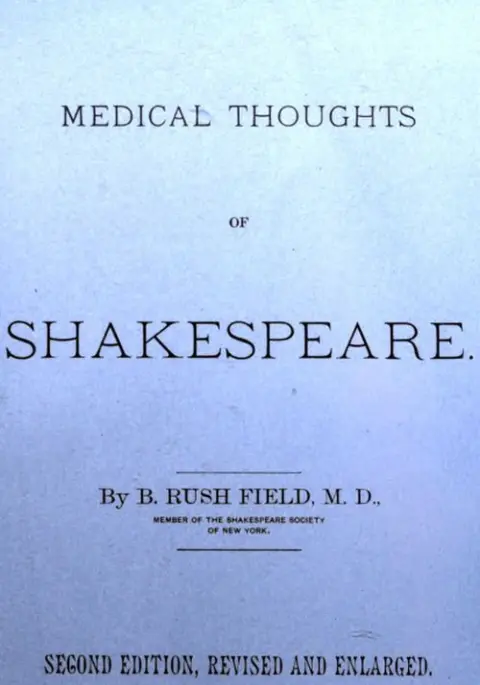
THE CLASSIC COLLECTION · 1884
"Medical Thoughts of Shakespeare" by Benjamin Rush Field is a scholarly publication written in the late 19th century. The work explores the intersection of medicine and the literary genius of Shakespeare, analyzing various medical references and characters within his plays. It aims to highlight Shakespeare's understanding of medical practices and terminology through various citations from his works, providing insights into the medical knowledge of his time. At the start of the text, the author introduces the revised second edition, noting the expansion of content and the addition of new topics related to medicine, surgery, and pharmacology. The opening includes a preface that acknowledges the book's reception and outlines the chapters to follow, suggesting an organized analytical approach. Field begins discussing Shakespeare's portrayal of physicians in his plays and quotes lines showcasing the playwright’s grasp of medical concepts, setting the stage for a detailed investigation into Shakespeare’s medical insights throughout the ensuing chapters.
Introduction adapted from the source catalogue; source summaries may be automatically generated.
Free to read · English · 25,133 words · No account needed
MAKE TIME FOR A GOOD BOOK
On by default. Untick to stop anonymous reading totals. Each page counts after 10 seconds in view. How this works.
Anonymous counting is on unless you have switched it off.
I asked the doctors after his disease— He died of the slow fever called the tertian, And left his widow to her own aversion. Byron—Don Juan, Canto I., Verse XXXIV.
His feelings had not those strange fits, like tertians Of common likings, which make some deplore What they should laugh at—the mere ague still Of men’s regards, the fever or the chill. Byron—Don Juan, Canto XIII., Verse XVII.
Plague has been alluded to frequently, but generally only the symptoms of carbuncles and the petechiæ are mentioned. As the latter only occur in very bad cases, they were called “God’s tokens,” and their appearance denoted a fatal termination of the disease. Hence the home of the patient was closed and “Lord have mercy on us” placed upon the door.
Write Lord have mercy on us on those three; They are infected, in their hearts it lies; They have the plague and caught it of your eyes. Love’s Labour’s Lost, Act V., Sc. II.
He is so plaguy-proud, that the death tokens of it cry— No recovery. Troilus and Cressida, Act II., Sc. III.
Enobarbus. How appears the fight? Scarus. On our side like the token’d pestilence, Where death is sure Antony and Cleopatra, Act III., Sc. X.
Now the red pestilence strike all trades in Rome, And occupations perish! Coriolanus, Act IV., Sc. I.
The searchers of the town, Suspecting that we both were in a house Where the infectious pestilence did reign, Sealed up the doors and would not let us forth. Romeo and Juliet, Act V., Sc. II.
Thou art a boil,
A plague sore, an embossed carbuncle,
In my corrupted blood.
King Lear, Act II., Sc. IV.
Boils and plagues
Plaster you o’er; that you may be abhorr’d
Further than seen, and one infect another
Against the wind a mile!
Coriolanus, Act I., Sc. IV.
Men take diseases, one of another: Therefore, let men take heed of their company. Henry IV—2d, Act V., Sc. I.
Being sick * * * * * * And as the wretch, whose fever-weaken’d joints, Like strengthless hinges, buckle under life. Henry IV—2d, Act I., Sc. I.
We are all diseas’d; and
* * * * *
Have brought ourselves into a burning fever,
And we must bleed for it.
Henry IV—2d, Act IV., Sc. I.
This fever, that hath troubled me so long,
Lies heavy on me. * * * *
This tyrant fever burns me up,
And will not let me welcome this good news.
King John, Act V., Sc. III.
What’s a fever but a fit of madness? Comedy of Errors, Act V., Sc. I.
Your reading position is saved on this browser. Take it to another device with a library code. Reading pages adapt to text, rather than matching a printed edition.
BEHIND THE BOOK
This eBook is for the use of anyone anywhere in the United States and most other parts of the world at no cost and with almost no restrictions whatsoever. You may copy it, give it away or re-use it under the terms of the Project Gutenberg License included with this eBook or online at www.gutenberg.org. If you are not located in the United States, you will have to check the laws of the country where you are located before using this eBook. Read the source licence.
The original source file, including credits and licence, is retained by this library. Request an original-format copy at no charge. Please include the book title and Project Gutenberg identifier #61366.
KEEP YOUR CURIOSITY GOING
Cécile Tormay

Moritz Busch
John L. Ransom
Frances Wright
Cécile Tormay

Mabel Potter Daggett