THE CLASSIC COLLECTION✦An outlaw’s diary: the CommuneCLASSIC FREE BOOKS
An outlaw’s diary: the Commune
Cécile Tormay
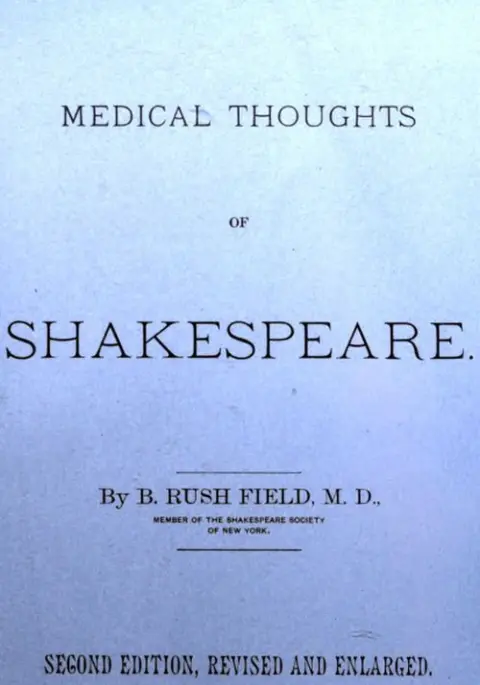
THE CLASSIC COLLECTION · 1884
"Medical Thoughts of Shakespeare" by Benjamin Rush Field is a scholarly publication written in the late 19th century. The work explores the intersection of medicine and the literary genius of Shakespeare, analyzing various medical references and characters within his plays. It aims to highlight Shakespeare's understanding of medical practices and terminology through various citations from his works, providing insights into the medical knowledge of his time. At the start of the text, the author introduces the revised second edition, noting the expansion of content and the addition of new topics related to medicine, surgery, and pharmacology. The opening includes a preface that acknowledges the book's reception and outlines the chapters to follow, suggesting an organized analytical approach. Field begins discussing Shakespeare's portrayal of physicians in his plays and quotes lines showcasing the playwright’s grasp of medical concepts, setting the stage for a detailed investigation into Shakespeare’s medical insights throughout the ensuing chapters.
Introduction adapted from the source catalogue; source summaries may be automatically generated.
Free to read · English · 25,133 words · No account needed
MAKE TIME FOR A GOOD BOOK
On by default. Untick to stop anonymous reading totals. Each page counts after 10 seconds in view. How this works.
Anonymous counting is on unless you have switched it off.
Shakespeare paid much more attention to the practice of medicine and obstetrics than to surgery. Perhaps the cause of this was that at that time surgery had not reached its present perfection. A more probable reason is that his son-in-law, Dr. John Hall, may not have been a surgeon.
Iago. What, are you hurt, lieutenant?
Cas. Ay, past all surgery.
Othello, Act II., Sc. III.
Can honour set a leg? No. Or an arm? No. Or take away the grief of a wound? No. Honour hath no skill in surgery then? No. Henry IV., Act V., Sc. I.
With the help of a surgeon he might yet recover. Midsummer Night’s Dream, Act V., Sc. I.
Let me have surgeons;
I am cut to the brains.
King Lear, Act IV., Sc. VI.
The king himself hath a heavy reckoning to make when all those legs, and arms, and heads, chopped off in a battle, shall join together at the latter day, and cry all——We died at such a place; some swearing, some crying for a surgeon, some, upon their wives left poor behind them. Henry V., Act IV., Sc. I.
Patr. Who keeps the tent now? Ther. The surgeon’s box, or the patient’s wound. Troilus and Cressida, Act V., Sc. 1.
Give physic to the sick, ease to the pain’d: The poor, lame, blind, halt, creep, cry out for thee. Lucrece.
What opposite discoveries we have seen! (Signs of true genius, and of empty pockets;) One makes new noses, one a guillotine, One breaks your bones, one sets them in their sockets. Byron—Don Juan, Canto I., Verse CXXIX.
The lawyer’s brief is like the surgeon’s knife Dissecting the whole inside of a question, And with it all the process of digestion. Byron—Don Juan, Canto X., Verse XIV.
All feel the ill, yet shun the cure. Can sense this paradox endure? Swift.
Syphilis is frequently referred to, and he represents several of his characters as having it; among them Falstaff and Dame Quickly.
Lysimachus to keeper of a bawdy house: Have you that a man may deal withal and defy the surgeon? Pericles, Act IV., Sc. VI.
You help to make the diseases, Doll: We catch of you, Doll, we catch of you. Henry IV—2d, Act II., Sc. IV.
Boult. Do you know the French knight that cowers i’ the hams? * * * Bawd. As for him he brought his disease hither. Pericles, Act IV., Sc. II.
Doth fortune play the huswife with me now? News have I, that my Nell is dead i’ the spital Of malady of France. Henry V., Act V., Sc. I.
Your reading position is saved on this browser. Take it to another device with a library code. Reading pages adapt to text, rather than matching a printed edition.
BEHIND THE BOOK
This eBook is for the use of anyone anywhere in the United States and most other parts of the world at no cost and with almost no restrictions whatsoever. You may copy it, give it away or re-use it under the terms of the Project Gutenberg License included with this eBook or online at www.gutenberg.org. If you are not located in the United States, you will have to check the laws of the country where you are located before using this eBook. Read the source licence.
The original source file, including credits and licence, is retained by this library. Request an original-format copy at no charge. Please include the book title and Project Gutenberg identifier #61366.
KEEP YOUR CURIOSITY GOING
Cécile Tormay

Moritz Busch
John L. Ransom
Frances Wright
Cécile Tormay

Mabel Potter Daggett