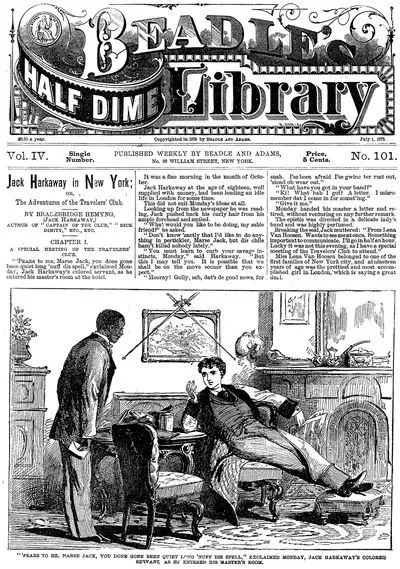
Jack Harkaway in New York; or, The Adventures of the Travelers’ Club
Bracebridge Hemyng
THE CLASSIC COLLECTION · 1900
"Jack Harkaway's Boy Tinker Among The Turks" by Bracebridge Hemyng is a fictional novel written in the late 19th century. The story follows young Jack Harkaway and his companion, the orphan Mr. Figgins, as they navigate various adventures and moral lessons during their travels in Turkey. The narrative is characterized by Jack's daring personality and wit, along with the humorous predicaments that arise as they encounter local customs and people. The opening portion of the book sets the stage for Jack Harkaway's escapades, beginning with a confrontation involving the ship's captain regarding their previous adventures. Jack’s boldness leads him to reflect on his actions and make amends, which introduces themes of bravery and moral growth. The scene also hints at the cultural peculiarities they will encounter, especially with Mr. Figgins expressing fears about Turkish customs, particularly regarding matrimony. The chapter ends with hints of impending visitors, creating anticipation for further encounters that will challenge the characters in both humorous and serious ways.
Introduction adapted from the source catalogue; source summaries may be automatically generated.
Free to read · English · 83,525 words · No account needed
MAKE TIME FOR A GOOD BOOK
On by default. Untick to stop anonymous reading totals. Each page counts after 10 seconds in view. How this works.
Anonymous counting is on unless you have switched it off.
The unfortunate Isaac Mole was now reduced to a position unprecedented even in his varied career.
He was placed in the "deepest dungeon" of the old castle, which was used as the town gaol, in a cold stone cell all to himself, and a couple of fierce-looking bashi-bazouks to watch him.
Bread and water--both of the stalest--constituted poor Mole's only fare, and his lodging was literally "on the cold, cold ground."
The constant fear of a terrible doom haunted him.
It was the third night of his incarceration, and about the middle of the night Mole was kept awake by his own depressing thoughts, together with the gambols of the rats that infested the dungeon.
Suddenly the deadly stillness was broken by a sound outside, which much
agitated him.
"Ha, what sound is that?" cried Mole; "yes, oh, joy, it is the sound of
a flute."
Could he mistake that note?
Who could make such melancholy strains but the desolate orphan--the
melodious Figgins?
Had Figgins, forgetting all past differences and animosities, come to soothe Mole's captivity, in this manner, or--horrible thought!--was it a strain of malice or revengeful triumph that emanated from the long-suffering and tortured instrument.
But the flute did not long continue playing, and Mole conjectured that it was only a signal to which he was expected to respond.
He had no mode whatever of doing so, excepting a melancholy whistle, which, however, served its purpose.
Through the bars of the prison, which were far too high up for him to reach, a small object suddenly came crashing, and very narrowly did it escape falling upon the prisoner's nose.
Reaching out his hand in the dark, Mr. Mole picked it up, and found it to be a stone wrapped in paper.
He knew at once that it must be a written message from his friends outside, and again he whistled as a signal that he had received it.
A few triumphant notes on the flute responded to this, and then all was
silent again.
How impatient Mole was for daylight, that he might read the letter.
But it was many hours to that yet, and sleep he found impossible.
At length, a faint streak came through the bars of the gloomy dungeon.
Mole, with some difficulty, dragged himself under this light, straightened out the paper, and read thus--
Your reading position is saved on this browser. Take it to another device with a library code. Reading pages adapt to text, rather than matching a printed edition.
BEHIND THE BOOK
This eBook is for the use of anyone anywhere in the United States and most other parts of the world at no cost and with almost no restrictions whatsoever. You may copy it, give it away or re-use it under the terms of the Project Gutenberg License included with this eBook or online at www.gutenberg.org. If you are not located in the United States, you will have to check the laws of the country where you are located before using this eBook. Read the source licence.
The original source file, including credits and licence, is retained by this library. Request an original-format copy at no charge. Please include the book title and Project Gutenberg identifier #20320.
KEEP YOUR CURIOSITY GOING
Coulson Kernahan

Maurice Baring
Frances Wright
Cécile Tormay

Frederic Jesup Stimson

W. H. P. (William Henry Pope) Jarvis