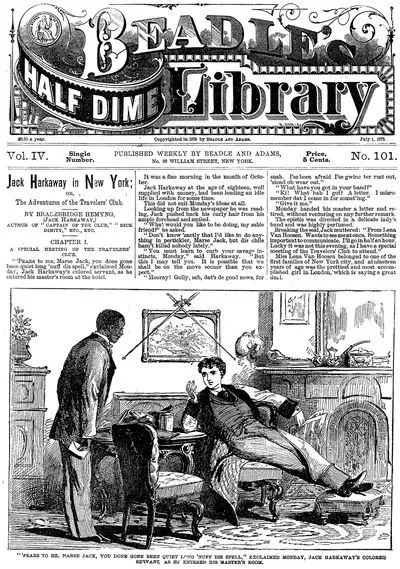
Jack Harkaway in New York; or, The Adventures of the Travelers’ Club
Bracebridge Hemyng
THE CLASSIC COLLECTION · 1900
"Jack Harkaway's Boy Tinker Among The Turks" by Bracebridge Hemyng is a fictional novel written in the late 19th century. The story follows young Jack Harkaway and his companion, the orphan Mr. Figgins, as they navigate various adventures and moral lessons during their travels in Turkey. The narrative is characterized by Jack's daring personality and wit, along with the humorous predicaments that arise as they encounter local customs and people. The opening portion of the book sets the stage for Jack Harkaway's escapades, beginning with a confrontation involving the ship's captain regarding their previous adventures. Jack’s boldness leads him to reflect on his actions and make amends, which introduces themes of bravery and moral growth. The scene also hints at the cultural peculiarities they will encounter, especially with Mr. Figgins expressing fears about Turkish customs, particularly regarding matrimony. The chapter ends with hints of impending visitors, creating anticipation for further encounters that will challenge the characters in both humorous and serious ways.
Introduction adapted from the source catalogue; source summaries may be automatically generated.
Free to read · English · 83,525 words · No account needed
MAKE TIME FOR A GOOD BOOK
On by default. Untick to stop anonymous reading totals. Each page counts after 10 seconds in view. How this works.
Anonymous counting is on unless you have switched it off.
"ISAAC MOLE, ESQUIRE,--You are not forgotten by your friends, who much lament your misfortune. We very narrowly escaped being caught and served in the same way. We have, through Captain Deering, got hold of the British consul, to whom we have represented the affair to be only a practical joke, not deserving of a severe punishment. So we hope to get you off with a fine, which we will undertake to pay, whatever it may be. Therefore, keep up your pecker, old man, and believe us to be
"Yours, truly as ever,
"Cool, after the way they've served me," was the tutor's mental comment upon this message; "but the question is, Can the British consul, or any other man, get me out of the clutches of these ferocious Turks?"
The next night, Mole was able to sleep.
But his sleep was suddenly and fearfully interrupted.
An awful and confused noise, shouting outside, flashing lights through the bars, the clash of arms and the hurried tramp of men, indicated that the prison was the scene of some warlike commotion.
Mole started up in a state of great alarm, and struggled towards the
door of his cell.
"Oh, dear, oh, dear!" cried poor Mole, "this is dreadful. Oh, if I was only a boy again. I would stick to Old England, and never leave it. There, they are at it again. Oh, dear, why did I leave Mrs. Mole?"
The noise was as if there were a mutiny or outbreak of some kind.
Nearer and nearer came the sound of footsteps, louder and louder sounded the clashing of arms, and the clanking of chains.
A shout of triumph sounded just outside his cell door, and amidst a volley of interjections in Turkish and Arabic, he fancied he could hear English shouts of--
"Hurrah! boys, we shall do it. Open every one of the doors, and set
them all free."
Two heavy bolts were shot back outside, the heavy key was turned in the lock, Mole's cell door was opened, and in a burst of torch-light entered groups of armed Bedouin Arabs.
Mole shrank back in a corner.
These ferocious Moslems had doubtless come to murder him in hot blood.
In reality their object was quite different.
The event that had happened was not an outbreak within the walls of the garrison, but an inbreak of those whose purpose was to rescue the captives.
Jack and Harry had the day before put up at the encampment of some friendly Arabs, who became more friendly still when they found their guests liberal in respect of coinage.
Your reading position is saved on this browser. Take it to another device with a library code. Reading pages adapt to text, rather than matching a printed edition.
BEHIND THE BOOK
This eBook is for the use of anyone anywhere in the United States and most other parts of the world at no cost and with almost no restrictions whatsoever. You may copy it, give it away or re-use it under the terms of the Project Gutenberg License included with this eBook or online at www.gutenberg.org. If you are not located in the United States, you will have to check the laws of the country where you are located before using this eBook. Read the source licence.
The original source file, including credits and licence, is retained by this library. Request an original-format copy at no charge. Please include the book title and Project Gutenberg identifier #20320.
KEEP YOUR CURIOSITY GOING
Coulson Kernahan

Maurice Baring
Frances Wright
Cécile Tormay

Frederic Jesup Stimson

W. H. P. (William Henry Pope) Jarvis