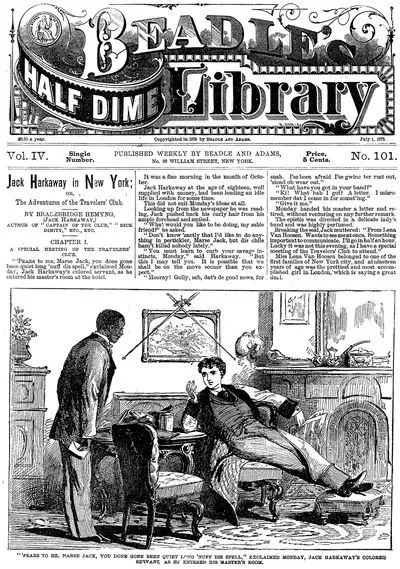
Jack Harkaway in New York; or, The Adventures of the Travelers’ Club
Bracebridge Hemyng
THE CLASSIC COLLECTION · 1900
"Jack Harkaway's Boy Tinker Among The Turks" by Bracebridge Hemyng is a fictional novel written in the late 19th century. The story follows young Jack Harkaway and his companion, the orphan Mr. Figgins, as they navigate various adventures and moral lessons during their travels in Turkey. The narrative is characterized by Jack's daring personality and wit, along with the humorous predicaments that arise as they encounter local customs and people. The opening portion of the book sets the stage for Jack Harkaway's escapades, beginning with a confrontation involving the ship's captain regarding their previous adventures. Jack’s boldness leads him to reflect on his actions and make amends, which introduces themes of bravery and moral growth. The scene also hints at the cultural peculiarities they will encounter, especially with Mr. Figgins expressing fears about Turkish customs, particularly regarding matrimony. The chapter ends with hints of impending visitors, creating anticipation for further encounters that will challenge the characters in both humorous and serious ways.
Introduction adapted from the source catalogue; source summaries may be automatically generated.
Free to read · English · 83,525 words · No account needed
MAKE TIME FOR A GOOD BOOK
On by default. Untick to stop anonymous reading totals. Each page counts after 10 seconds in view. How this works.
Anonymous counting is on unless you have switched it off.
OUR FRIENDS IN DURANCE VILE--A STROKE FOR LIBERTY--THE PRISONERS' PLOT--MOLE IS PRESCRIBED FOR--A FRIEND IN NEED--HOPES AND MISGIVINGS--"OLD WET BLANKET."
"It's very odd."
"Very."
"And scarcely polite," suggested Mr. Mole.
"Well, scarcely."
"That makes the fourth letter I have written to him, and he doesn't even condescend to notice them."
"Very odd."
"Very."
But while all the sufferers by the seeming neglect of the consul were expressing themselves so freely in the matter, old Sobersides, as Jack called his comrade, Harry Girdwood, remained silent and meditative.
Jack had great faith in his thoughtful chum.
"A penny for your thoughts, Harry," said he.
"I'll give them for nix," returned Harry Girdwood, gaily.
"Out with it."
"I was wondering whether, while you are all blaming the poor consul, he has ever received your letters."
"What, the four?"
"Yes."
"Of course."
"I don't see it."
"But, my dear fellow, consider. One may have miscarried--or two--but hang it! all four can't have gone wrong."
"Of course not," said Mole, with the air of a man who puts a final stop
to all arguments.
"There I beg leave to differ with you all."
"Why?"
"The letters have not reached the consul, perhaps; they may have been
intercepted."
"By whom?" was Jack's natural question.
"Can't say positively; possibly by Murray."
"Is it likely?"
"Is it not?"
"I don't see, unless he bought over the messenger."
"And what is more likely than that?" said Harry. "And if they have bought over one messenger, it is for good and all, not for a single letter, but for every scrap of paper you may send out of the prison, you may depend upon it."
This simple reasoning struck his hearers.
"Upon my life!" exclaimed Jack, "I believe Harry's right. We must
tackle the governor."
"So I think."
"And I too," added Harry Girdwood; "but how?"
"I'll write him a letter."
"Yes; and send it to him by the gaoler," said Harry.
"Yes."
"The gaoler who carried all the other letters? Why, Jack, Jack, what a thoughtless, rattlebrained chap you are. What on earth is the use of such a move as that?"
Jack's countenance fell again at this.
"You're right, Harry. I go jumping like a bull at a gate as usual. What
would you do?"
Harry's answer was brief and sententious.
"Think."
"Do so, mate," returned Jack, hopefully again; "do so."
"I will."
He pressed his lips and knit his brows with a burlesque, melodramatic air, and strode up and down, with his forefinger to his forehead.
Your reading position is saved on this browser. Take it to another device with a library code. Reading pages adapt to text, rather than matching a printed edition.
BEHIND THE BOOK
This eBook is for the use of anyone anywhere in the United States and most other parts of the world at no cost and with almost no restrictions whatsoever. You may copy it, give it away or re-use it under the terms of the Project Gutenberg License included with this eBook or online at www.gutenberg.org. If you are not located in the United States, you will have to check the laws of the country where you are located before using this eBook. Read the source licence.
The original source file, including credits and licence, is retained by this library. Request an original-format copy at no charge. Please include the book title and Project Gutenberg identifier #20320.
KEEP YOUR CURIOSITY GOING
Coulson Kernahan

Maurice Baring
Frances Wright
Cécile Tormay

Frederic Jesup Stimson

W. H. P. (William Henry Pope) Jarvis