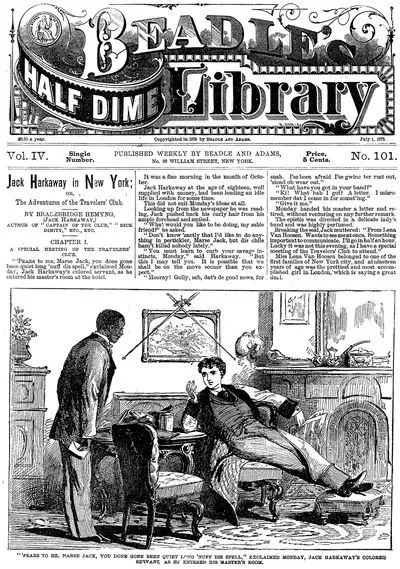
Jack Harkaway in New York; or, The Adventures of the Travelers’ Club
Bracebridge Hemyng
THE CLASSIC COLLECTION · 1900
"Jack Harkaway's Boy Tinker Among The Turks" by Bracebridge Hemyng is a fictional novel written in the late 19th century. The story follows young Jack Harkaway and his companion, the orphan Mr. Figgins, as they navigate various adventures and moral lessons during their travels in Turkey. The narrative is characterized by Jack's daring personality and wit, along with the humorous predicaments that arise as they encounter local customs and people. The opening portion of the book sets the stage for Jack Harkaway's escapades, beginning with a confrontation involving the ship's captain regarding their previous adventures. Jack’s boldness leads him to reflect on his actions and make amends, which introduces themes of bravery and moral growth. The scene also hints at the cultural peculiarities they will encounter, especially with Mr. Figgins expressing fears about Turkish customs, particularly regarding matrimony. The chapter ends with hints of impending visitors, creating anticipation for further encounters that will challenge the characters in both humorous and serious ways.
Introduction adapted from the source catalogue; source summaries may be automatically generated.
Free to read · English · 83,525 words · No account needed
MAKE TIME FOR A GOOD BOOK
On by default. Untick to stop anonymous reading totals. Each page counts after 10 seconds in view. How this works.
Anonymous counting is on unless you have switched it off.
Thyra was securely protected by these gallant tars until the rest of the party came up, which was not long, for after a slight skirmish, Jack and his friends managed to cut through the new force of opposing Turks, and make their way towards the ship.
Ibrahim Pasha, enraged at being thus defied, still pressed on, followed by all his force, but they only arrived at the shore in time to see Jack and the others embarking in the boats.
He now had recourse to threats.
"In the name of His Imperial Majesty the Sultan," he said to the officer in command, "I command you to give up to me these Englishmen, who have escaped from justice."
"They are British subjects," returned the officer, "who have sought the protection of their flag."
"Shall British subjects commit crime and yet go free?" inquired
Ibrahim.
"What crime have they committed?" asked the officer.
"Murder--the assassination of his highness, Moley Pasha."
"What evidence have you to show to connect them with his death?" asked the officer. "If you have but sufficient evidence, they shall be tried before a proper tribunal. Where the English flag floats, justice shall be done to all."
The pasha bit his lip.
He knew that his evidence against these Englishmen was very slight, being in fact only the assertion of Murray and Chivey, and that any mistake on his part would bring on political trouble that might be his ruin, so he began to draw in.
"At least," he said, "you can not refuse to give me back my own property, stolen from my palace."
"That's a reasonable request enough," answered the lieutenant. "Point out your property, and you shall have it."
"There it is," exclaimed Ibrahim, as he pointed to Thyra.
"That your property, eh?" said the astonished officer. "Well, a very nice property too. But how was she stolen?"
"Stolen from my harem by that son of Eblis!" cried the old pasha,
pointing to Jack.
"Ah, young man, I see how it is," said the officer, gravely shaking his head; "you've been going it rather too fast, and brought on this trouble all on account of this Greek girl."
"It's a lie," cried Jack, looking fiercely at the pasha; "she never was stolen, and never did belong to that old coffee-coloured villain, and what's more, never shall, if Britons can protect her. She fled of her own accord from the palace of Moley Pasha, before he arrived, and sought protection from me and my friends in the town."
"In that case," said the officer, "we cannot give her up, for the British government does not recognise slavery, domestic or otherwise. Under our flag she is free."
Your reading position is saved on this browser. Take it to another device with a library code. Reading pages adapt to text, rather than matching a printed edition.
BEHIND THE BOOK
This eBook is for the use of anyone anywhere in the United States and most other parts of the world at no cost and with almost no restrictions whatsoever. You may copy it, give it away or re-use it under the terms of the Project Gutenberg License included with this eBook or online at www.gutenberg.org. If you are not located in the United States, you will have to check the laws of the country where you are located before using this eBook. Read the source licence.
The original source file, including credits and licence, is retained by this library. Request an original-format copy at no charge. Please include the book title and Project Gutenberg identifier #20320.
KEEP YOUR CURIOSITY GOING
Coulson Kernahan

Maurice Baring
Frances Wright
Cécile Tormay

Frederic Jesup Stimson

W. H. P. (William Henry Pope) Jarvis