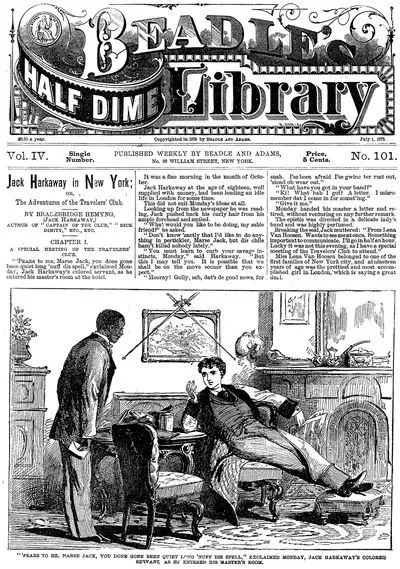
Jack Harkaway in New York; or, The Adventures of the Travelers’ Club
Bracebridge Hemyng
THE CLASSIC COLLECTION · 1900
"Jack Harkaway's Boy Tinker Among The Turks" by Bracebridge Hemyng is a fictional novel written in the late 19th century. The story follows young Jack Harkaway and his companion, the orphan Mr. Figgins, as they navigate various adventures and moral lessons during their travels in Turkey. The narrative is characterized by Jack's daring personality and wit, along with the humorous predicaments that arise as they encounter local customs and people. The opening portion of the book sets the stage for Jack Harkaway's escapades, beginning with a confrontation involving the ship's captain regarding their previous adventures. Jack’s boldness leads him to reflect on his actions and make amends, which introduces themes of bravery and moral growth. The scene also hints at the cultural peculiarities they will encounter, especially with Mr. Figgins expressing fears about Turkish customs, particularly regarding matrimony. The chapter ends with hints of impending visitors, creating anticipation for further encounters that will challenge the characters in both humorous and serious ways.
Introduction adapted from the source catalogue; source summaries may be automatically generated.
Free to read · English · 83,525 words · No account needed
MAKE TIME FOR A GOOD BOOK
On by default. Untick to stop anonymous reading totals. Each page counts after 10 seconds in view. How this works.
Anonymous counting is on unless you have switched it off.
"It will be taken as a grave insult to go ashore without paying your respects to his excellency."
"I can't help that," returned the orphan, resolutely; "I won't visit
him."
"Mr. Figgins," said Jack, in a voice of deep solemnity, "these Turks are cruel, vindictive, and revengeful. The last Englishman who refused was, by order of the pasha, skinned alive, placed on the sunny side of a wall, and blown to death by flies."
"Surely the Turks are not such barbarians," said Mr. Figgins.
"You'll find they are. They'd think no more of polishing you off than
of killing a fly."
If that rascal Jack intended to make poor Mr. Figgins uneasy, he
certainly succeeded very well.
Mr. Figgins looked supremely miserable.
"Good night, Mr. Figgins. Think it over."
"I tell you I----"
"Never mind, don't decide too rashly. Pleasant dreams."
"Pleasant dreams," said the orphan. "I shall have the nightmare."
The orphan's pillow was haunted that night by visions of a terrible
nature.
He fancied himself in the presence of a turbaned Turk, a powerful pasha, who was sitting cross-legged on an ottoman, smoking a pipe, of endless length, and holding in his hand a drawn sword--a scimitar that looked ready to chop his head off.
Beside this terrible Turk stood five ladies, in baggy trousers, and
long veils.
No words were spoken, but instinctively the orphan knew that he had to decide between the scimitar and the quintet of wives--wall-flowers of the pasha's harem.
Silently, in mute horror, the orphan was about to submit to the least of the two evils, and choose a wife.
Then he awoke suddenly.
What an immense relief it was to find it only a dream after all.
"I don't quite believe that young Harkaway," said the orphan, dubiously; "he is such a dreadful practical joker. But I won't go on shore, nevertheless. It's not very interesting to see these savages, after all; they really are nothing more than savages."
And after a long and tedious time spent in endeavouring to get to sleep
again, he dropped off.
But only to dream again about getting very much married.
He slept far into the morning, for his dreams had disturbed him much,
and he was tired out.
When he awoke, there was someone knocking at his cabin door.
"Come in."
"It's only me, Mr. Figgins," said a familiar voice.
"Come in, captain."
Captain Deering entered.
"Not up yet, Mr. Figgins?" he said, in surprise. "We've got visitors
aboard already."
"Dear me."
"Distinguished visitors. The pasha and his suite."
"You don't say so?" exclaimed the orphan, sitting up.
Your reading position is saved on this browser. Take it to another device with a library code. Reading pages adapt to text, rather than matching a printed edition.
BEHIND THE BOOK
This eBook is for the use of anyone anywhere in the United States and most other parts of the world at no cost and with almost no restrictions whatsoever. You may copy it, give it away or re-use it under the terms of the Project Gutenberg License included with this eBook or online at www.gutenberg.org. If you are not located in the United States, you will have to check the laws of the country where you are located before using this eBook. Read the source licence.
The original source file, including credits and licence, is retained by this library. Request an original-format copy at no charge. Please include the book title and Project Gutenberg identifier #20320.
KEEP YOUR CURIOSITY GOING
Coulson Kernahan

Maurice Baring
Frances Wright
Cécile Tormay

Frederic Jesup Stimson

W. H. P. (William Henry Pope) Jarvis