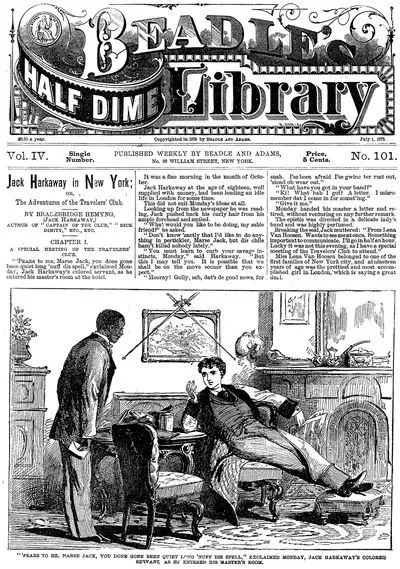
Jack Harkaway in New York; or, The Adventures of the Travelers’ Club
Bracebridge Hemyng
THE CLASSIC COLLECTION · 1900
"Jack Harkaway's Boy Tinker Among The Turks" by Bracebridge Hemyng is a fictional novel written in the late 19th century. The story follows young Jack Harkaway and his companion, the orphan Mr. Figgins, as they navigate various adventures and moral lessons during their travels in Turkey. The narrative is characterized by Jack's daring personality and wit, along with the humorous predicaments that arise as they encounter local customs and people. The opening portion of the book sets the stage for Jack Harkaway's escapades, beginning with a confrontation involving the ship's captain regarding their previous adventures. Jack’s boldness leads him to reflect on his actions and make amends, which introduces themes of bravery and moral growth. The scene also hints at the cultural peculiarities they will encounter, especially with Mr. Figgins expressing fears about Turkish customs, particularly regarding matrimony. The chapter ends with hints of impending visitors, creating anticipation for further encounters that will challenge the characters in both humorous and serious ways.
Introduction adapted from the source catalogue; source summaries may be automatically generated.
Free to read · English · 83,525 words · No account needed
MAKE TIME FOR A GOOD BOOK
On by default. Untick to stop anonymous reading totals. Each page counts after 10 seconds in view. How this works.
Anonymous counting is on unless you have switched it off.
"That's not the question, Mr. Figgins. You could refuse. It would cost you your life for a certainty."
The orphan nearly rolled off his cushion.
"What!"
"Fact, I assure you," said Jack, gravely.
"Explain."
"You will be expected to pay a visit of state to the pasha."
"Yes."
"That is the greatest honour on landing for a stranger."
"What is a pasha?"
"The governor of the province, a regular Bung."
"Well."
"Bluebeard was a pasha, you remember."
"No, no," interrupted the orphan, delighted to show his historical accuracy. "Bluebeard was a bashaw."
"It is the same thing, another way of writing or pronouncing the identical same dignity or rank. Well, you know that polygamy is the pet vice of the followers of Islam."
"Oh, it's dreadful, Jack."
"The greater the man, the greater the polygamist. A pasha has as many wives as he can keep, and more too. The pasha of this province is not rich for his rank, and for his matrimonial proclivities."
"Lor'!"
"How many wives should you suppose he has?" asked Jack, with an air of
deep gravity.
"Don't know," replied the orphan, quietly.
"Ninety-eight living."
Mr. Figgins jumped up and dropped his chibouk.
"Never."
"A fact," asserted Jack, with gravity.
"Why, the man must be a regular Bluebeard."
"You've hit it, sir," responded Jack; "that's the sort of man he is."
"Well, that is all very well for the Turks and for these old sinners the pashas, but I am an Englishman."
"This is the way it will most likely be done," continued Jack. "On your presentation to his excellency the pasha, you are expected to make some present. The pasha makes a return visit of ceremony, and leaves behind him some solid evidence of his liberality."
"Well?"
"Well, but the very highest compliment that a pasha can pay you is to leave you one of his wives. He generally makes it an old stock-keeper, something that has been a good thirty years or so in the seraglio."
Mr. Figgins took the liveliest interest in this narrative.
He was growing rapidly convinced of the truth of Jack's descriptions of these singular manners and customs of the country in which they were.
Yet he eyed Jack as one who has a lingering doubt.
"Ahem!" said Mr. Figgins, "I don't think that I shall join you on your visit ashore in the morning."
"We'll see in the morning," said Jack; "it's a pity to put off your trip for the sake of such a trifling danger as that of having a wife or so given to you."
"It's no use," said Mr. Figgins, "my mind is fully made up; I shall not
visit the pasha."
Your reading position is saved on this browser. Take it to another device with a library code. Reading pages adapt to text, rather than matching a printed edition.
BEHIND THE BOOK
This eBook is for the use of anyone anywhere in the United States and most other parts of the world at no cost and with almost no restrictions whatsoever. You may copy it, give it away or re-use it under the terms of the Project Gutenberg License included with this eBook or online at www.gutenberg.org. If you are not located in the United States, you will have to check the laws of the country where you are located before using this eBook. Read the source licence.
The original source file, including credits and licence, is retained by this library. Request an original-format copy at no charge. Please include the book title and Project Gutenberg identifier #20320.
KEEP YOUR CURIOSITY GOING
Coulson Kernahan

Maurice Baring
Frances Wright
Cécile Tormay

Frederic Jesup Stimson

W. H. P. (William Henry Pope) Jarvis