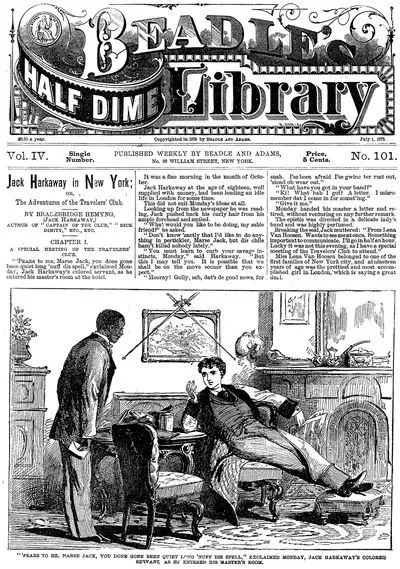
Jack Harkaway in New York; or, The Adventures of the Travelers’ Club
Bracebridge Hemyng
THE CLASSIC COLLECTION · 1900
"Jack Harkaway's Boy Tinker Among The Turks" by Bracebridge Hemyng is a fictional novel written in the late 19th century. The story follows young Jack Harkaway and his companion, the orphan Mr. Figgins, as they navigate various adventures and moral lessons during their travels in Turkey. The narrative is characterized by Jack's daring personality and wit, along with the humorous predicaments that arise as they encounter local customs and people. The opening portion of the book sets the stage for Jack Harkaway's escapades, beginning with a confrontation involving the ship's captain regarding their previous adventures. Jack’s boldness leads him to reflect on his actions and make amends, which introduces themes of bravery and moral growth. The scene also hints at the cultural peculiarities they will encounter, especially with Mr. Figgins expressing fears about Turkish customs, particularly regarding matrimony. The chapter ends with hints of impending visitors, creating anticipation for further encounters that will challenge the characters in both humorous and serious ways.
Introduction adapted from the source catalogue; source summaries may be automatically generated.
Free to read · English · 83,525 words · No account needed
MAKE TIME FOR A GOOD BOOK
On by default. Untick to stop anonymous reading totals. Each page counts after 10 seconds in view. How this works.
Anonymous counting is on unless you have switched it off.
Age preyed on his shaken body, and at length laid him on his deathbed.
Even then he could not help referring to the matrimonial portion of his
life.
"I have been too much married, Jack. I am 'a wictim to connubiality,' if I may be allowed to quote Sam Weller; but never again, dear boy."
And when only half conscious, he would repeat--"Never again, dear boy," expressing his firm determination not to marry again.
Poor Mole!
After all, he ended his days in peace, and died regretted by all his friends, who, if they had laughed at his failings, also remembered his kindly disposition.
He left behind him sufficient of this world's goods to enable his faithful Chloe to give the twins a good education.
They are now rollicking schoolboys, but will have a fair start when their guardians, Jack and Harry, fancy they are fitted to begin their battle with life.
Old Jack--he is getting old now--lives with Emily not far from his son, and with them, of course, is Dick Harvey.
Often on a fine day Old Jack will lead his grandchildren to the village churchyard, and while the youngsters deck poor old Mole's grave with flowers, will relate to them the best incidents of the old man's life.
Not far from poor Mole's grave is another tomb, in which rest the earthly remains of Monday, Prince of Limbi, who had grown grey in the service of Mr. Harkaway.
A much severer winter than usual laid the seeds of a complaint which
speedily carried him off.
Sunday, whose head is fast becoming white as snow, took his death much to heart, and even now frequently strolls into the quiet churchyard to indulge in pensive recollections of his old friend by the side of his grave--aye, and perchance to reflect on his own end, which he knows full well must be fast approaching.
Monday had been thrifty, and when the days of mourning were over, his widow retired to Oxford to pass the remainder of her days with many good presents from Jack Harkaway, given in remembrance of his faithful servant Monday, the Prince of Limbi.
Readers, our tale is told; and we leave Harkaway to the repose he has
so well earned.
But if you would prosper as he has done, be like him, truthful, brave,
and generous.
In bringing to a conclusion the long series of Harkaway stories, Mr. Edwin J. Brett cannot let the occasion pass without thanking the readers for the patience with which they have followed the hero's career, and the praise they have always bestowed upon the story or stories.
Your reading position is saved on this browser. Take it to another device with a library code. Reading pages adapt to text, rather than matching a printed edition.
BEHIND THE BOOK
This eBook is for the use of anyone anywhere in the United States and most other parts of the world at no cost and with almost no restrictions whatsoever. You may copy it, give it away or re-use it under the terms of the Project Gutenberg License included with this eBook or online at www.gutenberg.org. If you are not located in the United States, you will have to check the laws of the country where you are located before using this eBook. Read the source licence.
The original source file, including credits and licence, is retained by this library. Request an original-format copy at no charge. Please include the book title and Project Gutenberg identifier #20320.
KEEP YOUR CURIOSITY GOING
Coulson Kernahan

Maurice Baring
Frances Wright
Cécile Tormay

Frederic Jesup Stimson

W. H. P. (William Henry Pope) Jarvis