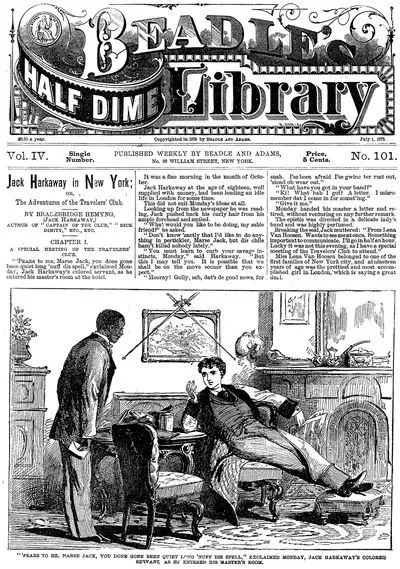
Jack Harkaway in New York; or, The Adventures of the Travelers’ Club
Bracebridge Hemyng
THE CLASSIC COLLECTION · 1900
"Jack Harkaway's Boy Tinker Among The Turks" by Bracebridge Hemyng is a fictional novel written in the late 19th century. The story follows young Jack Harkaway and his companion, the orphan Mr. Figgins, as they navigate various adventures and moral lessons during their travels in Turkey. The narrative is characterized by Jack's daring personality and wit, along with the humorous predicaments that arise as they encounter local customs and people. The opening portion of the book sets the stage for Jack Harkaway's escapades, beginning with a confrontation involving the ship's captain regarding their previous adventures. Jack’s boldness leads him to reflect on his actions and make amends, which introduces themes of bravery and moral growth. The scene also hints at the cultural peculiarities they will encounter, especially with Mr. Figgins expressing fears about Turkish customs, particularly regarding matrimony. The chapter ends with hints of impending visitors, creating anticipation for further encounters that will challenge the characters in both humorous and serious ways.
Introduction adapted from the source catalogue; source summaries may be automatically generated.
Free to read · English · 83,525 words · No account needed
MAKE TIME FOR A GOOD BOOK
On by default. Untick to stop anonymous reading totals. Each page counts after 10 seconds in view. How this works.
Anonymous counting is on unless you have switched it off.
Yet, in his retirement, his conscience pricked him for having left so hurriedly the friends who had rescued him from many a danger.
And Mole, too, his own particular travelling companion.
"I must go and see him once more," thought the orphan.
So one fine day he plucked up courage to venture a short journey on an English railway, and knowing where the elder Harkaway lived, was speedily instructed how to find Mole.
So now behold him shaking hands all round.
"I thought I must see you once more," said he, "but it is a great
undertaking, you know, for my travels made me more timid than ever I
was."
"Timid?" ejaculated Mole; "why, on one or two occasions you displayed bravery almost equal to my own."
"Mildly, Mr. Mole," said Jack.
"Ah, Mr. Harkaway, you three gentlemen are brave men, but I am only a
poor timid orphan."
"That need not make you timid."
"But it does. So I have resolved never to trust myself out of London
again."
"Then I am afraid we shall not meet very often, Mr. Figgins," said Mole, "for I, you know, hate town life."
"If you do come to town, though, you will call?"
"Certainly."
"Then, gentlemen, I will wish you farewell. I am deeply grateful for all you did when we were abroad----"
"Don't mention it."
"Mr. Mole, farewell. You know I feel more like an orphan than ever now
I am parting from you."
"Don't talk like that, Figgins," said Mole.
"I can't help it, indeed, I can't. Farewell, my dear friend, farewell!"
And Figgins retired to his City home, where he still lives, though he
is getting very feeble.
Still, he brightens up whenever he speaks of his old friend and
travelling companion, Mole.
It is hard to part with old friends, but the decrees of fate cannot be avoided, so we must conclude our story.
It will be hardly necessary, we fancy, to inform our readers that young Jack eventually married little Emily, and Harry Girdwood led Paquita to the altar.
And as weddings are very much alike, we will not describe the ceremony, but content ourselves with saying that as much happiness as this world can afford was and is theirs.
Jack and Harry have extensive farms near each other, and are wealthy
country gentlemen.
They are fond of outdoor sports, and have recently established a pack of harriers, Tinker and Bogey being respectively first and second whips. In each establishment there was formerly a room kept always ready for Mr. Mole, who went from one to the other as it pleased him, sure of a hearty welcome always.
But, alas! poor Mole is now no more.
Your reading position is saved on this browser. Take it to another device with a library code. Reading pages adapt to text, rather than matching a printed edition.
BEHIND THE BOOK
This eBook is for the use of anyone anywhere in the United States and most other parts of the world at no cost and with almost no restrictions whatsoever. You may copy it, give it away or re-use it under the terms of the Project Gutenberg License included with this eBook or online at www.gutenberg.org. If you are not located in the United States, you will have to check the laws of the country where you are located before using this eBook. Read the source licence.
The original source file, including credits and licence, is retained by this library. Request an original-format copy at no charge. Please include the book title and Project Gutenberg identifier #20320.
KEEP YOUR CURIOSITY GOING
Coulson Kernahan

Maurice Baring
Frances Wright
Cécile Tormay

Frederic Jesup Stimson

W. H. P. (William Henry Pope) Jarvis