
Last letters from the living dead man
David Patterson (Spirit) Hatch
THE CLASSIC COLLECTION · 1917
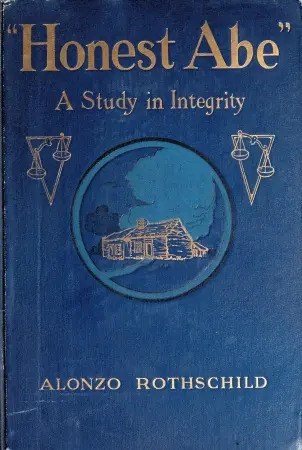
"Honest Abe: A Study in Integrity Based on the Early Life of Abraham Lincoln" by Alonzo Rothschild is a historical account written in the early 20th century. This work explores the formative years of Abraham Lincoln, focusing on his character, integrity, and the influence of his family background. It aims to shed light on how his early experiences shaped him into the emblematic figure of honesty and moral fortitude that he is celebrated as today. The opening of the book sets the foundation for a detailed exploration of Lincoln’s life, particularly emphasizing his inherent honesty and the hardships faced by his family during his upbringing. It describes the poverty Lincoln endured in his childhood and how the moral values instilled by his parents, especially his mother, played a crucial role in shaping his character. The narrative recounts anecdotes that highlight his early understanding of right and wrong and his unwavering commitment to truth, such as his willful efforts to settle debts and his conscientiousness in dealings with others. Throughout this introductory segment, Rothschild firmly establishes Lincoln's reputation as "Honest Abe," illustrating how his integrity was evident from a young age.
Introduction adapted from the source catalogue; source summaries may be automatically generated.
Free to read · English · 102,593 words · No account needed
MAKE TIME FOR A GOOD BOOK
On by default. Untick to stop anonymous reading totals. Each page counts after 10 seconds in view. How this works.
Anonymous counting is on unless you have switched it off.
[v-22] Nicolay and Hay, i, 158; Pratt, 52-53; Coffin, 125-27; Nicolay’s Boy’s Life, 59. Lincoln’s experience, it should be noted, in canvassing his district with a nominal outlay of money, was not uncommon. Gustav Koerner, running for the Illinois Legislature on the Democratic ticket, a few years later, did so under similar circumstances. “There were hardly,” he tells us, “any election expenses. We always stayed with friends when traveling through the county. We had our horses anyway. My entire electioneering expenses amounted to four dollars, and that for the printing of tickets. One Democratic Frenchman from the Bottom afterwards sent me a bill of $6.65 for which he said he had gratuitously treated for me. As he was a good fellow, I paid him, although I had not given him the slightest authority to do so.” (Koerner, i, 468-69.)
[v-23] See letter of Lincoln to Stuart, February 14, 1839, in Works,
xi, 98.
[v-24] Works, i, 6-7.
[v-25] This is exclusive of what was appropriated for the Illinois and Michigan Canal, then already in process of construction. That enterprise, the other improvement projects, and a few smaller public outlays carried the State debt, by the close of 1842, above $15,000,000.
[v-26] Works, i, 146.
[v-27] An Act to establish and maintain a General System of Internal Improvements. Approved February 27, 1837. Section 22, Illinois Session Laws, 1836-37.
[v-28] Works, i, 154-55; Lamon, 213-15.
[v-29] Gillespie, 24-25; Lamon, 216-17; Nicolay and Hay, i, 161-62; Davidson, 422-27; Herndon, i, 217; Morse, i, 60; Hapgood, 72-73. It may be of interest to note that Lincoln and his two colleagues were not the only acrobatic legislators revealed by our early local histories. General Lew Wallace, in his Autobiography (i, 251), tells, with contrition, how he bolted from the Indiana Senate to prevent an election of United States Senator; and Thaddeus Stevens, during his turbulent days in the Pennsylvania House of Representatives, jumped from a window after a scene of violence, in which, by a singular coincidence, he too had acted as the Whig leader.
[v-30] Lamon, 324; Browne, 237.
[v-31] Works, i, 27.
[v-32] Works, i, 135-37.
[v-33] Joshua F. Speed in Herndon, i, 161-63; Speed, 17-18; Speed, in Oldroyd, 143-45; Master, 50-52, 446.
[v-34] Holland, 97-98.
[v-35] Eulogy on Henry Clay, in Works, ii, 165.
[v-36] In the ballot for Speaker of the Illinois House of Representatives on December 3, 1838, William Lee D. Ewing received 43 votes, and Abraham Lincoln 38 votes. In a similar contest on November 24, 1840, Ewing received 46 votes, and Lincoln 36 votes.
[v-37] Browne’s Lincoln and Men, 185.
[v-38] White, 19-20.
[v-39] Joseph D. Roper, in Springfield (Ill.) Journal, January 30,
1909.
[v-40] Gibson W. Harris, in Woman’s Home Companion, December, 1903,
p. 15.
[v-41] Herndon, ii, 45.
[v-42] Works, i, 142-45.
Your reading position is saved on this browser. Take it to another device with a library code. Reading pages adapt to text, rather than matching a printed edition.
BEHIND THE BOOK
This eBook is for the use of anyone anywhere in the United States and most other parts of the world at no cost and with almost no restrictions whatsoever. You may copy it, give it away or re-use it under the terms of the Project Gutenberg License included with this eBook or online at www.gutenberg.org. If you are not located in the United States, you will have to check the laws of the country where you are located before using this eBook. Read the source licence.
The original source file, including credits and licence, is retained by this library. Request an original-format copy at no charge. Please include the book title and Project Gutenberg identifier #49679.
KEEP YOUR CURIOSITY GOING
David Patterson (Spirit) Hatch
Cécile Tormay

Moritz Busch
Coulson Kernahan
John L. Ransom

Ralph Waldo Emerson