
Last letters from the living dead man
David Patterson (Spirit) Hatch
THE CLASSIC COLLECTION · 1917
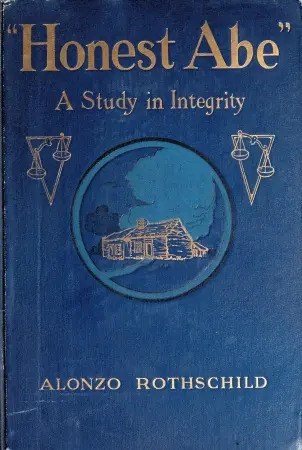
"Honest Abe: A Study in Integrity Based on the Early Life of Abraham Lincoln" by Alonzo Rothschild is a historical account written in the early 20th century. This work explores the formative years of Abraham Lincoln, focusing on his character, integrity, and the influence of his family background. It aims to shed light on how his early experiences shaped him into the emblematic figure of honesty and moral fortitude that he is celebrated as today. The opening of the book sets the foundation for a detailed exploration of Lincoln’s life, particularly emphasizing his inherent honesty and the hardships faced by his family during his upbringing. It describes the poverty Lincoln endured in his childhood and how the moral values instilled by his parents, especially his mother, played a crucial role in shaping his character. The narrative recounts anecdotes that highlight his early understanding of right and wrong and his unwavering commitment to truth, such as his willful efforts to settle debts and his conscientiousness in dealings with others. Throughout this introductory segment, Rothschild firmly establishes Lincoln's reputation as "Honest Abe," illustrating how his integrity was evident from a young age.
Introduction adapted from the source catalogue; source summaries may be automatically generated.
Free to read · English · 102,593 words · No account needed
MAKE TIME FOR A GOOD BOOK
On by default. Untick to stop anonymous reading totals. Each page counts after 10 seconds in view. How this works.
Anonymous counting is on unless you have switched it off.
[v-11] The practice of carrying documents in his hat became a habit with Lincoln. While at the bar in Springfield, long after the postmastership had become a memory, he explained his failure to answer a communication promptly, by writing: “When I received your letter I put it in my old hat, and buying a new one the next day, the old one was set aside, and so the letter was lost sight of for a time.” (See Tarbell, i, 98; and Tarbell’s Early Life, 179.)
[v-12] Lincoln was appointed Postmaster at New Salem on May 7, 1833. He served until May 30, 1836, by which time the population of the place had fallen off to such an extent that the office was discontinued, and its business transferred to Petersburg.
[v-13] Herndon, i, 111. See, also: Onstot, 249; Tarbell’s Early Life, 181; Tarbell, i, 99; Coffin, 81. Some currency having been given to an exaggerated and obviously erroneous report of the incident, Mr. Carpenter (110-12) repeated that version one day in the White House to Mr. Lincoln. The President thought they had “stretched the facts somewhat”; but his denial, such as it was, leaves the original story told by Simmons to Herndon, practically unimpeached.
[v-14] For a comprehensive note in which the local election returns of 1834 are collated, the reader is referred to Master, § 22, pp. 445-46.
[v-15] In a referendum of the question submitted to the people at the election of 1834, 7514 voters expressed a preference for Alton, 7148 for Vandalia, 7044 for Springfield, 744 for Illiopolis the geographical center, 486 for Peoria, and 272 for Jacksonville. When the final balloting took place in the General Assembly, twenty-nine places were voted upon. (See Parrish’s Illinois, 313.)
[v-16] Whitney, i, 139; Nicolay and Hay, i, 139.
[v-17] Details of these encounters are related in Master, 60-62.
[v-18] Lamon, 195; Herndon, i, 166.
[v-19] General T. H. Henderson, in Tarbell, i, 139.
[v-20] Whitney’s Life, i, 146.
[v-21] Statement of Coleman Smoot, in Lamon, 157. As Lincoln was thus supplied with sufficient means to defray his traveling expenses, the oft-repeated story, which depicts him as trudging, pack on back, over the road to Vandalia, may perhaps, with propriety, be assigned to a place among those pleasing traditions of history that are found, upon close scrutiny, to be more picturesque than plausible.
Your reading position is saved on this browser. Take it to another device with a library code. Reading pages adapt to text, rather than matching a printed edition.
BEHIND THE BOOK
This eBook is for the use of anyone anywhere in the United States and most other parts of the world at no cost and with almost no restrictions whatsoever. You may copy it, give it away or re-use it under the terms of the Project Gutenberg License included with this eBook or online at www.gutenberg.org. If you are not located in the United States, you will have to check the laws of the country where you are located before using this eBook. Read the source licence.
The original source file, including credits and licence, is retained by this library. Request an original-format copy at no charge. Please include the book title and Project Gutenberg identifier #49679.
KEEP YOUR CURIOSITY GOING
David Patterson (Spirit) Hatch
Cécile Tormay

Moritz Busch
Coulson Kernahan
John L. Ransom

Ralph Waldo Emerson