
Last letters from the living dead man
David Patterson (Spirit) Hatch
THE CLASSIC COLLECTION · 1917
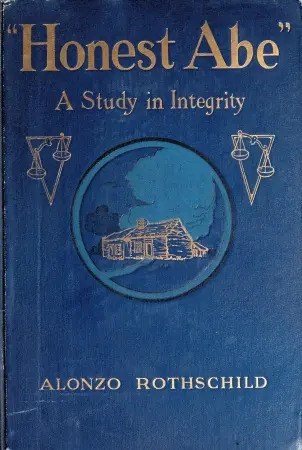
"Honest Abe: A Study in Integrity Based on the Early Life of Abraham Lincoln" by Alonzo Rothschild is a historical account written in the early 20th century. This work explores the formative years of Abraham Lincoln, focusing on his character, integrity, and the influence of his family background. It aims to shed light on how his early experiences shaped him into the emblematic figure of honesty and moral fortitude that he is celebrated as today. The opening of the book sets the foundation for a detailed exploration of Lincoln’s life, particularly emphasizing his inherent honesty and the hardships faced by his family during his upbringing. It describes the poverty Lincoln endured in his childhood and how the moral values instilled by his parents, especially his mother, played a crucial role in shaping his character. The narrative recounts anecdotes that highlight his early understanding of right and wrong and his unwavering commitment to truth, such as his willful efforts to settle debts and his conscientiousness in dealings with others. Throughout this introductory segment, Rothschild firmly establishes Lincoln's reputation as "Honest Abe," illustrating how his integrity was evident from a young age.
Introduction adapted from the source catalogue; source summaries may be automatically generated.
Free to read · English · 102,593 words · No account needed
MAKE TIME FOR A GOOD BOOK
On by default. Untick to stop anonymous reading totals. Each page counts after 10 seconds in view. How this works.
Anonymous counting is on unless you have switched it off.
[iv-1] Though under very different circumstances, Lincoln’s elation seems not unlike that of another famous man whose later life touched his at several points. The first dollar earned by Frederick Douglass, on free soil, in New Bedford, was paid to him, as he tells us, for stowing away a pile of coal for Mrs. Ephraim Peabody, the wife of a Unitarian minister. “I was not long in accomplishing the job,” runs his story, “when the dear lady put into my hand two silver half-dollars. To understand the emotion which swelled my heart as I clasped this money, realizing that I had no master who could take it from me,--that it was mine,--that my hands were my own, and could earn more of the precious coin,--one must have been in some sense himself a slave.” (Douglass, 210.)
[iv-2] Lamon, pointing out some inconsistencies in the details of this anecdote as it is generally quoted, expresses doubts concerning its authenticity. He evidently did not know how often Lincoln had told the story to different persons. Their versions, as might be expected, vary somewhat, but they agree in the essential facts. See: Carpenter, 96-98; William D. Kelley, in Rice, 279-80; Leonard Swett, in Rice, 457-58; Holland, 33-34; Brooks, 38; Pratt, 16-18; Morgan, 27-28; Lamon, 72; McClure’s Stories, 17-18; Hanaford, 156-58; Boyden, 83-84; Irelan, xvi, 62-64; Tarbell, i, 38-39; Browne, 72-73; Banks, 14-16; Ward, 277-78; Thayer, 169-71; Ludlow, 66-68; Curtis’s Lincoln, 24-25; Whipple, 62-63; Selby, 52-53; Raymond, 754; Onstot, 51-52; Egbert L. Viele, in Scribner’s Magazine, October, 1878, p. 817; Alban J. Conant, in McClure’s Magazine, March, 1909, p. 514; interview with Governor Frank Fuller, in the New York Times, October 1, 1911, p. 10.
[iv-3] Browne’s Lincoln and Men, i, 259-61, 356; ii, 90-91.
[iv-4] Holland, 93.
[iv-5] See Lincoln to Speed, June 19, 1841, in Works, i, 168-75, and in Lamon, 318-19; also, Gibson W. Harris, in Columbia (Ky.) Spectator, January 27, 1905.
[iv-6] Oldroyd, 394-95.
[iv-7] Onstot, 41-44.
[iv-8] Lincoln to Whitney, December 18, 1857, in Works, xi, 103.
[iv-9] Brockett, 702-03; McClure’s Yarns, 341-42; Barrett (New), i, 154-55; interview with Mrs. Rose Linder Wilkinson, in Chicago Times-Herald, September 11, 1895.
[iv-10] The nature of these kindnesses may be inferred from the
following despatch:--
EXECUTIVE MANSION, December 26, 1863.
HON. U. F. LINDER,
Chicago, Ill.:
Your son Dan has just left me, with my order to the Secretary of War, to administer to him the oath of allegiance, discharge him, and send him to you.
(Works, ix, 275; see, also, ibid., 272.)
[iv-11] Boston Advertiser, February 12, 1909, p. 7.
[iv-12] Stowe, 21; Carpenter, 245; Browne, 229; French, 80; McClure’s Stories, 89-91; Thayer, 284-85; Gallaher, 39-40.
[iv-13] Gibson W. Harris, in Browne, 220.
[iv-14] Koerner, ii, 112.
[iv-15] Caroline H. Dall, in Atlantic Monthly, April, 1867, p. 413.
Your reading position is saved on this browser. Take it to another device with a library code. Reading pages adapt to text, rather than matching a printed edition.
BEHIND THE BOOK
This eBook is for the use of anyone anywhere in the United States and most other parts of the world at no cost and with almost no restrictions whatsoever. You may copy it, give it away or re-use it under the terms of the Project Gutenberg License included with this eBook or online at www.gutenberg.org. If you are not located in the United States, you will have to check the laws of the country where you are located before using this eBook. Read the source licence.
The original source file, including credits and licence, is retained by this library. Request an original-format copy at no charge. Please include the book title and Project Gutenberg identifier #49679.
KEEP YOUR CURIOSITY GOING
David Patterson (Spirit) Hatch
Cécile Tormay

Moritz Busch
Coulson Kernahan
John L. Ransom

Ralph Waldo Emerson