
Last letters from the living dead man
David Patterson (Spirit) Hatch
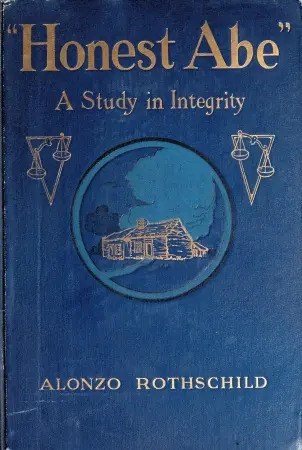
THE CLASSIC COLLECTION · 1917
"Honest Abe: A Study in Integrity Based on the Early Life of Abraham Lincoln" by Alonzo Rothschild is a historical account written in the early 20th century. This work explores the formative years of Abraham Lincoln, focusing on his character, integrity, and the influence of his family background. It aims to shed light on how his early experiences shaped him into the emblematic figure of honesty and moral fortitude that he is celebrated as today. The opening of the book sets the foundation for a detailed exploration of Lincoln’s life, particularly emphasizing his inherent honesty and the hardships faced by his family during his upbringing. It describes the poverty Lincoln endured in his childhood and how the moral values instilled by his parents, especially his mother, played a crucial role in shaping his character. The narrative recounts anecdotes that highlight his early understanding of right and wrong and his unwavering commitment to truth, such as his willful efforts to settle debts and his conscientiousness in dealings with others. Throughout this introductory segment, Rothschild firmly establishes Lincoln's reputation as "Honest Abe," illustrating how his integrity was evident from a young age.
Introduction adapted from the source catalogue; source summaries may be automatically generated.
Free to read · English · 102,593 words · No account needed
MAKE TIME FOR A GOOD BOOK
On by default. Untick to stop anonymous reading totals. Each page counts after 10 seconds in view. How this works.
Anonymous counting is on unless you have switched it off.
[v-43] During Lincoln’s last term in the Illinois House of Representatives he offered the following resolution:--
“RESOLVED, that so much of the Governor’s message as relates to fraudulent voting, and other fraudulent practices at elections, be referred to the Committee on Elections, with instructions to said committee to prepare and report to the House a bill for such an act as may, in their judgment, afford the greatest possible protection of the elective franchise against all frauds of all sorts whatsoever.”
This failed of adoption, and in its stead was passed a substitute offered by John A. McClernand, one of the Democratic leaders. (See Illinois House Journals, 1840-41, p. 34; and Works, i, 152-53.)
[v-44] Horace White, in Herndon, i, xxii.
[v-45] Lincoln to Herndon, June 22, 1848, Works, ii, 50. See, also: Herndon, i, 270-72; Lamon, 295.
[v-46] Phillips’s Men Who Knew, 160-62.
[v-47] Whitney, 117.
[v-48] Schurz, ii, 91.
[v-49] The sequel to this little adventure, as Mr. Nelson tells it, should not be omitted. “I had many opportunities after the stage ride,” he relates, “to cultivate Mr. Lincoln’s acquaintance, and was a zealous advocate of his nomination and election to the Presidency. Before leaving his home for Washington, Mr. Lincoln caused John P. Usher and myself to be invited to accompany him. We agreed to join him in Indianapolis. On reaching that city the Presidential party had already arrived, and upon inquiry we were informed that the President-elect was in the dining-room of the hotel, at supper. Passing through, we saw that every seat at the numerous tables was occupied, but failed to find Mr. Lincoln. As we were nearing the door to the office of the hotel, a long arm reached to my shoulder and a shrill voice exclaimed, ‘Hello, Nelson! Do you think, after all, the world is going to follow the darned thing off?’ It was Mr. Lincoln.” (Herndon, i, 303-06. See, also: Coffin, 132; Selby, 89-90; Williams, 136-37; McClure’s Yarns, 410.)
[v-50] Herndon, i, 253.
[v-51] The affair with James Shields. See Master, 65-77.
[v-52] Lincoln to Martin M. Morris, March 26, 1843, Works, i, 262.
[v-53] A. Y. Ellis, in Lamon, 143; and in Herndon, i, 255.
[v-54] For an amusing account of how Lincoln exposed one of these demagogues to public ridicule, on the stump, see Master, 54-56.
[v-55] Works, v, 238-39.
[v-56] “He took his friend James Matheney out into the woods with him one day and, calling up the bitter features of the canvass, protested ‘vehemently and with great emphasis’ that he was anything but aristocratic and proud. ‘Why, Jim,’ he said, ‘I am now and always shall be the same Abe Lincoln I was when you first saw me.’” (Herndon, i, 256; Lamon, 273.)
Your reading position is saved on this browser. Take it to another device with a library code. Reading pages adapt to text, rather than matching a printed edition.
BEHIND THE BOOK
This eBook is for the use of anyone anywhere in the United States and most other parts of the world at no cost and with almost no restrictions whatsoever. You may copy it, give it away or re-use it under the terms of the Project Gutenberg License included with this eBook or online at www.gutenberg.org. If you are not located in the United States, you will have to check the laws of the country where you are located before using this eBook. Read the source licence.
The original source file, including credits and licence, is retained by this library. Request an original-format copy at no charge. Please include the book title and Project Gutenberg identifier #49679.
KEEP YOUR CURIOSITY GOING
David Patterson (Spirit) Hatch
Cécile Tormay

Moritz Busch
Coulson Kernahan
John L. Ransom

Ralph Waldo Emerson