
Last letters from the living dead man
David Patterson (Spirit) Hatch
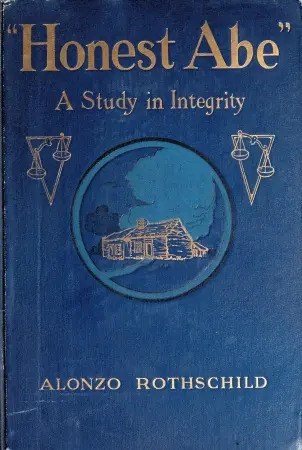
THE CLASSIC COLLECTION · 1917
"Honest Abe: A Study in Integrity Based on the Early Life of Abraham Lincoln" by Alonzo Rothschild is a historical account written in the early 20th century. This work explores the formative years of Abraham Lincoln, focusing on his character, integrity, and the influence of his family background. It aims to shed light on how his early experiences shaped him into the emblematic figure of honesty and moral fortitude that he is celebrated as today. The opening of the book sets the foundation for a detailed exploration of Lincoln’s life, particularly emphasizing his inherent honesty and the hardships faced by his family during his upbringing. It describes the poverty Lincoln endured in his childhood and how the moral values instilled by his parents, especially his mother, played a crucial role in shaping his character. The narrative recounts anecdotes that highlight his early understanding of right and wrong and his unwavering commitment to truth, such as his willful efforts to settle debts and his conscientiousness in dealings with others. Throughout this introductory segment, Rothschild firmly establishes Lincoln's reputation as "Honest Abe," illustrating how his integrity was evident from a young age.
Introduction adapted from the source catalogue; source summaries may be automatically generated.
Free to read · English · 102,593 words · No account needed
MAKE TIME FOR A GOOD BOOK
On by default. Untick to stop anonymous reading totals. Each page counts after 10 seconds in view. How this works.
Anonymous counting is on unless you have switched it off.
[iii-1] It would not be correct, however, to say, as is sometimes said, that Lincoln won every case which he should have won. Contemporary lawyers testify to the contrary.
[iii-2] Herndon, ii, 3; Whitney, 251.
[iii-3] Hill, 225-26.
[iii-4] Whitney, 259; Whitney’s Life, i, 177.
[iii-5] Anthony Thornton, in the Chicago Tribune, February 12, 1900,
p. 14.
[iii-6] Illinois Reports, xxxvii, 15.
[iii-7] Whitney, 262-63; Whitney’s Life, i, 196.
These tributes to Lincoln’s honorable methods again recall the principles that contributed not a little toward Horace Binney’s preëminence. In the review of his career he wrote: “I at all times disdained to practise any stratagem, trick or artifice for the purpose of gaining an advantage over my adversary; and unless I thought him unfair, I was generally willing that he should see all my cards while I played them. I can truly say that I am not conscious of having lost anything by this candor; but, on the contrary, have repeatedly gained by it. If my client was at any time suspected, I had no reason to think that I was, by either the Court or the bar; and how many balancing cases, in the course of thirty-five years’ practice, this sort of reputation assisted, I need not say.” (Binney, 443.)
[iii-8] Herndon, i, 326-28; Atlantic Monthly, April, 1867, p. 412.
Whatever the practice at the Springfield bar may have been, Lincoln’s objection to the making of a fictitious plea was of course not finical. No less an authority than Chief Justice Holt had said: “The attorney, if he puts in a false plea to delay justice, breaks his oath, and may be fined for putting a deceit on the Court.” (Pierce vs. Blake, Salkeld’s Reports, ii, 515. See, also, Johnson vs. Alston, Campbell’s Reports, i, 176.)
[iii-9] Whitney, 263-64; Herndon, ii, 17-18. It should be noted that April 24, 1856, fell on a Thursday, not a Saturday. Whether the 4 is a misprint for 6, or whether this term of court extended to Saturday, May 24, or whether the error lies elsewhere, cannot now be determined.
[iii-10] Browne’s Lincoln and Men, i, 360-62.
[iii-11] Lincoln to Trumbull, December 18, 1857, in the Century Magazine, February, 1909, p. 620.
[iii-12] Justice David Davis from the bench of the Federal Circuit Court, at Indianapolis, May 19, 1865.
[iii-13] Holland, 130; Lamon’s Recollections, 19-20; Stowe, 22;
Browne, 162.
[iii-14] Koerner, ii, 110.
[iii-15] Recollections of Colonel Richard J. Hinton, in the Chicago Times-Herald, November 17, 1895.
[iii-16] Holland, 80. See, also, Nicolay and Hay, i, 307; Ward, 205,
270; Browne, 238.
[iii-17] Mrs. Norman B. Judd, in Oldroyd, 523; also, in Tarbell, i, 277-78. A report of Lincoln’s argument, rather full, though far from complete, has been reprinted from the Chicago Daily Press, in Works, ii, 340-54, and Tarbell, ii, 324-30.
Your reading position is saved on this browser. Take it to another device with a library code. Reading pages adapt to text, rather than matching a printed edition.
BEHIND THE BOOK
This eBook is for the use of anyone anywhere in the United States and most other parts of the world at no cost and with almost no restrictions whatsoever. You may copy it, give it away or re-use it under the terms of the Project Gutenberg License included with this eBook or online at www.gutenberg.org. If you are not located in the United States, you will have to check the laws of the country where you are located before using this eBook. Read the source licence.
The original source file, including credits and licence, is retained by this library. Request an original-format copy at no charge. Please include the book title and Project Gutenberg identifier #49679.
KEEP YOUR CURIOSITY GOING
David Patterson (Spirit) Hatch
Cécile Tormay

Moritz Busch
Coulson Kernahan
John L. Ransom

Ralph Waldo Emerson