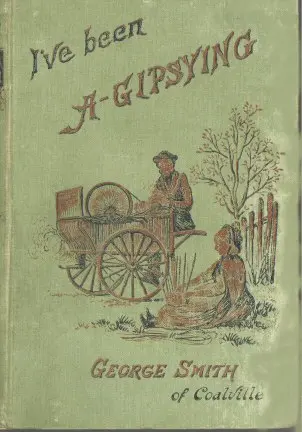
I’ve been a Gipsying or, Rambles among our Gipsies and their children in their tents and vans
George Smith
THE CLASSIC COLLECTION · 1880
"Gipsy Life" by George Smith is an account written in the late 19th century that examines the lives, origins, and social conditions of the Gipsy population in England. The book delves into the challenges faced by Gipsies, particularly women and children, highlighting themes of neglect and societal misunderstanding. The opening reveals the author's dedication to raising awareness about the plight of Gipsies and the need for educational intervention in their lives. Smith outlines the historical treatment of Gipsies across Europe, touching on their origins and the stigma associated with their lifestyle. He paints a vivid picture of the struggles they have endured, from persecution in various countries to their current state in England, emphasizing the importance of understanding their story to foster compassion and potential improvement in their circumstances.
Introduction adapted from the source catalogue; source summaries may be automatically generated.
Free to read · English · 108,927 words · No account needed
MAKE TIME FOR A GOOD BOOK
On by default. Untick to stop anonymous reading totals. Each page counts after 10 seconds in view. How this works.
Anonymous counting is on unless you have switched it off.
"Junius," in the Northampton Mercury, under date June 27th, 1814, writes:--"When we consider the immense sums raised for every probable means of doing good which have hitherto been made public, we cannot doubt if a proper method should be proposed for the relief and ameliorating the state of these people it would meet with deserved encouragement. Suppose that legislature should think this not unworthy its notice, and as a part of the great family they ought not to be overlooked." Another correspondent to the same Journal, "A Friend of Religion," writes under date July 21st, 1815, urging the necessity of some means being adopted for their improvement, and remarks as follows:--"Thousands of our fellow-creatures would be raised from depravity and wretchedness to a state of comfort; the private property of individuals be much more secure, and the public materially benefited."
Instead of putting into practice measures for their improvement, and the State taking hold of them by the hand as children belonging to us, and with us, and for whom our first care ought to have been, we have said in anger--
"'Heathen dog!
Begone, begone! you shall have nothing here.'
The Indian turned; then facing Collingrew,
In accents low and musical, he said:
'But I am very hungry; it is long
Since I have eaten. Only give me a crust,
A bone, to cheer me on my weary way.'
Then answered he, with fury and a frown:
'Go! Get you gone! you red-skinned heathen hound!
I've nothing for you. Get you gone, I say!'"
HARRIS, "Wayside Pictures."
During the summer of 1814, Mr. John Hoyland, of Sheffield, set to work in earnest to try to improve the condition of the Gipsies, and for that purpose he visited, in conjuction with Mr. Allen, solicitor at Higham Ferners, many parts of Northamptonshire and neighbouring counties; and he also sent out a circular to most of the sheriffs in England with a number of questions upon it relating to their numbers, condition, &c., and the following are a few of the answers sent in reply:--1. All Gipsies suppose the first of them came from Egypt. 2. They cannot form any idea of the number in England. 5. The more common names are Smith, Cooper, Draper, Taylor, Boswell, Lee, Lovell, Leversedge, Allen, Mansfield, Glover, Williams, Carew, Martin, Stanley, Buckley, Plunkett, and Corrie. 6 and 7. The gangs in different towns have not any connection or organisation. 8. In the county of Herts it is computed there may be sixty families, having many children. Whether they are quite so numerous in Buckinghamshire, Bedfordshire, and Northamptonshire the answers are not sufficiently definite to determine. In Cambridgeshire, Oxfordshire, Warwickshire, Wiltshire, and Dorsetshire, greater numbers are calculated upon. 9. More than half their numbers follow no business; others are dealers in horses and asses, &c., &c. 10. Children are brought up in the habits of their parents, particular to music and dancing, and are of dissolute conduct. 11. The women mostly carry baskets with trinkets and small wares, and tell fortunes. 13. In most counties there are particular situations to which they are partial. 15, 16, and 17. Do not know of any person that can write the language, or of any written specimen of it. 19. Those who profess any religion represent it to be that of the country in which they reside; but their description of it seldom goes beyond repeating the Lord's Prayer, and only a few of them are capable of that. 20. They marry, for the most part, by pledging to each other, without any ceremony. 21. They do not teach their children religion. 22 and 23. Not one in a thousand can read. Most of these answers were confirmed by Riley Smith, who, during many years, was accounted the chief of the Gipsies in Northamptonshire. Mr. John Forster and Mr. William Carrington, respectable merchants of Biggleswade, and who knew Riley Smith well, corroborated his statements. After Hoyland had published his book no one stepped into the breach, with flag in hand, to take up the cry; and for several years--except the efforts of a clergyman here and there--the interest in the cause of the Gipsies dwindled down, and became gradually and miserably less, and the consequence was the Gipsies have not improved an iota during the three centuries they have been in our midst. As they were, so they are, and likely to remain unless brought under State control.
Your reading position is saved on this browser. Take it to another device with a library code. Reading pages adapt to text, rather than matching a printed edition.
George Smith
George Smith
BEHIND THE BOOK
This eBook is for the use of anyone anywhere in the United States and most other parts of the world at no cost and with almost no restrictions whatsoever. You may copy it, give it away or re-use it under the terms of the Project Gutenberg License included with this eBook or online at www.gutenberg.org. If you are not located in the United States, you will have to check the laws of the country where you are located before using this eBook. Read the source licence.
The original source file, including credits and licence, is retained by this library. Request an original-format copy at no charge. Please include the book title and Project Gutenberg identifier #28548.
KEEP YOUR CURIOSITY GOING
Cécile Tormay

Moritz Busch
John L. Ransom
Frances Wright
Cécile Tormay

Mabel Potter Daggett