THE CLASSIC COLLECTION✦John March, SouthernerCLASSIC FREE BOOKS
John March, Southerner
George Washington Cable
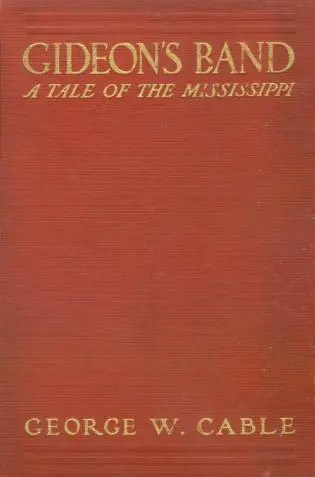
THE CLASSIC COLLECTION · 1914
"Gideon's Band: A Tale of the Mississippi" by George Washington Cable is a historical novel written in the early 20th century. The story explores life along the Mississippi River, particularly focusing on the experiences and interactions of various characters aboard a steamboat named the "Votaress". Key figures include Ramsey Hayle, a young woman navigating her way through a world filled with both vibrant human drama and the harsh realities of a society influenced by immigration and commerce. The opening of "Gideon's Band" vividly depicts the bustling scene at a steamboat levee in New Orleans, where numerous individuals and colorful characters converge. The narrative introduces us to the "Votaress", preparing for its journey upriver, and illustrates its significance as a new vessel while highlighting the diverse passengers waiting to board. Among these passengers, young Ramsey Hayle stands out as she interacts with her surroundings, filled with curiosity and excitement about the journey ahead. The dynamics between various characters, including the Hayle twins and the passengers of different backgrounds, hint at the central conflicts and themes that will unfold throughout the novel. This slow build in the opening chapters sets the stage for deeper explorations of identity, class, and the tensions of the antebellum South.
Introduction adapted from the source catalogue; source summaries may be automatically generated.
Free to read · English · 111,383 words · No account needed
MAKE TIME FOR A GOOD BOOK
On by default. Untick to stop anonymous reading totals. Each page counts after 10 seconds in view. How this works.
Anonymous counting is on unless you have switched it off.
Yes, these wild shores were States--States of the great Union, the world's hope; Jackson's, Clay's, Webster's Union, which "must and shall be preserved," "now and forever, one and inseparable." Somewhere between these shores, moreover, and not behind but away on up-stream, probably, Mr. Watson said, in Dead Man's Bend, was, once more, the Antelope. In the long wait at Bayou Sara, where Hugh and the outlandish Otto--who could speak French--had found the priest while the commodore and the mate were getting the doctor, the Antelope had reappeared, swept up, and foamed by, and now was so far ahead that in hardly less than another hundred and sixty miles could she be again overtaken. But to Ramsey, even without the Antelope or any or all of the sights and facts of landscape and history, no moment could go stale while the tale of Phyllis and the Quakeress waited like funds in a bank, and while the commodore, the captain, and Hugh, the pilots, the mate, the Gilmores, the judge, general, bishop, squire, senator, Otto Marburg in his green coat, and dozens and scores of others were all over the boat, each more and more a story, a study, as hourly she grew older.
On the bench close behind her in the pilot-house a lady with needlework, a gentleman with De Bow's Review (the squire's sister and brother-in-law), had begun to talk with the Gilmores and presently mentioned the twins, speaking in such a tone of doom as to give Ramsey a sudden panic.
"It's fine!" said the husband, praising Julian's devotion to his stricken brother. "And they are fine. Their faults--which you've had occasion to discover, sir--are spots on the sun; the faults, madam, of all our young Southern gentlemen----"
"Would you say of all?" asked the actor's wife.
"No!" said the other lady, "no, not of all!" and her husband was glad to
stand corrected.
"No," he admitted, "but still of almost all; faults of which we may almost say, sir, that we may almost be proud!"
"Oh, well," begged his wife, "please almost don't say it! They're the faults of our 'peculiar institution' and I wish our 'peculiar institution' were--" She sewed hard.
"In the deep bosom of the ocean buried," suggested her husband to the players. "Why, honestly, so do I. But it's not, and can't be, and as long as it can't be we----"
"Oh, well," said his wife, "don't let's begin on that."
Reckless of institutions Ramsey turned. "Is my brother worse?" she broke in, but a white-jacket entered with the dinner-bell and spoke softly to old Joy. "Yes," said Ramsey to him, "I'm Miss Hayle. What is it? Is my brother worse?"
Your reading position is saved on this browser. Take it to another device with a library code. Reading pages adapt to text, rather than matching a printed edition.
George Washington Cable
George Washington Cable

George Washington Cable
George Washington Cable
BEHIND THE BOOK
This eBook is for the use of anyone anywhere in the United States and most other parts of the world at no cost and with almost no restrictions whatsoever. You may copy it, give it away or re-use it under the terms of the Project Gutenberg License included with this eBook or online at www.gutenberg.org. If you are not located in the United States, you will have to check the laws of the country where you are located before using this eBook. Read the source licence.
The original source file, including credits and licence, is retained by this library. Request an original-format copy at no charge. Please include the book title and Project Gutenberg identifier #19348.
KEEP YOUR CURIOSITY GOING
Cécile Tormay

Moritz Busch
Coulson Kernahan
John L. Ransom

Maurice Baring
Frances Wright