THE CLASSIC COLLECTION✦John March, SouthernerCLASSIC FREE BOOKS
John March, Southerner
George Washington Cable
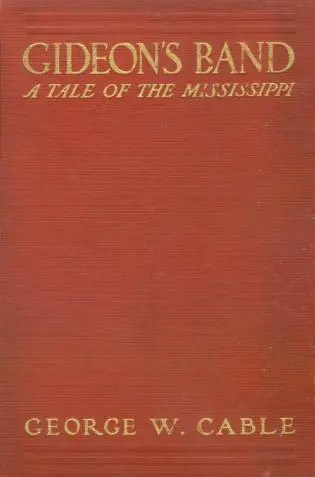
THE CLASSIC COLLECTION · 1914
"Gideon's Band: A Tale of the Mississippi" by George Washington Cable is a historical novel written in the early 20th century. The story explores life along the Mississippi River, particularly focusing on the experiences and interactions of various characters aboard a steamboat named the "Votaress". Key figures include Ramsey Hayle, a young woman navigating her way through a world filled with both vibrant human drama and the harsh realities of a society influenced by immigration and commerce. The opening of "Gideon's Band" vividly depicts the bustling scene at a steamboat levee in New Orleans, where numerous individuals and colorful characters converge. The narrative introduces us to the "Votaress", preparing for its journey upriver, and illustrates its significance as a new vessel while highlighting the diverse passengers waiting to board. Among these passengers, young Ramsey Hayle stands out as she interacts with her surroundings, filled with curiosity and excitement about the journey ahead. The dynamics between various characters, including the Hayle twins and the passengers of different backgrounds, hint at the central conflicts and themes that will unfold throughout the novel. This slow build in the opening chapters sets the stage for deeper explorations of identity, class, and the tensions of the antebellum South.
Introduction adapted from the source catalogue; source summaries may be automatically generated.
Free to read · English · 111,383 words · No account needed
MAKE TIME FOR A GOOD BOOK
On by default. Untick to stop anonymous reading totals. Each page counts after 10 seconds in view. How this works.
Anonymous counting is on unless you have switched it off.
"Courage," the slender play was called. It is to be regretted that we cannot fully set it forth, for Gilmore was himself its author.
Also because, whatever it lacked, there was in it a lucky fitness for this occasion, since, conditions being what they were on the decks above and below, the one strong apology for giving it was the need of upholding the courage of its audience.
It was even a sort of kind rejoinder to the various ferments kept up by the truculent twins, the pusillanimous exhorter, and the terrified Basile. Its preachment might well have been less obvious, though lines, its author bade Hugh notice, never overbalanced action, never came till situation called them. It was to the effect, first, that courage is human character's prime essential, without which no rightness or goodness is stable or real; and, second, that as no virtue of character can be relied on where courage is poor, so neither can courage be trusted for right conduct when unmated to other virtues of character, the chiefest being fidelity--fidelity to truth and right, of course, since fidelity to evil is but a contradiction of terms. "From courage and fidelity," it was the part of one player at a telling moment to say, "springs the whole arch of character," and again, "These are the Adam and Eve of all the virtues." (Adam and Eve were decided to be quite mentionable. Mention was not impersonation.)
Naturally the Gilmores knew every line of the play.
"As perfectly," ventured the two young Napoleonites, "as John the Baptist knows the moral law, don't you?"
"Better, I infer," said Gilmore abstractedly. They were in the ladies' cabin, awaiting its preparation as a stage, behind the curtains that screened it from the gentlemen's cabin, the auditorium. His wife smiled for him.
"Even my Harriet," she said, "knows one or two parts. She's played Miss Ramsey's in emergencies."
Her half-dozen feminine hearers flinched. Yet one said, excusingly: "That's a servant's part, anyhow."
"And Harriet's her very size and shape," said another.
And another, drolly: "They're enough alike to be kin!"
"Harriet's free, isn't she?" asked the first.
"Yes," replied Mrs. Gilmore, without a blush, looking squarely at Hugh, who stood among them silent.
"You'd never notice she was a nigrah if you wa'n't told," said another, "or didn't see her with nigrahs."
But then said a youth, cousin to one of the girls: "Yet after all a
nigrah she is."
"No such thing!" said his cousin. "After all that's what she isn't. Our
own laws say she isn't."
"Well, I say she is. One drop of nigrah blood makes a nigrah--for me,
law or no law."
"Well, that's monstrous--for me."
Your reading position is saved on this browser. Take it to another device with a library code. Reading pages adapt to text, rather than matching a printed edition.
George Washington Cable
George Washington Cable

George Washington Cable
George Washington Cable
BEHIND THE BOOK
This eBook is for the use of anyone anywhere in the United States and most other parts of the world at no cost and with almost no restrictions whatsoever. You may copy it, give it away or re-use it under the terms of the Project Gutenberg License included with this eBook or online at www.gutenberg.org. If you are not located in the United States, you will have to check the laws of the country where you are located before using this eBook. Read the source licence.
The original source file, including credits and licence, is retained by this library. Request an original-format copy at no charge. Please include the book title and Project Gutenberg identifier #19348.
KEEP YOUR CURIOSITY GOING
Cécile Tormay

Moritz Busch
Coulson Kernahan
John L. Ransom

Maurice Baring
Frances Wright