THE CLASSIC COLLECTION✦John March, SouthernerCLASSIC FREE BOOKS
John March, Southerner
George Washington Cable
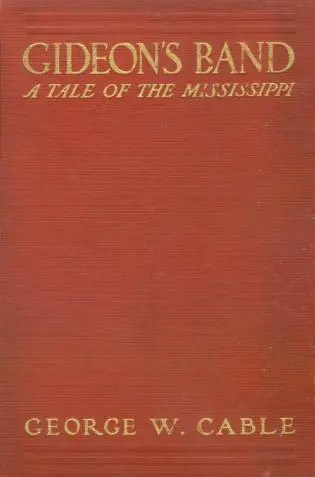
THE CLASSIC COLLECTION · 1914
"Gideon's Band: A Tale of the Mississippi" by George Washington Cable is a historical novel written in the early 20th century. The story explores life along the Mississippi River, particularly focusing on the experiences and interactions of various characters aboard a steamboat named the "Votaress". Key figures include Ramsey Hayle, a young woman navigating her way through a world filled with both vibrant human drama and the harsh realities of a society influenced by immigration and commerce. The opening of "Gideon's Band" vividly depicts the bustling scene at a steamboat levee in New Orleans, where numerous individuals and colorful characters converge. The narrative introduces us to the "Votaress", preparing for its journey upriver, and illustrates its significance as a new vessel while highlighting the diverse passengers waiting to board. Among these passengers, young Ramsey Hayle stands out as she interacts with her surroundings, filled with curiosity and excitement about the journey ahead. The dynamics between various characters, including the Hayle twins and the passengers of different backgrounds, hint at the central conflicts and themes that will unfold throughout the novel. This slow build in the opening chapters sets the stage for deeper explorations of identity, class, and the tensions of the antebellum South.
Introduction adapted from the source catalogue; source summaries may be automatically generated.
Free to read · English · 111,383 words · No account needed
MAKE TIME FOR A GOOD BOOK
On by default. Untick to stop anonymous reading totals. Each page counts after 10 seconds in view. How this works.
Anonymous counting is on unless you have switched it off.
But the grandfather addressed the adventurer. "You'd rather not, I
fancy."
"Rather not; looks too unanimous the wrong way."
"Would you still like to have Hugh's advice?"
"I would! I'd like to hear yo'-all's argument."
Ramsey dropped into her chair with a tired sigh and up-stream gaze though with an inner ear of keenest attention.
Hugh glanced toward his father's door, whence at any moment, as every one realized, the actor might beckon.
"I have no argument," he began.
"You have," breathed a voice, unmistakably Ramsey's; "you always have."
"You know," he continued to the Kentuckian, "there's something in all of us, I don't say what, or whether wise or foolish, that says: 'Don't do it.' You feel it, don't you?"
Madame interrupted: "Mais don't do w'at?"
Ramsey faced the group as if to answer just that question. "Now we pass between Cedar Point and Pecan Point and head for the Second Chickasaw Bluffs!"
"Ah bah, les bloff'," murmured madame and repeated to Hugh: "Something say, 'Don' do it'? Mais w'at it say don' do?"
"Don't mix the great races we know apart by their color."
"Umph! An' w'at is thad something w'at tell uz that?"
"Grandfather calls it race conscience."
"Grandfather!" whimpered Ramsey, while madame asked:
"Of w'at race has Phylliz the conscien'? An' you would know Phylliz' race--ad sight--by the color?"
"I'd know it!" put in the Kentuckian. "She's white, to all intents and
purposes."
"No," said Hugh, "not quite to all. Not to all as organized society, in
its----"
Ramsey, with eyes up the river, sighed: "Mrs. Grundy?"
"Yes, but Mrs. Grundy in her best intents and purposes."
"In her race conscience," wailed Ramsey to the breeze.
"In her race conscience," assented Hugh.
Ramsey whipped around. "Thought you had no argument."
"I'm giving grandfather's," said the grandson.
"Humph! it's yours. I'd know it at sight--by the color."
"Miss Ramsey," said the old man, toying with his cane, "Hugh and I have been finding that, right or wrong, Mrs. Grundy or Mr. Grundy, race conscience is a wonderful, unaccountable thing for which men will give their life-blood by thousands." His voice failed. He waved smilingly to Hugh.
"And when," broke in Hugh to Ramsey, "when Mrs. Grundy, in her race conscience, says Phyllis is not white no one ought to snap his fingers in even Mrs. Grundy's face merely to please himself or to relieve some private situation."
Ramsey stood up, flashing first on him and then to her mother, dropped again, and with her face in her elbow on the chair's back recited drearily--from her third reader:
Your reading position is saved on this browser. Take it to another device with a library code. Reading pages adapt to text, rather than matching a printed edition.
George Washington Cable
George Washington Cable

George Washington Cable
George Washington Cable
BEHIND THE BOOK
This eBook is for the use of anyone anywhere in the United States and most other parts of the world at no cost and with almost no restrictions whatsoever. You may copy it, give it away or re-use it under the terms of the Project Gutenberg License included with this eBook or online at www.gutenberg.org. If you are not located in the United States, you will have to check the laws of the country where you are located before using this eBook. Read the source licence.
The original source file, including credits and licence, is retained by this library. Request an original-format copy at no charge. Please include the book title and Project Gutenberg identifier #19348.
KEEP YOUR CURIOSITY GOING
Cécile Tormay

Moritz Busch
Coulson Kernahan
John L. Ransom

Maurice Baring
Frances Wright