THE CLASSIC COLLECTION✦John March, SouthernerCLASSIC FREE BOOKS
John March, Southerner
George Washington Cable
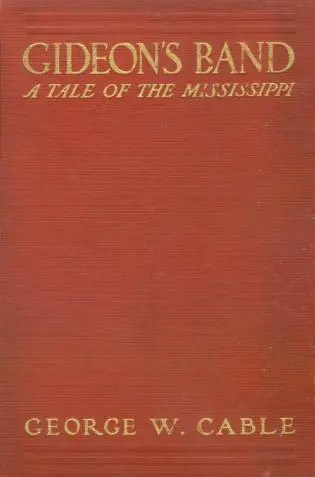
THE CLASSIC COLLECTION · 1914
"Gideon's Band: A Tale of the Mississippi" by George Washington Cable is a historical novel written in the early 20th century. The story explores life along the Mississippi River, particularly focusing on the experiences and interactions of various characters aboard a steamboat named the "Votaress". Key figures include Ramsey Hayle, a young woman navigating her way through a world filled with both vibrant human drama and the harsh realities of a society influenced by immigration and commerce. The opening of "Gideon's Band" vividly depicts the bustling scene at a steamboat levee in New Orleans, where numerous individuals and colorful characters converge. The narrative introduces us to the "Votaress", preparing for its journey upriver, and illustrates its significance as a new vessel while highlighting the diverse passengers waiting to board. Among these passengers, young Ramsey Hayle stands out as she interacts with her surroundings, filled with curiosity and excitement about the journey ahead. The dynamics between various characters, including the Hayle twins and the passengers of different backgrounds, hint at the central conflicts and themes that will unfold throughout the novel. This slow build in the opening chapters sets the stage for deeper explorations of identity, class, and the tensions of the antebellum South.
Introduction adapted from the source catalogue; source summaries may be automatically generated.
Free to read · English · 111,383 words · No account needed
MAKE TIME FOR A GOOD BOOK
On by default. Untick to stop anonymous reading totals. Each page counts after 10 seconds in view. How this works.
Anonymous counting is on unless you have switched it off.
"Wait here," slowly said Hugh in response to the gold-hunter's touch.
"I'll--see you presently."
The modest adventurer waved assent, yet looked so disappointed that Mrs. Gilmore, moving to take his arm, asked:
"Can't Mr. So-and-so go with us?"
Oh, kind, quick wit! Three is a crowd, four is only twice two!
"Certainly," said Hugh, and to Ramsey added: "We'd better lead the way."
As they led she softly inquired: "Does he want to know something about
the twins?"
What arrows were her questions, and how straight they struck home! Yet with that low voice for their bowstring they gave him comfort. Her forays into his confidence not only relieved the loneliness of his too secretive mind but often, as now, involved a sweet yielding of her confidence to him. Yet now a straight answer was quite impossible.
"He wants to know something about you," was the reply.
She let the palpable evasion pass. On the hurricane roof there was a new sight. The breeze was astern and moved so evenly with the boat as to enfold her in a calm. Looking up for the stars, one saw only the giant chimneys towering straight into the darkness and sending their smoke as straight and as far again beyond, spangled with two firefly swarms of sparks that fell at last in a perpetual, noiseless shower.
"Why do we go this way?" she asked, meaning forward around the skylight roof instead of across it.
"Because this way's longer."
"Humph!" was the soft response. Presently she added, "We get more fresh air this way," and called back to their two followers: "This is to avoid the sparks."
"Um-hmm!" thought kind Mrs. Gilmore, and, "Oh, ho!" mused the Californian, not quite so unselfishly.
Around in front of the bell both youth and maiden observed how palely the derrick posts loomed against the spectral chimneys and their smoke, and silently recalled their first meeting, just here, in the long ago of two days earlier. The captain's chair was occupied.
"Well, father," said Hugh.
"Good evening," twittered Ramsey.
"Good evening, Miss Ramsey. Be back this way, Hugh?"
"In a moment, sir." They passed on. Ramsey looked behind at the
Californian.
"What does he want to know about me?" she asked.
"He says," said Hugh, "he's nursed this sickness at sea and at Panama and hasn't the slightest fear of it."
"Humph!... That's not about me."
"Yes, it--was. He's taken a great fancy----"
"To Basile."
"To several of us, including Basile."
"Yes, because he and Basile played cards together."
Your reading position is saved on this browser. Take it to another device with a library code. Reading pages adapt to text, rather than matching a printed edition.
George Washington Cable
George Washington Cable

George Washington Cable
George Washington Cable
BEHIND THE BOOK
This eBook is for the use of anyone anywhere in the United States and most other parts of the world at no cost and with almost no restrictions whatsoever. You may copy it, give it away or re-use it under the terms of the Project Gutenberg License included with this eBook or online at www.gutenberg.org. If you are not located in the United States, you will have to check the laws of the country where you are located before using this eBook. Read the source licence.
The original source file, including credits and licence, is retained by this library. Request an original-format copy at no charge. Please include the book title and Project Gutenberg identifier #19348.
KEEP YOUR CURIOSITY GOING
Cécile Tormay

Moritz Busch
Coulson Kernahan
John L. Ransom

Maurice Baring
Frances Wright