THE CLASSIC COLLECTION✦John March, SouthernerCLASSIC FREE BOOKS
John March, Southerner
George Washington Cable
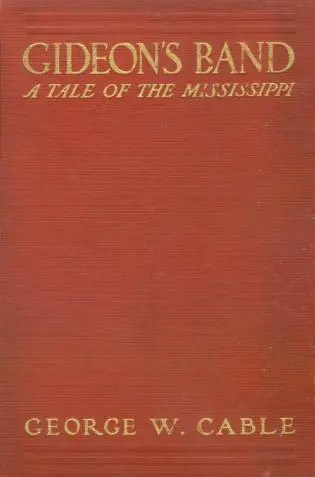
THE CLASSIC COLLECTION · 1914
"Gideon's Band: A Tale of the Mississippi" by George Washington Cable is a historical novel written in the early 20th century. The story explores life along the Mississippi River, particularly focusing on the experiences and interactions of various characters aboard a steamboat named the "Votaress". Key figures include Ramsey Hayle, a young woman navigating her way through a world filled with both vibrant human drama and the harsh realities of a society influenced by immigration and commerce. The opening of "Gideon's Band" vividly depicts the bustling scene at a steamboat levee in New Orleans, where numerous individuals and colorful characters converge. The narrative introduces us to the "Votaress", preparing for its journey upriver, and illustrates its significance as a new vessel while highlighting the diverse passengers waiting to board. Among these passengers, young Ramsey Hayle stands out as she interacts with her surroundings, filled with curiosity and excitement about the journey ahead. The dynamics between various characters, including the Hayle twins and the passengers of different backgrounds, hint at the central conflicts and themes that will unfold throughout the novel. This slow build in the opening chapters sets the stage for deeper explorations of identity, class, and the tensions of the antebellum South.
Introduction adapted from the source catalogue; source summaries may be automatically generated.
Free to read · English · 111,383 words · No account needed
MAKE TIME FOR A GOOD BOOK
On by default. Untick to stop anonymous reading totals. Each page counts after 10 seconds in view. How this works.
Anonymous counting is on unless you have switched it off.
The best that could be said was that he was "holding out"--or "up"--or "on"--the commodore's voice was weak. He had come away from the captain's bed-side because a convalescent was "only in the way," he said, and because Hugh felt that he belonged on deck if anywhere, though that, the old man fondly added, was less important than Hugh chose to regard it. This unimportance Ramsey recognized by diverting the conversation so far as to announce that "mom-a" had just settled the whole Phyllis business.
"Mighty nigh," the Californian admitted, answering Hugh's quiet glance, while his heart praised the daughter's failure to credit him with his share in the achievement, that being a thing still in progress, whose design he had not fully revealed. The omission seemed to him most maidenly and daughterly. He spoke on, to the two ladies:
"There's a thing or two more----"
"Oh, I'll pay that two hundred dollars!" cried Ramsey.
In animated approval her mother nodded to both.
"Not if the court knows itself," said the modest man, with so winsome a smile that every one noticed how blue were his eyes. "I can trump that," he added, musingly.
"What's the other thing? You said a thing or two," asked Ramsey.
"Her wages, ain't it, for eleven years?"
"Ho, ho!" laughed madame in amiable scorn, while----
"Paid!" cried Ramsey. "Mrs. Gilmore's always paid her!"
"Knowin' she was a runaway? and who' from?"
Madame bowed sweetly, yet with an aroused sparkle.
"Humph!" said Ramsey, watching the boat back out and lay her course for Island Thirty-five, "I'd have done as they did, either of them." She stepped into the freshening breeze.
The inquirer's eyes rested on her, bluer than ever.
"Don't you propose to collect?" he asked.
"Most certainly not!" sang Ramsey at full height.
"Not a sou," said madame, looking about in grand amusement. "Not a
pic-ah-yune--hoh!"
"But she's going back into yo' hands?"
"My 'an's," said madame.
"And you'll never sell her?"
"Can't!" laughed Ramsey, with eyes ahead.
"You can hire her."
"Yes," said Ramsey, turning. "Oh, yes."
"Well, what'll you take, from the right bidder, for that girl's free
papers dated ahead to when you come of age, bidder takin' all the
resks?"
"You said down-stairs you wasn't an abolitionist!"
Your reading position is saved on this browser. Take it to another device with a library code. Reading pages adapt to text, rather than matching a printed edition.
George Washington Cable
George Washington Cable

George Washington Cable
George Washington Cable
BEHIND THE BOOK
This eBook is for the use of anyone anywhere in the United States and most other parts of the world at no cost and with almost no restrictions whatsoever. You may copy it, give it away or re-use it under the terms of the Project Gutenberg License included with this eBook or online at www.gutenberg.org. If you are not located in the United States, you will have to check the laws of the country where you are located before using this eBook. Read the source licence.
The original source file, including credits and licence, is retained by this library. Request an original-format copy at no charge. Please include the book title and Project Gutenberg identifier #19348.
KEEP YOUR CURIOSITY GOING
Cécile Tormay

Moritz Busch
Coulson Kernahan
John L. Ransom

Maurice Baring
Frances Wright