THE CLASSIC COLLECTION✦John March, SouthernerCLASSIC FREE BOOKS
John March, Southerner
George Washington Cable
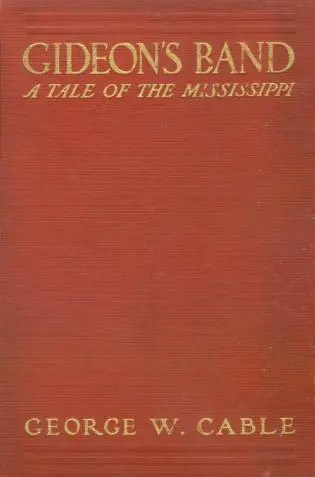
THE CLASSIC COLLECTION · 1914
"Gideon's Band: A Tale of the Mississippi" by George Washington Cable is a historical novel written in the early 20th century. The story explores life along the Mississippi River, particularly focusing on the experiences and interactions of various characters aboard a steamboat named the "Votaress". Key figures include Ramsey Hayle, a young woman navigating her way through a world filled with both vibrant human drama and the harsh realities of a society influenced by immigration and commerce. The opening of "Gideon's Band" vividly depicts the bustling scene at a steamboat levee in New Orleans, where numerous individuals and colorful characters converge. The narrative introduces us to the "Votaress", preparing for its journey upriver, and illustrates its significance as a new vessel while highlighting the diverse passengers waiting to board. Among these passengers, young Ramsey Hayle stands out as she interacts with her surroundings, filled with curiosity and excitement about the journey ahead. The dynamics between various characters, including the Hayle twins and the passengers of different backgrounds, hint at the central conflicts and themes that will unfold throughout the novel. This slow build in the opening chapters sets the stage for deeper explorations of identity, class, and the tensions of the antebellum South.
Introduction adapted from the source catalogue; source summaries may be automatically generated.
Free to read · English · 111,383 words · No account needed
MAKE TIME FOR A GOOD BOOK
On by default. Untick to stop anonymous reading totals. Each page counts after 10 seconds in view. How this works.
Anonymous counting is on unless you have switched it off.
For an instant Ramsey was all pride for him they exalted; but in the next instant a wave of resentment went through her as if their vaunting were his; as if her pride were his own confessed, colossal vanity; as if the price of his uplift were her belittlement. Never mind, he should pay! Absurd, absurd; but she was harrowingly tired, lonely, idle, grief-burdened, and desolate, and absurdity itself was relief. He should pay, let his paying cost her double. Somehow, in some feminine, minute, pinhole way, she would deflate him, wing him, bring him down, before he should soar another round. With old Joy at her feet, in the dusk of her corner beyond Mrs. So-and-so, the parson's wife; she allowed herself a poor, bitter-sweet smile.
Each time when Hugh had come back to the bench, room had been hurriedly made for him next the parson's wife--"stabboard side"--who, speaking for all, promptly began to interrogate him, her first question always being as to his father's condition, which did not improve. Making room on the bench made room in the conversation--decoying pauses hopefully designed to lure him into saying something, anything, to Ramsey, or her to him; but always the kind trap had gone unsprung. Two or three times, obviously, Mrs. So-and-so's inquiries had first been Ramsey's to her; as when one of them elicited the fact that the next turn would be Horseshoe Cut-off and Kangaroo Point; and once, at length, after twice failing to believe the ear she bent to Ramsey's murmur, she said audibly:
"Ask him, dear; ask him yourself."
Every one waited and presently Hugh remarked:
"I'll answer if I can."
"I'd rather," faltered Ramsey, "ask John the Baptist."
The unlucky mention took no evident effect on any one. If that was the snub she would have to try again.
"I can ask him for you," said Hugh. "He's up, expecting to leave us at
Helena."
"No, thank you," she sighed, "you're too awfully busy. It won't make any real difference if I never find out."
"Won't sink the boat to ask," drawled Watson; but she remained silent
till Hugh inquired:
"Are you sure I can't tell you?"
"Oh, you can!" came from Ramsey's dark corner. "But--with the whole boat in your care--we oughtn't to ask you things we don't have to know."
"Lard! belch it out," urged the innocent Ned, taking her in earnest; but
again she was silent.
"Well?" said Hugh.
"Oh, well, are there many--? Oh, it ain't important."
"Why, missy," muttered old Joy, "you's dess natchiully bleeds to ax it
now."
"Yes, dear," said the parson's wife, "let's have it."
Your reading position is saved on this browser. Take it to another device with a library code. Reading pages adapt to text, rather than matching a printed edition.
George Washington Cable
George Washington Cable

George Washington Cable
George Washington Cable
BEHIND THE BOOK
This eBook is for the use of anyone anywhere in the United States and most other parts of the world at no cost and with almost no restrictions whatsoever. You may copy it, give it away or re-use it under the terms of the Project Gutenberg License included with this eBook or online at www.gutenberg.org. If you are not located in the United States, you will have to check the laws of the country where you are located before using this eBook. Read the source licence.
The original source file, including credits and licence, is retained by this library. Request an original-format copy at no charge. Please include the book title and Project Gutenberg identifier #19348.
KEEP YOUR CURIOSITY GOING
Cécile Tormay

Moritz Busch
Coulson Kernahan
John L. Ransom

Maurice Baring
Frances Wright