THE CLASSIC COLLECTION✦John March, SouthernerCLASSIC FREE BOOKS
John March, Southerner
George Washington Cable
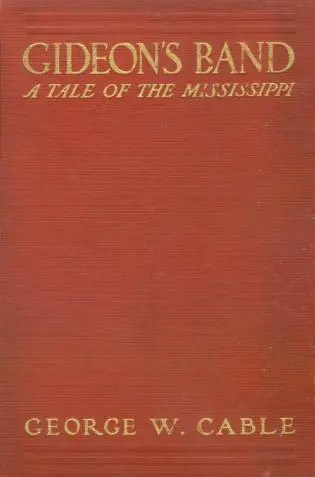
THE CLASSIC COLLECTION · 1914
"Gideon's Band: A Tale of the Mississippi" by George Washington Cable is a historical novel written in the early 20th century. The story explores life along the Mississippi River, particularly focusing on the experiences and interactions of various characters aboard a steamboat named the "Votaress". Key figures include Ramsey Hayle, a young woman navigating her way through a world filled with both vibrant human drama and the harsh realities of a society influenced by immigration and commerce. The opening of "Gideon's Band" vividly depicts the bustling scene at a steamboat levee in New Orleans, where numerous individuals and colorful characters converge. The narrative introduces us to the "Votaress", preparing for its journey upriver, and illustrates its significance as a new vessel while highlighting the diverse passengers waiting to board. Among these passengers, young Ramsey Hayle stands out as she interacts with her surroundings, filled with curiosity and excitement about the journey ahead. The dynamics between various characters, including the Hayle twins and the passengers of different backgrounds, hint at the central conflicts and themes that will unfold throughout the novel. This slow build in the opening chapters sets the stage for deeper explorations of identity, class, and the tensions of the antebellum South.
Introduction adapted from the source catalogue; source summaries may be automatically generated.
Free to read · English · 111,383 words · No account needed
MAKE TIME FOR A GOOD BOOK
On by default. Untick to stop anonymous reading totals. Each page counts after 10 seconds in view. How this works.
Anonymous counting is on unless you have switched it off.
"Phew! how modest" She stared an instant, turned her back, clasped the rail, and with her forehead on her arms laughed till Hugh was weary--not necessarily long.
He spoke: "Here come the Westwood and the Antelope."
"Where?" She glanced round, sprang up the steps, and soon was making room for him beside her at a larboard window behind Watson. Looking thence across the long, slim neck of Cole's Point they saw the two boats coming back westward in the upper reach of the fourteen-mile eastern loop they were running to make two miles into the north. Now the Westwood passed and now the Antelope, their skylights glinting like fireflies through the intervening tree tops, and Watson showed how to tell them apart by night. Presently they turned north again and vanished, leaving the mighty stream to its three students.
"It'll cut off this whole fourteen mile' some day," said Watson; but the other two, in their dim nook, remained silent. He knew that sort of silence. When Ramsey by and by spoke, her words were to Hugh exclusively and in undertone.
"The Quakeress--Oh, I didn't mean----!"
"That's all right," said Hugh. "The Quakeress----!"
"Oh, I meant the Antelope! She'll soon be in the lead again?"
"Yes."
"With both those letters."
"Both."
"Ain't you glad I didn't mean the Quakeress?"
"No."
"Well, you're glad I didn't mean Phyllis, ain't you?"
"No."
"Would you really be willing to tell me about Phyllis?"
"I would."
"You wasn't willing--before--was you?--were you?"
"No."
"What's changed your mind?"
"Lawd, missy!" sighed the forgotten Joy.
But Ramsey insisted: "What's changed it?"
"You, chiefly."
"I haven't," very quietly said the girl.
"You have."
Ramsey glanced cautiously at Watson, but the pilot's eyes were a league ahead. Hers returned to Hugh. "Wasn't it my brothers changed your mind--the twins?"
"They helped."
She looked him over absently: "I love my brothers."
"I don't," said Hugh.
She stared again and slowly remarked: "You haven't got to.... You're
powerful queer, ain't you?"
"Not by choice."
"I'm queer. Wish I wasn't--wa'n't--weren't--but I am."
"Yes," said Hugh, "you are."
She tilted her chin, stepped to Watson's side, and called down over the breast-board to the Gilmores, who had finished with their two pupils for a time and had taken chairs with a newly found young married pair on the texas roof:
"Oho, down there!"
"Oho!" the group answered.
"Do you want us to stay up here?" asked Ramsey. "'Cause if you do we'll come right down. Or if you'd rather we'd come down we'll stay up here!" It was a new note.
The players laughed. "It's the long dress says that," they observed to
the other pair.
Your reading position is saved on this browser. Take it to another device with a library code. Reading pages adapt to text, rather than matching a printed edition.
George Washington Cable
George Washington Cable

George Washington Cable
George Washington Cable
BEHIND THE BOOK
This eBook is for the use of anyone anywhere in the United States and most other parts of the world at no cost and with almost no restrictions whatsoever. You may copy it, give it away or re-use it under the terms of the Project Gutenberg License included with this eBook or online at www.gutenberg.org. If you are not located in the United States, you will have to check the laws of the country where you are located before using this eBook. Read the source licence.
The original source file, including credits and licence, is retained by this library. Request an original-format copy at no charge. Please include the book title and Project Gutenberg identifier #19348.
KEEP YOUR CURIOSITY GOING
Cécile Tormay

Moritz Busch
Coulson Kernahan
John L. Ransom

Maurice Baring
Frances Wright