THE CLASSIC COLLECTION✦John March, SouthernerCLASSIC FREE BOOKS
John March, Southerner
George Washington Cable
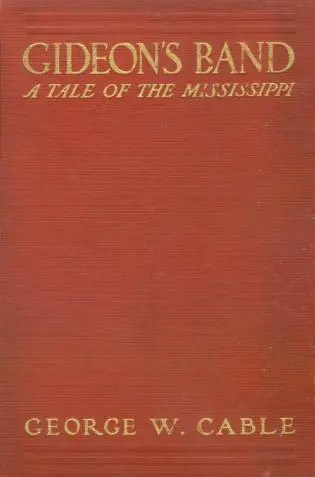
THE CLASSIC COLLECTION · 1914
"Gideon's Band: A Tale of the Mississippi" by George Washington Cable is a historical novel written in the early 20th century. The story explores life along the Mississippi River, particularly focusing on the experiences and interactions of various characters aboard a steamboat named the "Votaress". Key figures include Ramsey Hayle, a young woman navigating her way through a world filled with both vibrant human drama and the harsh realities of a society influenced by immigration and commerce. The opening of "Gideon's Band" vividly depicts the bustling scene at a steamboat levee in New Orleans, where numerous individuals and colorful characters converge. The narrative introduces us to the "Votaress", preparing for its journey upriver, and illustrates its significance as a new vessel while highlighting the diverse passengers waiting to board. Among these passengers, young Ramsey Hayle stands out as she interacts with her surroundings, filled with curiosity and excitement about the journey ahead. The dynamics between various characters, including the Hayle twins and the passengers of different backgrounds, hint at the central conflicts and themes that will unfold throughout the novel. This slow build in the opening chapters sets the stage for deeper explorations of identity, class, and the tensions of the antebellum South.
Introduction adapted from the source catalogue; source summaries may be automatically generated.
Free to read · English · 111,383 words · No account needed
MAKE TIME FOR A GOOD BOOK
On by default. Untick to stop anonymous reading totals. Each page counts after 10 seconds in view. How this works.
Anonymous counting is on unless you have switched it off.
"Cap' ought to be pootty tol'able tired, Ned."
"Well, now, he jest ought!" The partner dropped back and perched on the visitor's bench, whence he could still see the river though not the closely intervening cabin--and texas roofs; and all the two said later was without an exchange of glances. Watson thought the captain would "rest more now, on watch, than what he did before, off," having got matters running so much smoother down below; though the cholera was "a-growin', straight along."
Ned told of his pleasure in seeing Hugh conduct the senator down to the devotional services: "Lard, they hev done him brown, ain't they?--atween 'em, Hugh and Hayle's girl?"
"With some help," said Watson, modestly. "That petition--ef th's anything else aboard this boat as dead as what it is"--he ran into inelegancies.
Ned offered to bet it was not dead inside the senator, and Watson admitted that the statesman would probably never forgive the "genteel" way he had been euchred; though like euchre, he said, a lot of it was luck.
"But, man! the bluff he kin put up! Couldn't believe my eyes when we'd passed the hat an' adjourned an' I see him a-standin' at the fork o' the for'a'd stairs, ag'in the trunk room, same ole bell-wether as ever, a-makin' a bully speech to Madame Hayle an' that Marburg chap down in the gangway, foot o' the steps, an' a-present'n' him our 'oblations'--says he--meanin' the swag!"
"An' her a-translat'n' for him!" said Ned, fancying the scene, with the senator, under his mask, "a-gritt'n' his tushes!" and Watson, to heighten it, told of Hugh and the actor at one head of the double stair, and Mrs. Gilmore and Ramsey at the other--"a-chirpin' him on, an' the whole b'iler deck, ladies and gents, takin' it in, solid!"
The senator was long-headed. "Yes, an' yit Hugh's throwed him fair jest by main strength an' awk'ardness."
"I dunno!" said Ned. "It wuz long-headed, too, fo' Hugh an' the play-acto's to give him the job."
"It wuz long-headed in her who put 'em up to it."
"Oh, look here! She didn't do that, did she?"
"'Less'n I'm a liar," replied Watson, eyes front.
"Hunh! Wonder which! Say, Wats'; on the b'iler deck--did she have on this gownd she's a-wearin' now?"
"No," said Watson, tardily, with eyes still up-stream.
"Not wast'n' yo' words," said the inquirer.
"No."
"A short answer turneth away wrath, I s'pose."
"It turneth away discussion o' ladies' gownds."
"Lard! I don't discuss 'em to excess. Noticed hern--its upper works--an' a flounce or two--an' sort o' wondered as to the rest of it, how much water it's a-drawin'. Anything li-bell-ious about that?"
"No, considerin' the source."
Your reading position is saved on this browser. Take it to another device with a library code. Reading pages adapt to text, rather than matching a printed edition.
George Washington Cable
George Washington Cable

George Washington Cable
George Washington Cable
BEHIND THE BOOK
This eBook is for the use of anyone anywhere in the United States and most other parts of the world at no cost and with almost no restrictions whatsoever. You may copy it, give it away or re-use it under the terms of the Project Gutenberg License included with this eBook or online at www.gutenberg.org. If you are not located in the United States, you will have to check the laws of the country where you are located before using this eBook. Read the source licence.
The original source file, including credits and licence, is retained by this library. Request an original-format copy at no charge. Please include the book title and Project Gutenberg identifier #19348.
KEEP YOUR CURIOSITY GOING
Cécile Tormay

Moritz Busch
Coulson Kernahan
John L. Ransom

Maurice Baring
Frances Wright