THE CLASSIC COLLECTION✦An outlaw’s diary: the CommuneCLASSIC FREE BOOKS
An outlaw’s diary: the Commune
Cécile Tormay
THE CLASSIC COLLECTION · 1885
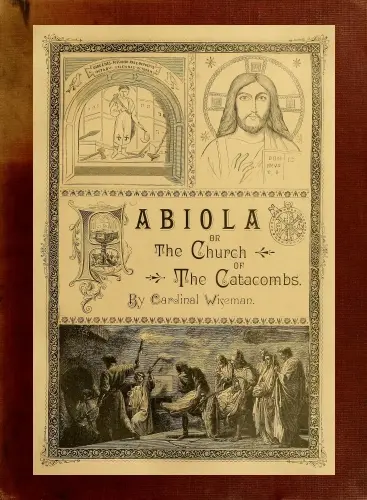
"Fabiola; Or, The Church of the Catacombs" by Nicholas Patrick Wiseman is a novel first published in 1854. Set in early fourth-century Rome during Diocletian's persecution of Christians, the story follows Fabiola, a spoiled noblewoman whose encounter with her Christian slave girl Syra sparks an unexpected transformation. Meanwhile, young Pancratius prepares for martyrdom while facing betrayal from his nemesis Corvinus. The novel weaves real martyrdom accounts with fictional drama, exploring themes of faith, forgiveness, and community among Rome's underground Christians.
Introduction adapted from the source catalogue; source summaries may be automatically generated.
Free to read · English · 141,871 words · No account needed
MAKE TIME FOR A GOOD BOOK
On by default. Untick to stop anonymous reading totals. Each page counts after 10 seconds in view. How this works.
Anonymous counting is on unless you have switched it off.
“We are just there,” she said to him; “a few more steps, and you shall sit down and rest.”
“Thank you, my child,” replied the poor old man, “how kind of you to come for me so early!”
“I knew,” she said, “you would want help; and as I am the most useless person about, I thought I would go and fetch you.”
“I have always heard that blind people are selfish, and it seems but natural; but you, Cæcilia, are certainly an exception.”
“Not at all; this is only my way of showing selfishness.”
“How do you mean?”
“Why, first, I get the advantage of your eyes, and then I get the satisfaction of supporting you. ‘I was an eye to the blind,’ that is you; and ‘a foot to the lame,’ that is myself.”[51]
They reached the door as she spoke these words.
“That girl is blind,” said Fulvius to Corvinus. “Do you not see how straight she walks, without looking right or left?”
“So she is,” answered the other. “Surely this is not the place so often spoken of, where beggars meet, and the blind see, and the lame walk, and all feast together? But yet I observed these people were so different from the mendicants on the Arician bridge.[52] They appeared respectable and even cheerful; and not one asked me for alms as he passed.”
“It is very strange; and I should like to discover the mystery. A good job might, perhaps, be got out of it. The old patrician, you say, is very rich?”
“Immensely!”
“Humph! How could one manage to get in?”
“I have it! I will take off my shoes, screw up one leg like a cripple, and join the next group of queer ones that come, and go boldly in, doing as they do.”
“That will hardly succeed; depend upon it every one of these people is
known at the house.”
“I am sure not, for several of them asked me if this was the house of
the Lady Agnes.”
“Of whom?” asked Fulvius, with a start.
“Why do you look so?” said Corvinus. “It is the house of her parents: but she is better known than they, as being a young heiress, nearly as rich as her cousin Fabiola.”
Fulvius paused for a moment; a strong suspicion, too subtle and important to be communicated to his rude companion, flashed through his mind. He said, therefore, to Corvinus:
“If you are sure that these people are not familiar at the house, try your plan. I have met the lady before, and will venture by the front door. Thus we shall have a double chance.”
Your reading position is saved on this browser. Take it to another device with a library code. Reading pages adapt to text, rather than matching a printed edition.
BEHIND THE BOOK
This eBook is for the use of anyone anywhere in the United States and most other parts of the world at no cost and with almost no restrictions whatsoever. You may copy it, give it away or re-use it under the terms of the Project Gutenberg License included with this eBook or online at www.gutenberg.org. If you are not located in the United States, you will have to check the laws of the country where you are located before using this eBook. Read the source licence.
The original source file, including credits and licence, is retained by this library. Request an original-format copy at no charge. Please include the book title and Project Gutenberg identifier #62254.
KEEP YOUR CURIOSITY GOING
Cécile Tormay

Moritz Busch
Coulson Kernahan
John L. Ransom

Maurice Baring
Frances Wright