THE CLASSIC COLLECTION✦An outlaw’s diary: the CommuneCLASSIC FREE BOOKS
An outlaw’s diary: the Commune
Cécile Tormay
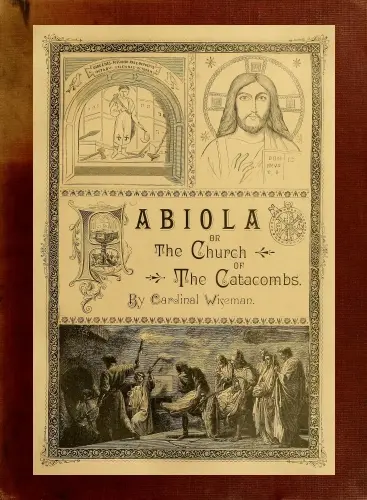
THE CLASSIC COLLECTION · 1885
"Fabiola; Or, The Church of the Catacombs" by Nicholas Patrick Wiseman is a novel first published in 1854. Set in early fourth-century Rome during Diocletian's persecution of Christians, the story follows Fabiola, a spoiled noblewoman whose encounter with her Christian slave girl Syra sparks an unexpected transformation. Meanwhile, young Pancratius prepares for martyrdom while facing betrayal from his nemesis Corvinus. The novel weaves real martyrdom accounts with fictional drama, exploring themes of faith, forgiveness, and community among Rome's underground Christians.
Introduction adapted from the source catalogue; source summaries may be automatically generated.
Free to read · English · 141,871 words · No account needed
MAKE TIME FOR A GOOD BOOK
On by default. Untick to stop anonymous reading totals. Each page counts after 10 seconds in view. How this works.
Anonymous counting is on unless you have switched it off.
“If you double your fist,” rejoined Corvinus, “to show me the fine rings on your delicate fingers, it is very well. But if you mean to threaten by it, you may as well put your hand again into the folds of your toga. It is more graceful.”
“Cut this matter short, sir. Again I ask, what do you mean?”
“This, Fulvius,” and he whispered into his ear, “that you are a spy and
an informer.”
Fulvius was staggered; then rallying, said, “What right have you to make such an odious charge against me?”
“You discovered” (with a strong emphasis) “a conspiracy in the East,
and Dioclesian--”
Fulvius stopped him, and asked, “What is your name, and who are you?”
“I am Corvinus, the son of Tertullus, prefect of the city.”
This seemed to account for all; and Fulvius said, in subdued tones, “No more here; I see friends coming. Meet me disguised at daybreak to-morrow in the Patrician Street,[50] under the portico of the Baths of Novatus. We will talk more at leisure.”
Corvinus returned home, not ill-satisfied with his first attempt at diplomacy; he procured a garment shabbier than his own from one of his father’s slaves, and was at the appointed spot by the first dawn of day. He had to wait a long time, and had almost lost patience, when he saw his new friend approach.
Fulvius was well wrapped up in a large overcoat, and wore its hood over his face. He thus saluted Corvinus:
“Good morning, comrade; I fear I have kept you waiting in the cold morning air, especially as you are thinly clad.”
“I own,” replied Corvinus, “that I should have been tired, had I not been immensely amused and yet puzzled, by what I have been observing.”
“What is that?”
“Why, from an early hour, long, I suspect, before my coming, there have been arriving here from every side, and entering into that house, by the back door in the narrow street, the rarest collection of miserable objects that you ever saw; the blind, the lame, the maimed, the decrepit, the deformed of every possible shape; while by the front door several persons have entered, evidently of a different class.”
“Whose dwelling is it, do you know? It looks a large old house, but rather out of condition.”
“It belongs to a very rich, and, it is said, very miserly old patrician. But look! there come some more.”
At that moment a very feeble man, bent down by age, was approaching, supported by a young and cheerful girl, who chatted most kindly to him as she supported him.
Your reading position is saved on this browser. Take it to another device with a library code. Reading pages adapt to text, rather than matching a printed edition.
BEHIND THE BOOK
This eBook is for the use of anyone anywhere in the United States and most other parts of the world at no cost and with almost no restrictions whatsoever. You may copy it, give it away or re-use it under the terms of the Project Gutenberg License included with this eBook or online at www.gutenberg.org. If you are not located in the United States, you will have to check the laws of the country where you are located before using this eBook. Read the source licence.
The original source file, including credits and licence, is retained by this library. Request an original-format copy at no charge. Please include the book title and Project Gutenberg identifier #62254.
KEEP YOUR CURIOSITY GOING
Cécile Tormay

Moritz Busch
Coulson Kernahan
John L. Ransom

Maurice Baring
Frances Wright