THE CLASSIC COLLECTION✦An outlaw’s diary: the CommuneCLASSIC FREE BOOKS
An outlaw’s diary: the Commune
Cécile Tormay
THE CLASSIC COLLECTION · 1885
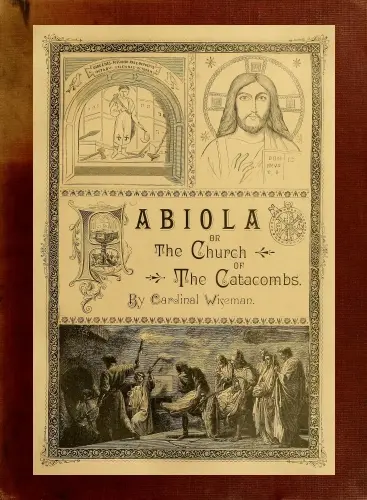
"Fabiola; Or, The Church of the Catacombs" by Nicholas Patrick Wiseman is a novel first published in 1854. Set in early fourth-century Rome during Diocletian's persecution of Christians, the story follows Fabiola, a spoiled noblewoman whose encounter with her Christian slave girl Syra sparks an unexpected transformation. Meanwhile, young Pancratius prepares for martyrdom while facing betrayal from his nemesis Corvinus. The novel weaves real martyrdom accounts with fictional drama, exploring themes of faith, forgiveness, and community among Rome's underground Christians.
Introduction adapted from the source catalogue; source summaries may be automatically generated.
Free to read · English · 141,871 words · No account needed
MAKE TIME FOR A GOOD BOOK
On by default. Untick to stop anonymous reading totals. Each page counts after 10 seconds in view. How this works.
Anonymous counting is on unless you have switched it off.
“He came up first, and began to chat quite friendly, asked me if it was not very cold, and that sort of thing. At last I remembered that I had to run through any one that came near me----”
“Exactly,” interrupted Corvinus; “and why did you not do it?”
“Only because he wouldn’t let me. I told him to be off, or I should spear him, and drew back and stretched out my javelin; when in the quietest manner, but I don’t know how, he twisted it out of my hand, broke it over his knee, as if it had been a mountebank’s wooden sword, and dashed the iron-headed piece fast into the ground, where you see it, fifty yards off.”
“Then why did you not rush on him with your sword, and despatch him at once? But where is your sword? it is not in your scabbard.”
The Dacian, with a stupid grin, pointed to the roof of the neighboring basilica, and said: “There, don’t you see it shining on the tiles, in the morning light?” Corvinus looked, and there indeed he saw what appeared like such an object, but he could hardly believe his own eyes.
“How did it get there, you stupid booby?” he asked.
The soldier twisted his moustache in an ominous way, which made Corvinus ask again more civilly, and then he was answered:
“He, or it, whatever it was, without any apparent effort, by a sort of conjuring, whisked it out of my hand, and up where you see it, as easily as I could cast a quoit a dozen yards.”
“And then?”
“And then, he and the boy, who came from round the pillar, walked off in
the dark.”
“What a strange story!” muttered Corvinus to himself; “yet there are proofs of the fellow’s tale. It is not every one who could have performed that feat. But pray, sirrah, why did you not give the alarm, and rouse the other guards to pursuit?”
“First, Master Kornweiner, because, in my country, we will fight any living men, but we do not choose to pursue hobgoblins. And, secondly, what was the use? I saw the board that you gave into my care all safe and sound.”
“Stupid barbarian!” growled Corvinus, but well within his teeth; then added: “This business will go hard with you; you know it is a capital offence.”
“What is?”
“Why, to let a man come up and speak to you, without giving the
watchword.”
“Gently, captain; who says he did not give it? I never said so.”
“But did he, though? Then it could be no Christian.”
Your reading position is saved on this browser. Take it to another device with a library code. Reading pages adapt to text, rather than matching a printed edition.
BEHIND THE BOOK
This eBook is for the use of anyone anywhere in the United States and most other parts of the world at no cost and with almost no restrictions whatsoever. You may copy it, give it away or re-use it under the terms of the Project Gutenberg License included with this eBook or online at www.gutenberg.org. If you are not located in the United States, you will have to check the laws of the country where you are located before using this eBook. Read the source licence.
The original source file, including credits and licence, is retained by this library. Request an original-format copy at no charge. Please include the book title and Project Gutenberg identifier #62254.
KEEP YOUR CURIOSITY GOING
Cécile Tormay

Moritz Busch
Coulson Kernahan
John L. Ransom

Maurice Baring
Frances Wright