THE CLASSIC COLLECTION✦An outlaw’s diary: the CommuneCLASSIC FREE BOOKS
An outlaw’s diary: the Commune
Cécile Tormay
THE CLASSIC COLLECTION · 1885
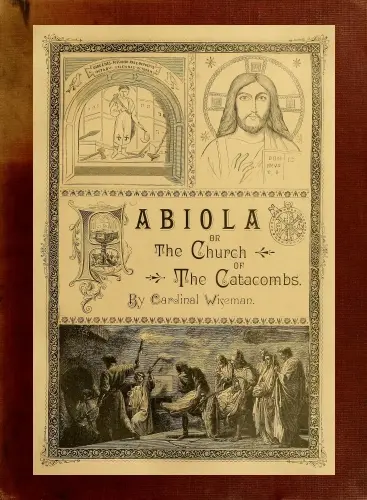
"Fabiola; Or, The Church of the Catacombs" by Nicholas Patrick Wiseman is a novel first published in 1854. Set in early fourth-century Rome during Diocletian's persecution of Christians, the story follows Fabiola, a spoiled noblewoman whose encounter with her Christian slave girl Syra sparks an unexpected transformation. Meanwhile, young Pancratius prepares for martyrdom while facing betrayal from his nemesis Corvinus. The novel weaves real martyrdom accounts with fictional drama, exploring themes of faith, forgiveness, and community among Rome's underground Christians.
Introduction adapted from the source catalogue; source summaries may be automatically generated.
Free to read · English · 141,871 words · No account needed
MAKE TIME FOR A GOOD BOOK
On by default. Untick to stop anonymous reading totals. Each page counts after 10 seconds in view. How this works.
Anonymous counting is on unless you have switched it off.
“If you will look over the arcosolium,”[103] answered Severus, “you will see a fuller representation of the scene. But I think we had better first continue what we have begun, and finish the ceiling. You see that figure on the right?”
“Yes,” replied Tiburtius; “it is that of a man apparently in a chest, with a dove flying towards him. Is that meant to represent the Deluge?”
“It is,” said Severus, “as the emblem of regeneration by water and the Holy Spirit; and of the salvation of the world. Such is our beginning; and here is our end: Jonas thrown out of the boat, and swallowed by the whale; and then sitting in enjoyment under his gourd. The resurrection with our Lord, and eternal rest as its fruit.”
“How natural is this representation in such a place!” observed Pancratius, pointing to the other side; “and here we have another type of the same consoling doctrine.”
“Where?” asked Torquatus, languidly; “I see nothing but a figure bandaged all round, and standing up, like a huge infant in a small temple; and another person opposite to it.”
“Exactly,” said Severus; “that is the way we always represent the resurrection of Lazarus. Here look, is a touching expression of the hopes of our fathers in persecution: The three Babylonian children in the fiery furnace.”
“Well, now, I think,” said Torquatus, “we may come to the arcosolium, and finish this room. What are these pictures round it?”
“If you look at the left side, you see the multiplication of the loaves and fishes. The fish[104] is, you know, the symbol of Christ.”
“Why so?” asked Torquatus, rather impatiently. Severus turned to Pancratius, as the better scholar, to answer.
“There are two opinions about its origin,” said the youth, readily; “one finds the meaning in the word itself; its letters forming the beginning of words, so as to mean ‘Jesus Christ, Son of God, Saviour.’[105] Another puts it in the symbol itself; that as fish are born and live in the water, so is the Christian born of water, and buried with Christ in it, by baptism.[106] Hence, as we came along, we saw the figure of a fish carved on tombs, or its name engraven on them. Now go on, Severus.”
“Then the union of the bread and the fish in one multiplication shows us how, in the Eucharist, Christ becomes the food of all.[107] Opposite, is Moses striking the rock, from which all drank, and which is Christ, our drink as well as our food.”[108]
“Now, at last,” said Torquatus, “we are come to the Good Shepherd.”
Your reading position is saved on this browser. Take it to another device with a library code. Reading pages adapt to text, rather than matching a printed edition.
BEHIND THE BOOK
This eBook is for the use of anyone anywhere in the United States and most other parts of the world at no cost and with almost no restrictions whatsoever. You may copy it, give it away or re-use it under the terms of the Project Gutenberg License included with this eBook or online at www.gutenberg.org. If you are not located in the United States, you will have to check the laws of the country where you are located before using this eBook. Read the source licence.
The original source file, including credits and licence, is retained by this library. Request an original-format copy at no charge. Please include the book title and Project Gutenberg identifier #62254.
KEEP YOUR CURIOSITY GOING
Cécile Tormay

Moritz Busch
Coulson Kernahan
John L. Ransom

Maurice Baring
Frances Wright