THE CLASSIC COLLECTION✦An outlaw’s diary: the CommuneCLASSIC FREE BOOKS
An outlaw’s diary: the Commune
Cécile Tormay
THE CLASSIC COLLECTION · 1885
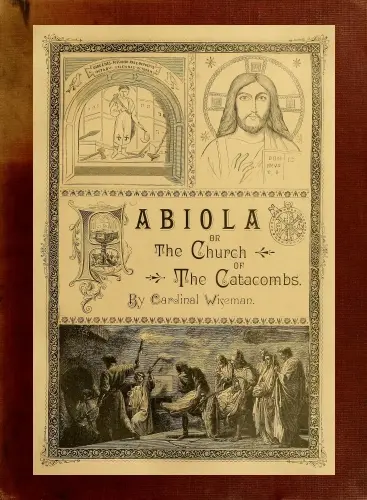
"Fabiola; Or, The Church of the Catacombs" by Nicholas Patrick Wiseman is a novel first published in 1854. Set in early fourth-century Rome during Diocletian's persecution of Christians, the story follows Fabiola, a spoiled noblewoman whose encounter with her Christian slave girl Syra sparks an unexpected transformation. Meanwhile, young Pancratius prepares for martyrdom while facing betrayal from his nemesis Corvinus. The novel weaves real martyrdom accounts with fictional drama, exploring themes of faith, forgiveness, and community among Rome's underground Christians.
Introduction adapted from the source catalogue; source summaries may be automatically generated.
Free to read · English · 141,871 words · No account needed
MAKE TIME FOR A GOOD BOOK
On by default. Untick to stop anonymous reading totals. Each page counts after 10 seconds in view. How this works.
Anonymous counting is on unless you have switched it off.
“Perhaps my two friends,” interposed Pancratius, “so recently baptized, may not have heard it; but I know it well. It is surely one of the glorious privileges of martyrdom, to have the Lord’s sacred Body and precious Blood offered upon one’s ashes, and to repose thus under the very feet of God.[102] But let us see well the paintings all over this crypt.”
“It is on account of them that I brought you into this chamber, in preference to so many others in the cemetery. It is one of the most ancient, and contains a most complete series of pictures, from the remotest times down to some of my son’s doing.”
“Well, then, Diogenes, explain them systematically to my friends,” said Pancratius. “I think I know most of them, but not all; and I shall be glad to hear you describe them.”
“I am no scholar,” replied the old man, modestly, “but when one has lived sixty years, man and boy, among things, one gets to know them better than others, because one loves them more. All here have been fully initiated, I suppose?” he added, with a pause.
“All,” answered Tiburtius, “though not so fully instructed as converts ordinarily are. Torquatus and myself have received the sacred gift.”
“Enough,” resumed the excavator. “The ceiling is the oldest part of the painting, as is natural; for that was done when the crypt was excavated, whereas the walls were decorated, as tombs were hollowed out. You see the ceiling has a sort of trellis-work painted over it, with grapes, to represent perhaps our true Vine, of which we are the branches. There you see Orpheus sitting down, and playing sweet music, not only to his own flock, but to the wild beasts of the desert, which stand charmed around him.”
“Why, that is a heathen picture altogether,” interrupted Torquatus, with pettishness, and some sarcasm; “what has it to do with Christianity?”
“It is an allegory, Torquatus,” replied Pancratius, gently, “and a favorite one. The use of Gentile images, when in themselves harmless, has been permitted. You see masks, for instance, and other pagan ornaments in this ceiling, and they belong generally to a very ancient period. And so our Lord was represented under the symbol of Orpheus, to conceal His sacred representation from Gentile blasphemy and sacrilege. Look, now, in that arch; you have a more recent representation of the same subject.”
“I see,” said Torquatus, “a shepherd with a sheep over his
shoulders--the Good Shepherd; that I can understand; I remember the
parable.”
“But why is this subject such a favorite one?” asked Tiburtius; “I have observed it in other cemeteries.”
Your reading position is saved on this browser. Take it to another device with a library code. Reading pages adapt to text, rather than matching a printed edition.
BEHIND THE BOOK
This eBook is for the use of anyone anywhere in the United States and most other parts of the world at no cost and with almost no restrictions whatsoever. You may copy it, give it away or re-use it under the terms of the Project Gutenberg License included with this eBook or online at www.gutenberg.org. If you are not located in the United States, you will have to check the laws of the country where you are located before using this eBook. Read the source licence.
The original source file, including credits and licence, is retained by this library. Request an original-format copy at no charge. Please include the book title and Project Gutenberg identifier #62254.
KEEP YOUR CURIOSITY GOING
Cécile Tormay

Moritz Busch
Coulson Kernahan
John L. Ransom

Maurice Baring
Frances Wright