THE CLASSIC COLLECTION✦An outlaw’s diary: the CommuneCLASSIC FREE BOOKS
An outlaw’s diary: the Commune
Cécile Tormay
THE CLASSIC COLLECTION · 1885
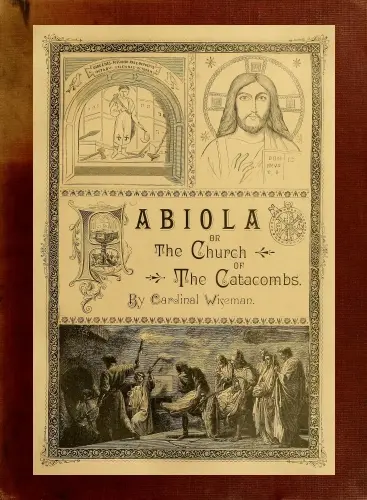
"Fabiola; Or, The Church of the Catacombs" by Nicholas Patrick Wiseman is a novel first published in 1854. Set in early fourth-century Rome during Diocletian's persecution of Christians, the story follows Fabiola, a spoiled noblewoman whose encounter with her Christian slave girl Syra sparks an unexpected transformation. Meanwhile, young Pancratius prepares for martyrdom while facing betrayal from his nemesis Corvinus. The novel weaves real martyrdom accounts with fictional drama, exploring themes of faith, forgiveness, and community among Rome's underground Christians.
Introduction adapted from the source catalogue; source summaries may be automatically generated.
Free to read · English · 141,871 words · No account needed
MAKE TIME FOR A GOOD BOOK
On by default. Untick to stop anonymous reading totals. Each page counts after 10 seconds in view. How this works.
Anonymous counting is on unless you have switched it off.
The company broke up; every body slunk away from the discovered Christian, as from one pest-stricken. He felt alone and depressed, when Fulvius, who had whispered a word to Fabius, and to Corvinus, went up to him, and taking him by the hand said, courteously: “I fear, I spoke inconsiderately, in drawing out from you a declaration which may prove dangerous.”
“I fear nothing,” replied Torquatus, again excited; “I will stand to my colors to the last.”
“Hush, hush!” broke in Fulvius, “the slaves may betray you. Come with me to another chamber, where we can talk quietly together.”
So saying, he led him into an elegant room, where Fabius had ordered goblets and flagons of the richest Falernian wine to be brought, for such as, according to Roman fashion, liked to enjoy a commissatio, or drinking-bout. But only Corvinus, engaged by Fulvius, followed.
On a beautifully inlaid table were dice. Fulvius, after plying Torquatus with more liquor, negligently took them up, and threw them playfully down, talking in the mean time on indifferent subjects. “Dear me!” he kept exclaiming, “what throws! It is well I am not playing with any one, or I should have been ruined. You try, Torquatus.”
Gambling, as we learnt before, had been the ruin of Torquatus: for a transaction arising out of it he was in prison when Sebastian converted him. As he took the dice into his hand, with no intention, as he thought, of playing, Fulvius watched him as a lynx might its prey. Torquatus’s eye flashed keenly, his lips quivered, his hand trembled. Fulvius at once recognized in all this, coupled with the poising of his hand, the knowing cast of the wrist, and the sharp eye to the value of the throw, the violence of a first temptation to resume a renounced vice.
“I fear you are not a better hand than I am at this stupid occupation,” said he indifferently; “but, I dare say, Corvinus here will give you a chance, if you will stake something very low.”
“It must be very low indeed,--merely for recreation; for I have renounced gambling. Once, indeed--but no matter.”
“Come on,” said Corvinus, whom Fulvius had pressed to his work by a
look.
They began to throw for the most trifling stakes, and Torquatus generally won. Fulvius made him drink still, from time to time, and he became very talkative.
“Corvinus, Corvinus,” he said at length, as if recollecting himself, “was not that the name that Cassianus mentioned?”
“Who?” asked the other, surprised.
Your reading position is saved on this browser. Take it to another device with a library code. Reading pages adapt to text, rather than matching a printed edition.
BEHIND THE BOOK
This eBook is for the use of anyone anywhere in the United States and most other parts of the world at no cost and with almost no restrictions whatsoever. You may copy it, give it away or re-use it under the terms of the Project Gutenberg License included with this eBook or online at www.gutenberg.org. If you are not located in the United States, you will have to check the laws of the country where you are located before using this eBook. Read the source licence.
The original source file, including credits and licence, is retained by this library. Request an original-format copy at no charge. Please include the book title and Project Gutenberg identifier #62254.
KEEP YOUR CURIOSITY GOING
Cécile Tormay

Moritz Busch
Coulson Kernahan
John L. Ransom

Maurice Baring
Frances Wright