THE CLASSIC COLLECTION✦An outlaw’s diary: the CommuneCLASSIC FREE BOOKS
An outlaw’s diary: the Commune
Cécile Tormay
THE CLASSIC COLLECTION · 1885
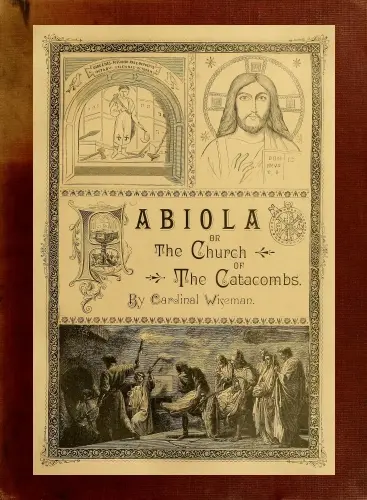
"Fabiola; Or, The Church of the Catacombs" by Nicholas Patrick Wiseman is a novel first published in 1854. Set in early fourth-century Rome during Diocletian's persecution of Christians, the story follows Fabiola, a spoiled noblewoman whose encounter with her Christian slave girl Syra sparks an unexpected transformation. Meanwhile, young Pancratius prepares for martyrdom while facing betrayal from his nemesis Corvinus. The novel weaves real martyrdom accounts with fictional drama, exploring themes of faith, forgiveness, and community among Rome's underground Christians.
Introduction adapted from the source catalogue; source summaries may be automatically generated.
Free to read · English · 141,871 words · No account needed
MAKE TIME FOR A GOOD BOOK
On by default. Untick to stop anonymous reading totals. Each page counts after 10 seconds in view. How this works.
Anonymous counting is on unless you have switched it off.
The youth was silent; but his countenance, by turns, was pale and flushed. Wine had given him a rash courage, which some strong principle restrained. Now he clenched his hand, and pressed it to his breast; now he bit his lip. At one time he was crumbling the bread between his fingers; at another, he drank off, unconsciously, a cup of wine.
“These Christians hate us, and would destroy us all if they could,” said one. Torquatus leaned forward, opened his lips, but remained silent.
“Destroy us, indeed! Did they not burn Rome, under Nero; and have they not just set fire to the palace in Asia, over the emperor’s head?” asked a second. Torquatus rose upon his couch, stretched forth his hand, as if about to reply, but drew it back.
“But what is infinitely worse is, their maintaining such anti-social doctrines, conniving at such frightful excesses, and degrading themselves to the disgusting worship of an ass’s head,” proceeded a third. Torquatus now fairly writhed; and rising, had lifted his arm, when Fulvius, with a cool calculation of time and words, added, in bitter sarcasm: “Ay, and massacre a child, and devour his flesh and blood, at every assembly.”[70]
The arm descended on the table, with a blow that made every goblet and beaker dance and ring, as, in a choked voice, Torquatus exclaimed: “It is a lie! a cursed lie!”
“How can you know that?” asked Fulvius, with his blandest tone and look.
“Because,” answered the other, with great excitement, “I am myself a Christian; and ready to die for my faith!”
If the beautiful alabaster statue, with a bronze head, in the niche beside the table, had fallen forward, and been smashed on the marble pavement, it could not have caused a more fearful sensation than this sudden announcement. All were startled for a moment. Next, a long blank pause ensued, after which, each began to show his feelings in his features. Fabius looked exceedingly foolish, as if conscious that he had brought his guests into bad company. Calpurnius puffed himself out, evidently thinking himself ill-used, by having a guest brought in, who might absurdly be supposed to know more about Christians than himself. A young man opened his mouth as he stared at Torquatus; and a testy old gentleman was evidently hesitating, whether he should not knock down somebody or other, no matter whom. Corvinus looked at the poor Christian with the sort of grin of delight, half idiotic, half savage, with which a countryman might gaze upon the vermin that he finds in his trap in a morning. Here was a man ready to hand, to put on the rack, or the gridiron, whenever he pleased. But the look of Fulvius was worth them all. If ever any microscopic observer has had the opportunity of witnessing the expression of the spider’s features, when, after a long fast, it sees a fly, plump with others’ blood, approach its net, and keenly watches every stroke of its wing, and studies how it can best throw only the first thread round it, sure that then all that gorges it shall be its own; that we fancy would be the best image of his looks, as certainly it is of his feelings. To get hold of a Christian, ready to turn traitor, had long been his desire and study. Here, he was sure, was one, if he could only manage him. How did he know this? Because he knew sufficient of Christians to be convinced, that no genuine one would have allowed himself either to drink to excess, or to boast of his readiness to court martyrdom.
Your reading position is saved on this browser. Take it to another device with a library code. Reading pages adapt to text, rather than matching a printed edition.
BEHIND THE BOOK
This eBook is for the use of anyone anywhere in the United States and most other parts of the world at no cost and with almost no restrictions whatsoever. You may copy it, give it away or re-use it under the terms of the Project Gutenberg License included with this eBook or online at www.gutenberg.org. If you are not located in the United States, you will have to check the laws of the country where you are located before using this eBook. Read the source licence.
The original source file, including credits and licence, is retained by this library. Request an original-format copy at no charge. Please include the book title and Project Gutenberg identifier #62254.
KEEP YOUR CURIOSITY GOING
Cécile Tormay

Moritz Busch
Coulson Kernahan
John L. Ransom

Maurice Baring
Frances Wright