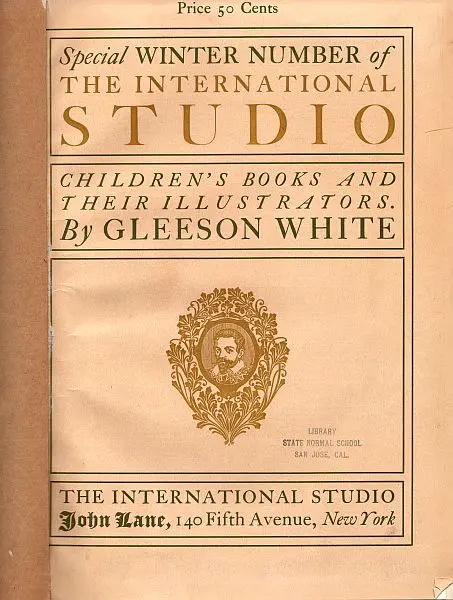
Children’s Books and Their Illustrators
Gleeson White
THE CLASSIC COLLECTION · 1903
"English Illustration 'The Sixties': 1855-70" by Gleeson White is a collection of critical essays and analyses written in the late 19th century. The work primarily focuses on the art and significance of various illustrators and illustrated periodicals from the 1860s, assessing their contributions to English literature and visual culture during this time. White reflects on how societal and aesthetic changes in this period influenced public perception of illustration and the artist's role. The opening of the volume sets the stage for a deep exploration of mid-Victorian illustration. Gleeson White expresses the need to reevaluate and appreciate the artists of the 1860s, who had once been overshadowed by painters but are now recognized for their merit in visual storytelling. He discusses the evolution of public interest in illustrations, linking it to a broader cultural shift that has made past styles and artists more appealing. This introduction suggests a rich examination of the art of the period and how it intermingled with societal trends, setting the groundwork for comprehensive discussions in subsequent chapters.
Introduction adapted from the source catalogue; source summaries may be automatically generated.
Free to read · English · 83,355 words · No account needed
MAKE TIME FOR A GOOD BOOK
On by default. Untick to stop anonymous reading totals. Each page counts after 10 seconds in view. How this works.
Anonymous counting is on unless you have switched it off.
In devoting another chapter to periodicals one must insist upon their relative importance; for the time and money expended on them in a single year would balance possibly the cost of all the books mentioned in this volume. In a naïve yet admirable article in the Christmas Bookseller, 1862, written from a commercial standpoint, the author says, speaking of some pictures in Good Words: 'Some of these, we are informed, cost as much as £50 a block, a sum which appears marvellous when we look at the low price of the magazine'; he instances also the celebrated 'J. B.'[3], 'whose delineations of animals are equal to Landseer. The magazines to be noticed are those only which contain original designs; others, The National Magazine, the Fine Arts Quarterly, and the like, which relied upon the reproductions of paintings, are not even mentioned.
Any periodical containing the work of Millais and Sandys is, obviously, in the front rank, but The Churchman's Family Magazine, which started in January 1863, did not long maintain its high level; yet the first half a dozen volumes have enough good work to entitle them to more than passing mention. This, like London Society, was published by Mr. James Hogg, and must not be confounded with another of the same price, with similar title, The Churchman's Shilling Magazine, to which reference is made elsewhere. In the familiar octavo of its class, it is well printed and well illustrated. The first volume contains two full pages by Millais, Let that be please (p. 15) and You will forgive me (p. 221); three illustrations by E. J. Poynter to The Painter's Glory (pp. 124, 131, 136); three by T. Morten (pp. 137, 432, and 531); five by J. D. Watson, Only Grandmamma (p. 89), Christian Martyr (p. 104), Sunday Evening (p. 191), The Hermit (p. 260), and Mary Magdalene (p. 346); three by Charles Green to How Susy Tried (pp. 57, 64, 71), and one each to Henry II. (p. 385), and An Incident in Canterbury Cathedral (p. 482), a drawing strangely resembling a 'John Gilbert.' H. S. Marks is represented by Home Longing (p. 113) and Age and Youth (p. 337); H. H. Armstead by Fourth Sunday in Lent (p. 245) and Angel Teachers (p. 539); J. C. Horsley by Anne Boleyn (p. 136); F. R. Pickersgill by The Still Small Voice (p. 586); G. H. Thomas by Catechising in Church (p. 225), and R. Barnes by Music for the Cottage (p. 289) and The Strange Gentleman (p. 293). Besides these the volume contains others by Rebecca (sister to Simeon) Solomon (p. 571), L. Huard, D. H. Friston, H. C. Selous, T. Macquoid, W. M'Connell, T. Sulman, E. K. Johnson (Spenser, p. 576), and J. B. Zwecker--a very fairly representative group of the average illustrator of the period. The second half of 1863 (vol. ii.) enshrines the fine Frederick Sandys, The Waiting Time, an incident of the Lancashire cotton famine (p. 91). Another of M. J. Lawless's most charming designs, One Dead (p. 275), (reprinted under the title of The Silent Chamber), will be found here. M. E. Edwards contributes two, Ianthe's Grave (p. 128) and Child, I said (p. 405); G. J. Pinwell is represented once with By the Sea (p. 257); and T. Morten with The Bell-ringers' Christmas Story (p. 513). The other artists include H. C. Selous, C. W. Cope, F. R. Pickersgill, E. Armitage, A. W. Cooper, E. H. Wehnert, E. H. Corbould, Marshall Claxton, P. W. Justyne, P. Skelton, Paulo Priolo, D. H. Friston, H. Sanderson, Creswick, and T. B. Dalziel. In vol. iii. (1864) M. J. Lawless has Harold Massey's Confession (p. 65); C. Green, Thinking and Wishing (p. 223); G. J. Pinwell, March Winds (p. 232); M. E. Edwards, At the Casement (p. 354); and T. Morten, The Twilight Hour (p. 553). Among other contributors are Florence Caxton, L. Huard, H. M. Vining, W. M'Connell, Rebecca Solomon, H. Fitzcook, John Absolon, Percy Justyne, F. W. Keyl, W. J. Allen.
Your reading position is saved on this browser. Take it to another device with a library code. Reading pages adapt to text, rather than matching a printed edition.
Gleeson White
BEHIND THE BOOK
This eBook is for the use of anyone anywhere in the United States and most other parts of the world at no cost and with almost no restrictions whatsoever. You may copy it, give it away or re-use it under the terms of the Project Gutenberg License included with this eBook or online at www.gutenberg.org. If you are not located in the United States, you will have to check the laws of the country where you are located before using this eBook. Read the source licence.
The original source file, including credits and licence, is retained by this library. Request an original-format copy at no charge. Please include the book title and Project Gutenberg identifier #45426.
KEEP YOUR CURIOSITY GOING

David Patterson (Spirit) Hatch

David Patterson (Spirit) Hatch

David Patterson (Spirit) Hatch
Cécile Tormay

Moritz Busch
John L. Ransom