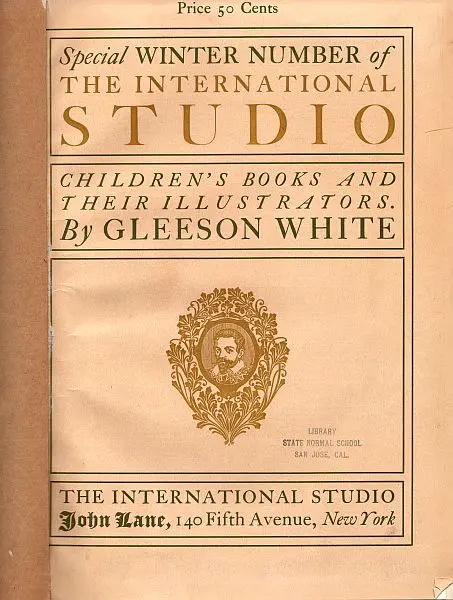
Children’s Books and Their Illustrators
Gleeson White
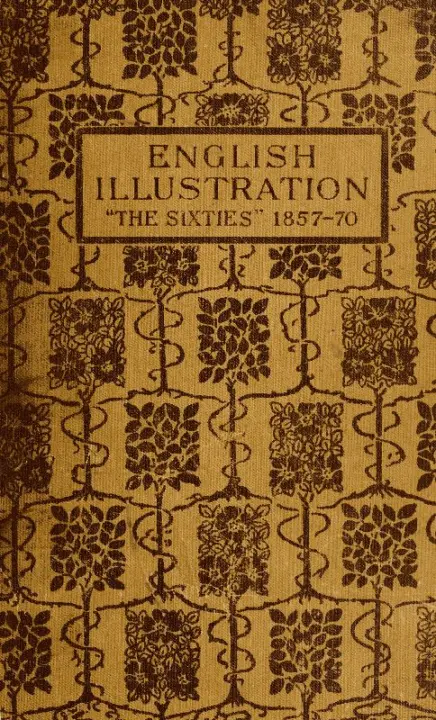
THE CLASSIC COLLECTION · 1903
"English Illustration 'The Sixties': 1855-70" by Gleeson White is a collection of critical essays and analyses written in the late 19th century. The work primarily focuses on the art and significance of various illustrators and illustrated periodicals from the 1860s, assessing their contributions to English literature and visual culture during this time. White reflects on how societal and aesthetic changes in this period influenced public perception of illustration and the artist's role. The opening of the volume sets the stage for a deep exploration of mid-Victorian illustration. Gleeson White expresses the need to reevaluate and appreciate the artists of the 1860s, who had once been overshadowed by painters but are now recognized for their merit in visual storytelling. He discusses the evolution of public interest in illustrations, linking it to a broader cultural shift that has made past styles and artists more appealing. This introduction suggests a rich examination of the art of the period and how it intermingled with societal trends, setting the groundwork for comprehensive discussions in subsequent chapters.
Introduction adapted from the source catalogue; source summaries may be automatically generated.
Free to read · English · 83,355 words · No account needed
MAKE TIME FOR A GOOD BOOK
On by default. Untick to stop anonymous reading totals. Each page counts after 10 seconds in view. How this works.
Anonymous counting is on unless you have switched it off.
To draw up a complete list, with the barest details of title, artist, author, and publisher of the books in the period with which this volume is concerned would be unnecessary, and well-nigh impossible. The English Catalogue, 1863-1872, covering but a part of the time, claims to give some 30,000 entries. Many, possibly a large majority, of these books are not illustrated; but on the other hand, the current periodicals not included contain thousands of pictures. The following chapters cannot even claim to mention every book worth the collector's notice, and refer hardly at all to many which seemed to the compiler to represent merely the commercial average of their time. Whether this was better or worse than the commercial average to-day is of no moment. Nearly all of the books mentioned have been referred to personally, and the facts reported at first hand. In spite of taxing the inexhaustible courtesy of the officials of the British Museum to the extent of eighty or more volumes during a single afternoon, I cannot pretend to have seen the whole output of the period, for it is not easy to learn from the catalogue those particulars that are needed to identify which books are illustrated.
So far as we are concerned here, the interest of the book lies solely in its illustrations, but the catalogue may not even record the fact that it contains any, much less attribute them to their author. Of those in which the artist's share has been recognised by the publisher in his announcements, I have done my best to find the first edition of each. By dint of patient wading through the advertisements, and review columns of literary journals, trade periodicals, and catalogues, a good many have turned up which had otherwise escaped notice; although for the last twenty years at least I have never missed an opportunity of seeing every illustrated book of the sixties, with a view to this chronicle, which had been shaping itself, if not actually begun, long before any work on modern English illustrators had appeared. When a school-boy I made a collection of examples of the work of each artist whose style I had learned to recognise, and some of that material gathered together so long ago has been of no little use now. These personal reminiscences are not put forward by way of magnifying the result; but rather to show that even with so many years' desultory preparation the digesting and classification of the various facts has proved too onerous. A staff of qualified assistants under a capable director would be needed to accomplish the work as thoroughly as Mr. Sidney Lee has accomplished a not dissimilar, if infinitely more important, task--The Dictionary of National Biography. A certain proportion of errors must needs creep in, and the possible errors of omission are even more to be dreaded than those of commission. A false date, or an incorrect reference to a given book or illustration, is easily corrected by a later worker in the same field; but an omission may possibly escape another student of the subject as it escaped me. As a rule, in a majority of cases--so large that it is practically ninety-nine per cent., if not more--the notes have been made side by side with the publication to which they refer. But in transcribing hasty jottings errors are apt to creep in, and despite the collation of these pages when in proof by other hands, I cannot flatter myself that they are impeccable. For experience shows that you never open the final printed text of any work under your control as editor or author, but errors, hitherto overlooked, instantly jump from the page and force themselves on your notice. An editor of one of the most widely circulated of all our magazines confesses that he has made it a rule never to glance at any number after it was published. He had too often suffered the misery of being confronted with obvious errors of fact and taste which no amount of patient care on his part (and he is a most conscientious workman) had discovered, until it was too late to rectify them. In the matter of dates alone a difficulty meets one at first sight. Many books dated one year were issued several months before the previous Christmas, and are consequently advertised and reviewed in the year before the date which appears upon their title-page. Again, many books, and some volumes of magazines (Messrs. Cassell and Co.'s publications to wit), bear no date. 'Women and books should never be dated' is a proverb as foolish as it is widely known. Yet all the same, inaccuracy of a few months is of little importance in this context; a book or a picture does not cease to exist as soon as it is born, like the performance of an actor or a musician. Consequently, beyond its relative place as evidence of the development or decline of the author's talent, it is not of great moment whether a book was issued in 1869 or 1870, whether a drawing was published in January or February. But for those who wish to refer to the subjects noted, the information has been made as exact as circumstances permitted. When, however, a book has been reissued in a second, or later edition, with no reference to earlier issues, it is tempting to accept the date on its title-page without question. One such volume I traced back from 1868 to 1849, and for all I know the original may have been issued some years earlier; for the British Museum library is not complete; every collector can point with pride to a few books on his shelves which he has failed to discover in its voluminous catalogue.
Your reading position is saved on this browser. Take it to another device with a library code. Reading pages adapt to text, rather than matching a printed edition.
Gleeson White
BEHIND THE BOOK
This eBook is for the use of anyone anywhere in the United States and most other parts of the world at no cost and with almost no restrictions whatsoever. You may copy it, give it away or re-use it under the terms of the Project Gutenberg License included with this eBook or online at www.gutenberg.org. If you are not located in the United States, you will have to check the laws of the country where you are located before using this eBook. Read the source licence.
The original source file, including credits and licence, is retained by this library. Request an original-format copy at no charge. Please include the book title and Project Gutenberg identifier #45426.
KEEP YOUR CURIOSITY GOING

David Patterson (Spirit) Hatch

David Patterson (Spirit) Hatch

David Patterson (Spirit) Hatch
Cécile Tormay

Moritz Busch
John L. Ransom