
Last letters from the living dead man
David Patterson (Spirit) Hatch
THE CLASSIC COLLECTION · 1892
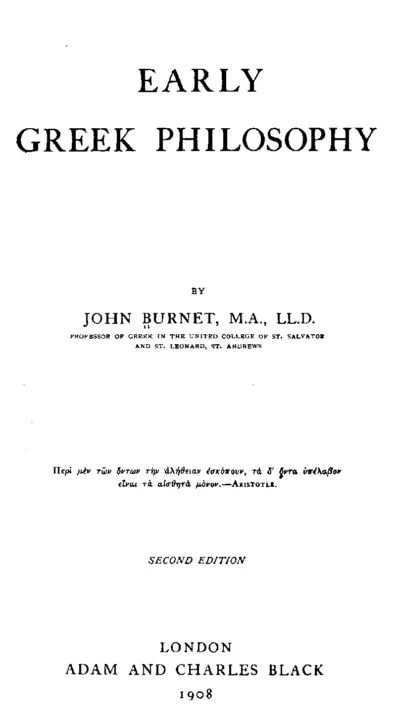
"Early Greek Philosophy" by John Burnet is a scholarly account of ancient Greek philosophical thought written in the late 19th century. The work explores the evolution of philosophical ideas and cosmological theories from the early Greek thinkers, particularly focusing on how their inquiries laid the groundwork for subsequent philosophical developments. The opening of the text introduces the cosmological character of early Greek philosophy, emphasizing that it arose from the breakdown of traditional views of the world and life. Burnet explains that the earliest philosophers were preoccupied with understanding nature and existence, as old maxims were challenged and replaced by rigorous inquiry. He sets the stage for a detailed examination of various schools of thought, beginning with the Milesian school and its notable figures, such as Thales, who began to systematize knowledge in an attempt to explain the universe's order and structure. Overall, the initial chapters highlight the shift from mythological explanations to rational inquiry that characterized this formative period of philosophical history.
Introduction adapted from the source catalogue; source summaries may be automatically generated.
Free to read · English · 137,668 words · No account needed
MAKE TIME FOR A GOOD BOOK
On by default. Untick to stop anonymous reading totals. Each page counts after 10 seconds in view. How this works.
Anonymous counting is on unless you have switched it off.
(58) Physicians who cut, burn, stab, and rack the sick, demand a fee for it which they do not deserve to get. R. P. 47 c.[351]
(59) Couples are things whole and things not whole, what is drawn together and what is drawn asunder, the harmonious and the discordant. The one is made up of all things, and all things issue from the one.[352]
(60) Men would not have known the name of justice if these things were
not.[353]
(61) To God all things are fair and good and right, but men hold some things wrong and some right. R. P. 45.
(62) We must know that war is common to all and strife is justice, and that all things come into being and pass away (?) through strife.
(64) All the things we see when awake are death, even as all we see in slumber are sleep. R. P. 42 c.[354]
(65) The wise is one only. It is unwilling and willing to be called by the name of Zeus. R. P. 40.
(66) The bow (βιός) is called life (βίος), but its work is death. R.
P. 49 a.
(67) Mortals are immortals and immortals are mortals, the one living the others’ death and dying the others’ life. R. P. 46.
(68) For it is death to souls to become water, and death to water to become earth. But water comes from earth; and from water, soul. R. P. 38.
(69) The way up and the way down is one and the same. R. P. 36 d.
(70) In the circumference of a circle the beginning and end are
common.
(71) You will not find the boundaries of soul by travelling in any direction, so deep is the measure of it.[355] R. P. 41 d.
(72) It is pleasure to souls to become moist. R. P. 46 c.
(73) A man, when he gets drunk, is led by a beardless lad, tripping, knowing not where he steps, having his soul moist. R. P. 42.
(74-76) The dry soul is the wisest and best.[356] R. P. 42.
(77) Man is kindled and put out like a light in the night-time.
(78) And it is the same thing in us that is quick and dead, awake and asleep, young and old; the former are shifted[357] and become the latter, and the latter in turn are shifted and become the former. R. P. 47.
(79) Time is a child playing draughts, the kingly power is a child’s.
R. P. 40 a.
(80) I have sought for myself. R. P. 48.
(81) We step and do not step into the same rivers; we are and are not.
R. P. 33 a.
(82) It is a weariness to labour for the same masters and be ruled by
them.
(83) It rests by changing.
(84) Even the posset separates if it is not stirred.
(85) Corpses are more fit to be cast out than dung.
Your reading position is saved on this browser. Take it to another device with a library code. Reading pages adapt to text, rather than matching a printed edition.
BEHIND THE BOOK
This eBook is for the use of anyone anywhere in the United States and most other parts of the world at no cost and with almost no restrictions whatsoever. You may copy it, give it away or re-use it under the terms of the Project Gutenberg License included with this eBook or online at www.gutenberg.org. If you are not located in the United States, you will have to check the laws of the country where you are located before using this eBook. Read the source licence.
The original source file, including credits and licence, is retained by this library. Request an original-format copy at no charge. Please include the book title and Project Gutenberg identifier #67097.
KEEP YOUR CURIOSITY GOING
David Patterson (Spirit) Hatch
Cécile Tormay

Moritz Busch
Coulson Kernahan
John L. Ransom

Ralph Waldo Emerson