
Last letters from the living dead man
David Patterson (Spirit) Hatch
THE CLASSIC COLLECTION · 1892
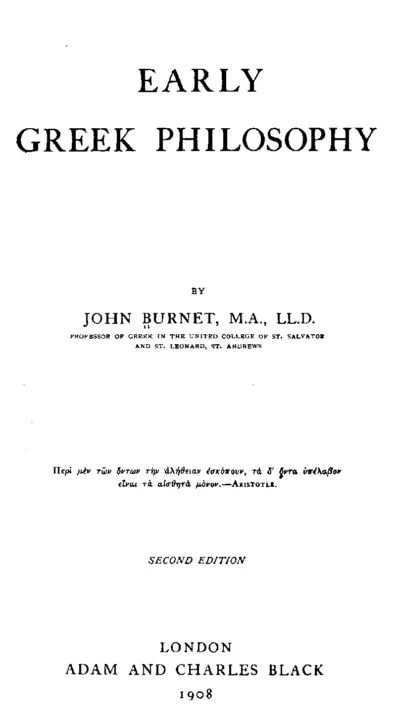
"Early Greek Philosophy" by John Burnet is a scholarly account of ancient Greek philosophical thought written in the late 19th century. The work explores the evolution of philosophical ideas and cosmological theories from the early Greek thinkers, particularly focusing on how their inquiries laid the groundwork for subsequent philosophical developments. The opening of the text introduces the cosmological character of early Greek philosophy, emphasizing that it arose from the breakdown of traditional views of the world and life. Burnet explains that the earliest philosophers were preoccupied with understanding nature and existence, as old maxims were challenged and replaced by rigorous inquiry. He sets the stage for a detailed examination of various schools of thought, beginning with the Milesian school and its notable figures, such as Thales, who began to systematize knowledge in an attempt to explain the universe's order and structure. Overall, the initial chapters highlight the shift from mythological explanations to rational inquiry that characterized this formative period of philosophical history.
Introduction adapted from the source catalogue; source summaries may be automatically generated.
Free to read · English · 137,668 words · No account needed
MAKE TIME FOR A GOOD BOOK
On by default. Untick to stop anonymous reading totals. Each page counts after 10 seconds in view. How this works.
Anonymous counting is on unless you have switched it off.
(86) When they are born, they wish to live and to meet with their dooms—or rather to rest—and they leave children behind them to meet with their dooms in turn.
(87-89) A man may be a grandfather in thirty years.
(90) Those who are asleep are fellow-workers....
(91a) Thought is common to all.
(91b) Those who speak with understanding must hold fast to what is common to all as a city holds fast to its law, and even more strongly. For all human laws are fed by the one divine law. It prevails as much as it will, and suffices for all things with something to spare. R. P. 43.
(92) So we must follow the common,[358] yet the many live as if they had a wisdom of their own. R. P. 44.
(93) They are estranged from that with which they have most constant intercourse.[359] R. P. 32 b.
(94) It is not meet to act and speak like men asleep.
(95) The waking have one common world, but the sleeping turn aside each into a world of his own.
(96) The way of man has no wisdom, but that of God has. R. P. 45.
(97) Man is called a baby by God, even as a child by a man. R. P. 45.
(98, 99) The wisest man is an ape compared to God, just as the most beautiful ape is ugly compared to man.
(100) The people must fight for its law as for its walls. R. P. 43 b.
(101) Greater deaths win greater portions. R. P. 49 a.
(102) Gods and men honour those who are slain in battle. R. P. 49 a.
(103) Wantonness needs putting out, even more than a house on fire. R.
P. 49 a.
(104) It is not good for men to get all they wish to get. It is sickness that makes health pleasant; evil,[360] good; hunger, plenty; weariness, rest. R. P. 48 b.
(105-107) It is hard to fight with one’s heart’s desire.[361] Whatever it wishes to get, it purchases at the cost of soul. R. P. 49 a.
(108, 109) It is best to hide folly; but it is hard in times of
relaxation, over our cups.
(110) And it is law, too, to obey the counsel of one. R. P. 49 a.
(111) For what thought or wisdom have they? They follow the poets and take the crowd as their teacher, knowing not that there are many bad and few good. For even the best of them choose one thing above all others, immortal glory among mortals, while most of them are glutted like beasts.[362] R. P. 31 a.
(112) In Priene lived Bias, son of Teutamas, who is of more account than the rest. (He said, “Most men are bad.”)
(113) One is ten thousand to me, if he be the best. R. P. 31 a.
Your reading position is saved on this browser. Take it to another device with a library code. Reading pages adapt to text, rather than matching a printed edition.
BEHIND THE BOOK
This eBook is for the use of anyone anywhere in the United States and most other parts of the world at no cost and with almost no restrictions whatsoever. You may copy it, give it away or re-use it under the terms of the Project Gutenberg License included with this eBook or online at www.gutenberg.org. If you are not located in the United States, you will have to check the laws of the country where you are located before using this eBook. Read the source licence.
The original source file, including credits and licence, is retained by this library. Request an original-format copy at no charge. Please include the book title and Project Gutenberg identifier #67097.
KEEP YOUR CURIOSITY GOING
David Patterson (Spirit) Hatch
Cécile Tormay

Moritz Busch
Coulson Kernahan
John L. Ransom

Ralph Waldo Emerson