
Last letters from the living dead man
David Patterson (Spirit) Hatch
THE CLASSIC COLLECTION · 1892
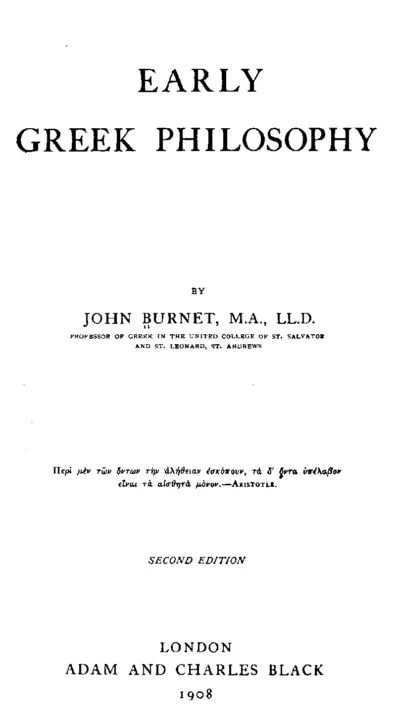
"Early Greek Philosophy" by John Burnet is a scholarly account of ancient Greek philosophical thought written in the late 19th century. The work explores the evolution of philosophical ideas and cosmological theories from the early Greek thinkers, particularly focusing on how their inquiries laid the groundwork for subsequent philosophical developments. The opening of the text introduces the cosmological character of early Greek philosophy, emphasizing that it arose from the breakdown of traditional views of the world and life. Burnet explains that the earliest philosophers were preoccupied with understanding nature and existence, as old maxims were challenged and replaced by rigorous inquiry. He sets the stage for a detailed examination of various schools of thought, beginning with the Milesian school and its notable figures, such as Thales, who began to systematize knowledge in an attempt to explain the universe's order and structure. Overall, the initial chapters highlight the shift from mythological explanations to rational inquiry that characterized this formative period of philosophical history.
Introduction adapted from the source catalogue; source summaries may be automatically generated.
Free to read · English · 137,668 words · No account needed
MAKE TIME FOR A GOOD BOOK
On by default. Untick to stop anonymous reading totals. Each page counts after 10 seconds in view. How this works.
Anonymous counting is on unless you have switched it off.
ἀδικία, 56, 60, 71
ἀήρ, 79 n. 154, 263, 264 n. 583, 284 n. 634.
See Air
αἰθήρ, 263, 264 n. 583, 312 n. 709
ἀκούσματα, 105 sq., 328
ἀκουσματικοί, 96, 103
Ἀνάγκη, 219, 256 n. 569, 269
ἀναθυμίασις, 167 n. 382, 168 n. 385
ἀντέρεισις, 400
ἄντυξ, 216
ἄπειρον, 57 n. 105, 60 n. 113
ἄπνους, ἡ, 233 n. 520, 236 n. 533
ἀπορροαί, 236, 287 n. 642
ἀποτομή, 391 n. 949
ἀριθμητική dist. λογιστική, 23, 111 n. 233
ἁρμονία, 122, 158, 184
ἁρπεδονάπται, 24
ἀρχή, 13, 57
αὐτὸ ὃ ἔστιν, 355 n. 847
γαλεοί, 73 sq.
γόητες, 106
δαίμων, 155 n. 364, 172 n. 391
διαστήματα, 65 n. 126
δίκη, 32, 161 n. 374
δίνη. See Vortex
διορίζω, 120 n. 254
εἶδος, 355, 388 n. 943
εἴδωλα, 403
εἶναι, 198 n. 435;
τὸ ἐόν, 204 n. 450
ἔκθλιψις, 397 n. 962
ἔκκρισις, 61
ἐκπύρωσις, 178 sqq.
ἕν, τὸ, 140, 363 n. 880, 377
ἐναντία. See Opposites
ἑνίζειν, 139 n. 306
ἐπίψαυσις, 400
ἐστώ, 330 n. 770
θεός, 74.
See Gods
θεωρία, 28, 108
ἰδέα, 235 n. 527, 263 n. 580, 355, 356 n. 850, 388 n. 943
ἶδος, 243 n. 549, 249 n. 558
ἰσονομία, 225
ἰσορροπία, 398
ἱστορία, 14 n. 18, 28, 107 n. 244
καθαρμός, κάθαρσις, 88, 107 sq.
κεγχρίτης λόγος, 1 n. 862
κλεψύδρα, 253 n. 565, 254 n. 566, 263, 309, 384
κληροῦχος, 219
κόσμος, 32, 148 n. 336, 182 n. 412
κρατέω, 310
λογιστική dist. ἀριθμητική, 23
λόγος, 146 n. 332, 148 n. 339, 152 n. 355, 153 n. 358 and n.
359, 157;
λόγος τοῦ εἶναι, 355 n. 847
μεσότης, 118
μετάρσια, 296 n. 670
μετεμψύχωσις, 101 n. 212
μετενσωμάτωσις, 101 n. 212
μετέωρα, 32
μορφή, 263 n. 580, 356 n. 850
ὄγκοι, 338 n. 794, 368 n. 894, 387 n. 939
ὁλκάς, 341 n. 805
ὁμοιομερῆ, 306
ὅμοιος, ὁμοιότης, 72 n. 138
ὄργια, 88 n. 175
ὅρος, 115 n. 240
οὐρανός, 31, 140 n. 310;
Aristotle’s πρῶτος οὐρανός, 177
πάγος, 273 n. 603
παλιγγενεσία, 101 n. 212
παλίντονος, 150 n. 184
παλίντροπος, 150 n. 347, 198 n. 438
πανσπερμία, 307, 389
περιαγωγή, 63 n. 119
περιέχω, 60 n. 114, 170 n. 389
περίστασις, 63 n. 119
πίλησις, 77 n. 151
πόροι, 224, 226 n. 500, 236, 269, 284 sq., 383
πρηστήρ, 69 n. 133, 165
πυραμίς, 25 n. 38
ῥαψῳδῶ, 127 n. 276
ῥοπή, 398
σῆμα σῶμα, 321
στασιῶται, 140 n. 307
στέφαναι, 215
στοιχεῖον, 54 n. 101, 56 n. 103, 263 n. 586, 265 n. 586, 306,
333, 388 n. 942
συνοικειῶ, 157 n. 370
τετρακτύς, 113 sq.
τροπαί, 67 n. 129, 174
ὕλη, 57, 330 n. 770, 342 n. 807
ὑπόθεσις, 33 n. 46, 360 n. 866, 361 n. 871
ὑποτείνουσα, 116 n. 242
φαινόμενα, σῴζειν τὰ, 33 n. 46
φιλοσοφία, φιλόσοφος, φιλοσοφῶ, 28.
See Philosophy
φύσις, 12 sq., 56, 388 n. 941 and n. 944
χώρα, 114 n. 238, 115 n. 240
Printed by R. & R. CLARK, LIMITED, Edinburgh.
Transcriber’s Note
When Burnet gives the fragments of a Greek philosopher, he does so selectively, resulting in gaps in the sequence.
Some quoted and translated passages, printed as prose, also include line numbers in the right margin. These now appear in the text delimited by << >> at the place in the text where they originally appeared. These numbers should be regarded as approximate.
In note 813, the Greek phrase includes an unmatched closing bracket. This is a direct quotation from p. 234 of Scholia in Lucianum, edited by Hugo Rabe. The bracket was used by Rabe to separate the topic (the pentagram) from its gloss.
Errors deemed most likely to be the printer’s have been corrected, and are noted here. The references are to the page and line in the original.
75.13 according to Theophra[s]tos Added.
197.21 Look stea[fd/df]astly with thy mind Transposed.
212.26 It seem[s] to me Added.
213.18 and Theoph[astros/rastos]certainly followed Misplaced.
him
249.21 meadows of Aph[h]rodite Removed.
292.34 διήκουσε)[”] Added.
331.19 Aristotle on the Number[s]. Added.
332.32 τὰ γοῦν θεωρήματα πρ[ό/ο]σάπτουσι Replaced.
402 οἱ μὲν ἄλλοι φύσει τὰ αἰσθητ[α/ά] Replaced.
415.6 Anaxagorea[ns] Presumed.
433.5 παλίντροπ[ὸ/ο]ς Replaced.
Your reading position is saved on this browser. Take it to another device with a library code. Reading pages adapt to text, rather than matching a printed edition.
BEHIND THE BOOK
This eBook is for the use of anyone anywhere in the United States and most other parts of the world at no cost and with almost no restrictions whatsoever. You may copy it, give it away or re-use it under the terms of the Project Gutenberg License included with this eBook or online at www.gutenberg.org. If you are not located in the United States, you will have to check the laws of the country where you are located before using this eBook. Read the source licence.
The original source file, including credits and licence, is retained by this library. Request an original-format copy at no charge. Please include the book title and Project Gutenberg identifier #67097.
KEEP YOUR CURIOSITY GOING
David Patterson (Spirit) Hatch
Cécile Tormay

Moritz Busch
Coulson Kernahan
John L. Ransom

Ralph Waldo Emerson