
Last letters from the living dead man
David Patterson (Spirit) Hatch
THE CLASSIC COLLECTION · 1892
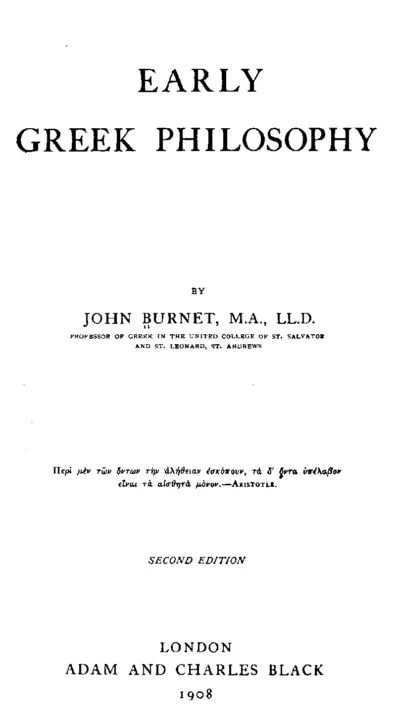
"Early Greek Philosophy" by John Burnet is a scholarly account of ancient Greek philosophical thought written in the late 19th century. The work explores the evolution of philosophical ideas and cosmological theories from the early Greek thinkers, particularly focusing on how their inquiries laid the groundwork for subsequent philosophical developments. The opening of the text introduces the cosmological character of early Greek philosophy, emphasizing that it arose from the breakdown of traditional views of the world and life. Burnet explains that the earliest philosophers were preoccupied with understanding nature and existence, as old maxims were challenged and replaced by rigorous inquiry. He sets the stage for a detailed examination of various schools of thought, beginning with the Milesian school and its notable figures, such as Thales, who began to systematize knowledge in an attempt to explain the universe's order and structure. Overall, the initial chapters highlight the shift from mythological explanations to rational inquiry that characterized this formative period of philosophical history.
Introduction adapted from the source catalogue; source summaries may be automatically generated.
Free to read · English · 137,668 words · No account needed
MAKE TIME FOR A GOOD BOOK
On by default. Untick to stop anonymous reading totals. Each page counts after 10 seconds in view. How this works.
Anonymous counting is on unless you have switched it off.
Aahmes, 22, 46
Abaris, 87, 97 n. 205
Abdera, school of, 381
Abstinence, Orphic and Pythagorean, 102 sq., 104 sq.;
Empedoklean, 289
Academy, 35
Achilles and the Tortoise, 367
Aether. See αἰθήρ
Aetios, App. § 10
Aigospotamos, meteoric stone of, 292, 312, 413 sq.
Air, 77, 78, 79 n. 154, 120, 173, 214, 224, 263, 309, 336, 341, 411
sq. See ἀήρ
Akousmata, 105 sq., 328
Akousmatics, 96, 103
Akragas, 228 sqq.
Akron, 231
Alexander Aetolus, 295
Alexander Aphrodisiensis, 139, 209
Alkidamas, 229 n. 504, 231 n. 5, 235, 297 n. 675, 321 n. 739,
360
Alkmaion, 123 n. 263, 223 sq., 236, 327, 344, 350
Amasis, 39
Ameinias, 193
Anaxagoras, 290 sqq.;
and Perikles, 294 sqq.;
and Euripides, 295;
relation to Ionic school, 292;
and Zeno, 362
Anaxagoreans, 35 n. 50, 415
Anaximander, 52 sqq.
Anaximenes, 75 sqq.;
School of, 83, 292, 408 n. 997
Androkydes, 328
Andron of Ephesos, 93
Animals, Anaximander, 72 sqq.;
Empedokles, 279 sqq.;
Anaxagoras, 315 sqq.;
Diogenes of Apollonia, 414
Antichthon, 344, 349 sqq.
Antonius Diogenes, 92
Apollo Hyperboreios, 93 n. 189, 97 n. 205, 232
Apollodoros, App. § 21, 43, 52, 75, 94 n. 192, 125, 143, 192 sq., 228
sq., 290 sq., 358, 370
Apollonios of Tyana, 90, 92
Apophthegms, 51, 127
Archelaos, 415 sqq.
Archippos, 99, 319
Archytas, 110, 319, 328, 346
Aristarchos of Samos, 349
Aristeas of Prokonnesos, 87, 97 n. 205
Aristophanes, 75, 296 n. 669, 381, 408
Aristotle, App. § 2;
on Egypt, 18, 23;
on Thales, 47 sqq., 50;
on Anaximander, 57 sqq.;
on Pythagoras, 93 n. 189, 100, 107 n. 226;
on Xenophanes, 137 sq., 139 sq.;
on Herakleitos, 160 n. 373, 162, 177, 179;
on Parmenides, 193, 203, 207, 208, 213;
on Alkmaion, 223;
on Empedokles, 177 n. 401, 228 n. 502, 231 n. 511, 234, 237,
253 n. 565, 265, 266, 267, 268, 269, 271, 272, 274 n. 606,
278, 280, 281, 397 n. 962;
on Anaxagoras, 263 n. 582, 291, 303, 305, 306, 309, 310;
on the Pythagoreans, 100 n. 208, 110, 111 n. 232, 119, 331 sqq.,
353 sqq.;
on Zeno, 361, 365 sqq.;
on Melissos, 374 sq., 377, 378;
on Leukippos, 380, 385 sq., 387, 397 n. 962;
on Hippon, 49 n. 2, 406;
on the galeus levis, 74 n. 141;
on the theoretic life, 90, 108;
on the mysteries, 91
[Aristotle] de Mundo, 185
[Aristotle] de Plantis, 279 n. 618, 298 n. 677, 315
Aristoxenos on Pythagoras, 92, 94 n. 191, 95, 96 n. 201, 3, 98 sq.,
102, 109 n. 231;
on the Pythagoreans, 107, 319, 334, 353;
Πυθαγορικαὶ ἀποφάσεις, 100 n. 209, 325;
on Hippon, 406 n. 988;
on Plato, 323 sqq.
Arithmetic, Egyptian, 22, 111 n. 233;
Pythagorean, 109 sq.
Arithmetical symbolism, 111
Astronomy, Babylonian and Greek, 25 sqq.
See Heavenly bodies, Sun, Moon, Planets, Stars, Earth, Eclipses,
Geocentric and Heliocentric hypothesis
Atheism, 51, 75, 141
Athens, Parmenides and Zeno at, 192;
Anaxagoras at, 294
Atomism. See Leukippos
Atoms, 387 sqq.
Babylonian language, 21 n. 29;
astronomy, 25 sqq.;
eclipse cycle, 41;
μαθηματικοί, 350 n. 834
Beans, 102
Biology. See Animals, Plants
Blood, Empedokles, 286, 288;
Diogenes of Apollonia, 414
Brain, Alkmaion, 224;
Empedokles, 235;
Sicilian school of medicine, 288 n. 645
Breath. See Respiration.
Breath of the World, 79, 120
Cave, Orphic, 257 n. 571
Chaos, 8, 9 n. 7
Chronos, 10
Cicero, App. § 12;
on Thales, 50;
on Anaximander, 64;
on Anaximenes, 82;
on Parmenides, 220, 221 n. 482;
on Atomism, 393 n. 953, 394 n. 956
Clement of Alexandria, 19
Comic poets on Pythagoreans, 103 n. 218
Condensation. See Rarefaction
Conflagration. See ἐκπύρωσις
Continuity, 369
Copernicus, 349
Corporealism, 15 sq., 206, 227, 357, 377
Cosmogonies, 8 sqq.
Croesus, 28, 37, 38
Çulvasūtras, 24
Damasias, 43 n. 68
Damaskios, 9 n. 10, 232
Darkness, 79, 121, 173, 214
Death, Herakleitos, 171 sqq.;
Parmenides, 222;
Alkmaion, 225;
Empedokles, 283
Dekad, 113
Demetrios Phalereus, 290, 408
Demokritos, 2 n. 1;
date, 381;
on Egyptian mathematics, 24;
on Anaxagoras, 291, 381;
primitive astronomy of, 345, 392;
and Leukippos, 381
Diagonal and Square, 116
Dialectic, 361
Dikaiarchos on Pythagoras, 92, 96 n. 202, 100
Diogenes of Apollonia, 381, 407 sqq.
Divisibility, 304, 306, 362, 365, 376
Dodecahedron, 341 sqq.
Doric dialect, 325, 327 sq.
Your reading position is saved on this browser. Take it to another device with a library code. Reading pages adapt to text, rather than matching a printed edition.
BEHIND THE BOOK
This eBook is for the use of anyone anywhere in the United States and most other parts of the world at no cost and with almost no restrictions whatsoever. You may copy it, give it away or re-use it under the terms of the Project Gutenberg License included with this eBook or online at www.gutenberg.org. If you are not located in the United States, you will have to check the laws of the country where you are located before using this eBook. Read the source licence.
The original source file, including credits and licence, is retained by this library. Request an original-format copy at no charge. Please include the book title and Project Gutenberg identifier #67097.
KEEP YOUR CURIOSITY GOING
David Patterson (Spirit) Hatch
Cécile Tormay

Moritz Busch
Coulson Kernahan
John L. Ransom

Ralph Waldo Emerson