
Last letters from the living dead man
David Patterson (Spirit) Hatch
THE CLASSIC COLLECTION · 1892
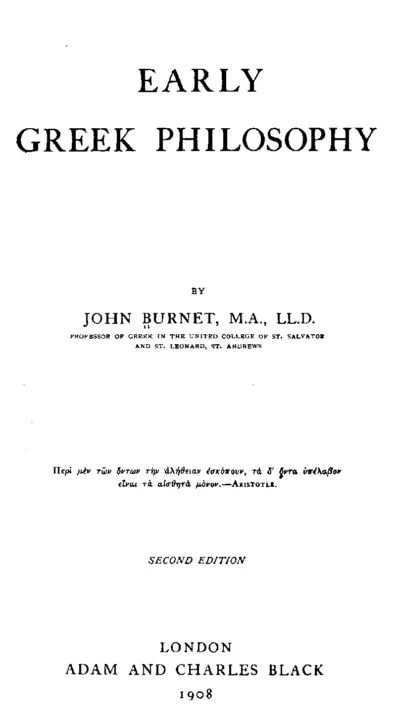
"Early Greek Philosophy" by John Burnet is a scholarly account of ancient Greek philosophical thought written in the late 19th century. The work explores the evolution of philosophical ideas and cosmological theories from the early Greek thinkers, particularly focusing on how their inquiries laid the groundwork for subsequent philosophical developments. The opening of the text introduces the cosmological character of early Greek philosophy, emphasizing that it arose from the breakdown of traditional views of the world and life. Burnet explains that the earliest philosophers were preoccupied with understanding nature and existence, as old maxims were challenged and replaced by rigorous inquiry. He sets the stage for a detailed examination of various schools of thought, beginning with the Milesian school and its notable figures, such as Thales, who began to systematize knowledge in an attempt to explain the universe's order and structure. Overall, the initial chapters highlight the shift from mythological explanations to rational inquiry that characterized this formative period of philosophical history.
Introduction adapted from the source catalogue; source summaries may be automatically generated.
Free to read · English · 137,668 words · No account needed
MAKE TIME FOR A GOOD BOOK
On by default. Untick to stop anonymous reading totals. Each page counts after 10 seconds in view. How this works.
Anonymous counting is on unless you have switched it off.
(29) The sun will not overstep his measures; if he does, the Erinyes, the handmaids of Justice, will find him out. R. P. 39.
(30) The limit of East and West is the Bear; and opposite the Bear is the boundary of bright Zeus.[342]
(31) If there were no sun it would be night, for all the other stars
could do.[343]
(32) The sun is new every day.
(33) See above, Chap. I. p. 41, n. 62.
(34) ... the seasons that bring all things.
(35) Hesiod is most men’s teacher. Men think he knew very many things, a man who did not know day or night! They are one.[344] R. P. 39 b.
(36) God is day and night, winter and summer, war and peace, surfeit and hunger; but he takes various shapes, just as fire,[345] when it is mingled with spices, is named according to the savour of each. R. P. 39 b.
(37) If all things were turned to smoke, the nostrils would
distinguish them.
(38) Souls smell in Hades. R. P. 46 d.
(39) Cold things become warm, and what is warm cools; what is wet dries, and the parched is moisted.
(40) It scatters and it gathers; it advances and retires.
(41, 42) You cannot step twice into the same rivers; for fresh waters are ever flowing in upon you. R. P. 33.
(43) Homer was wrong in saying: “Would that strife might perish from among gods and men!” He did not see that he was praying for the destruction of the universe; for, if his prayer were heard, all things would pass away.[346]... R. P. 34 d.
(44) War is the father of all and the king of all; and some he has made gods and some men, some bond and some free. R. P. 34.
(45) Men do not know how what is at variance agrees with itself. It is an attunement of opposite tensions,[347] like that of the bow and the lyre. R. P. 34.
(46) It is the opposite which is good for us.[348]
(47) The hidden attunement is better than the open. R. P. 34.
(48) Let us not conjecture at random about the greatest things.
(49) Men that love wisdom must be acquainted with very many things
indeed.
(50) The straight and the crooked path of the fuller’s comb is one and
the same.
(51) Asses would rather have straw than gold. R. P. 31 a.
(51a) Oxen are happy when they find bitter vetches to eat.[349] R.
P. 48 b.
(52) The sea is the purest and the impurest water. Fish can drink it, and it is good for them; to men it is undrinkable and destructive. R. P. 47 c.
(53) Swine wash in the mire, and barnyard fowls in dust.
(54) ... to delight in the mire.
(55) Every beast is driven to pasture with blows.[350]
(56) Same as 45.
(57) Good and ill are one. R. P. 47 c.
Your reading position is saved on this browser. Take it to another device with a library code. Reading pages adapt to text, rather than matching a printed edition.
BEHIND THE BOOK
This eBook is for the use of anyone anywhere in the United States and most other parts of the world at no cost and with almost no restrictions whatsoever. You may copy it, give it away or re-use it under the terms of the Project Gutenberg License included with this eBook or online at www.gutenberg.org. If you are not located in the United States, you will have to check the laws of the country where you are located before using this eBook. Read the source licence.
The original source file, including credits and licence, is retained by this library. Request an original-format copy at no charge. Please include the book title and Project Gutenberg identifier #67097.
KEEP YOUR CURIOSITY GOING
David Patterson (Spirit) Hatch
Cécile Tormay

Moritz Busch
Coulson Kernahan
John L. Ransom

Ralph Waldo Emerson